CẤP THCS
Đề ôn tập
BÀI ÔN TẬP TIẾNG ANH 8 – UNIT 2
Chủ đề: Life in the countryside
Thời gian làm bài: 60 phút (Đề gồm 40 câu)
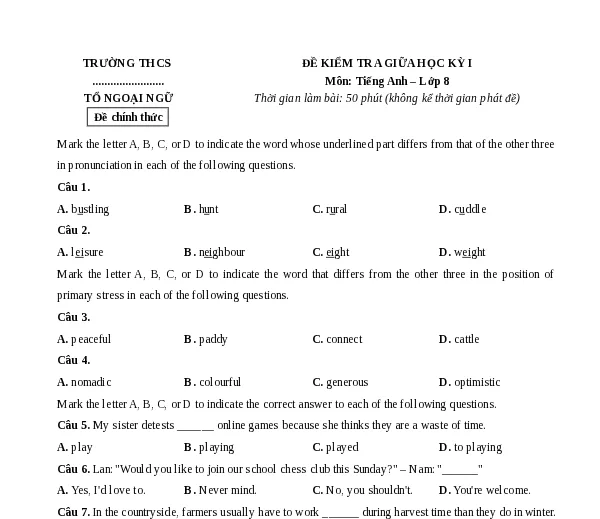
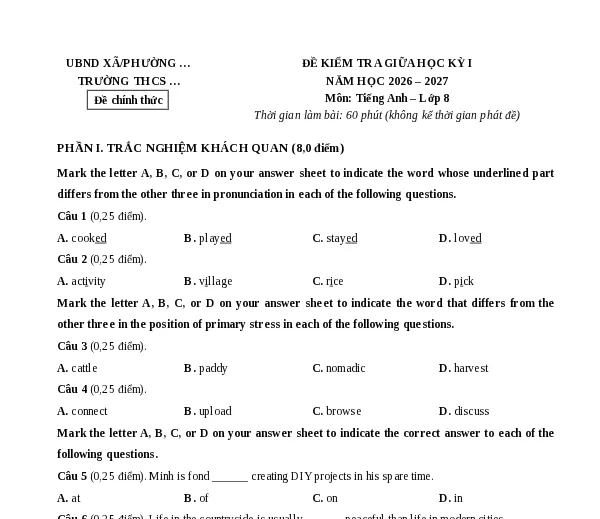
PHẦN I. PHONETICS
Mark the letter A, B, C, or D to indicate the word whose underlined part differs from the other three in pronunciation in each of the following questions.
Câu 1.
A. village
B. city
C. rice
D. busy
Câu 2.
A. cattle
B. paddy
C. tractor
D. harvest
Mark the letter A, B, C, or D to indicate the word that differs from the other three in the position of primary stress in each of the following questions.
Câu 3.
A. peaceful
B. canal
C. vastness
D. cattle
Câu 4.
A. picturesque
B. hospitable
C. cultivate
D. nomadic
PHẦN II. VOCABULARY & GRAMMAR
Mark the letter A, B, C, or D to indicate the correct answer to each of the following questions.
Câu 5. During harvest time, local farmers work very hard to ______ the rice from the fields into their trucks.
A. load
B. unload
C. fly
D. herd
Câu 6. In the afternoon, the village boys often help their parents to ______ the buffaloes and cows in the pasture.
A. drive
B. feed
C. herd
D. catch
Câu 7. The countryside is usually much more ______ than the noisy and crowded cities.
A. peaceful
B. polluted
C. stressful
D. modern
Câu 8. Look! The farmers are drying rice on the ______ field near their house.
A. football
B. paddy
C. flower
D. sports
Câu 9. People in the village are very ______; they always welcome visitors warmly.
A. hostile
B. envious
C. hospitable
D. selfish
Câu 10. Nowadays, farmers can harvest their crops ______ than they did in the past thanks to modern combine harvesters.
A. more fast
B. faster
C. more fastly
D. fastlier
Câu 11. Living in the city is exciting, but people often feel ______ relaxed than those living in the country.
A. fewer
B. lesser
C. less
D. least
Câu 12. A tractor can plow a field much ______ than a water buffalo.
A. more efficiently
B. efficienter
C. more efficient
D. efficiently
Câu 13. Nam runs ______ than his brother, so he won the village running race easily.
A. quickly
B. more quickly
C. most quickly
D. quicklier
Câu 14. Life in a nomadic area moves ______ than in bustling commercial centers.
A. more slowly
B. slowlier
C. more slow
D. slower
Câu 15. Farmers often have to wake up ______ than office workers to start their field work.
A. early
B. more early
C. earlier
D. more earlier
Câu 16. The children in my village usually play kites in the ______ after school hours.
A. library
B. open field
C. busy street
D. supermarket
Câu 17. Can you speak a little ______? The water pump is making a loud noise.
A. loud
B. louder
C. more loudly
D. loudly
Câu 18. In summer, teenagers often spend their time catching fish in the nearby ______.
A. canal
B. skyscraper
C. apartment
D. crossroad
Mark the letter A, B, C, or D to indicate the most suitable response to complete each of the following exchanges.
Câu 19. Lan: "How often do you go back to your hometown?" - Hoa: "______."
A. About twice a year
B. It takes two hours by bus
C. With my parents and sister
D. It is very peaceful and green
Câu 20. Peter: "Would you like to come to my village this weekend?" - John: "______."
A. Yes, I'd love to. Thanks!
B. Not at all, don't mention it.
C. You are welcome.
D. No, I don't think so.
PHẦN III. ERROR IDENTIFICATION
Mark the letter A, B, C, or D to indicate the underlined part that needs correction in each of the following questions.
Câu 21. My uncle can plow (A) the fields more better (B) and faster than (C) other farmers in his (D) commune.
A. plow
B. more better
C. than
D. his
Câu 22. Because of traffic congestion (A), people in the city travel (B) more slowlier (C) than people in the (D) countryside.
A. traffic congestion
B. travel
C. more slowlier
D. in the
Câu 23. Nomadic (A) children learn to (B) ride a horse early (C) than children in urban (D) areas.
A. Nomadic
B. learn to
C. early
D. urban
Câu 24. During harvest time, farmers (A) have to work harder (B) and more long (C) than they usually do (D).
A. farmers
B. harder
C. more long
D. usually do
PHẦN IV. READING
Read the following passage and mark the letter A, B, C, or D to indicate the correct word or phrase that best fits each of the numbered blanks from 25 to 29.
Life in the countryside has many distinct advantages that attract people seeking peace. First of all, the air in rural areas is fresh and clean because there are fewer factories and vehicles than in major cities. People can enjoy the (25) ______ scenery with vast green fields and blooming wildflowers.
Secondly, life in a village is often less stressful. The local residents do not have to worry about traffic jams or severe air (26) ______. They live close to nature and work (27) ______ with their neighbors during planting and harvesting seasons. In addition, villagers are remarkably friendly and (28) ______. Whenever someone has a problem or needs help, people in the community will readily offer assistance.
Finally, children growing up in the countryside have plenty of open spaces to play traditional games such as flying kites, playing hide-and-seek, or swimming in the river. They generally lead a (29) ______ lifestyle compared to city kids who spend hours glued to electronic screens.
Câu 25.
A. picturesque
B. noisy
C. polluted
D. narrow
Câu 26.
A. condition
B. pollution
C. protection
D. attraction
Câu 27.
A. hard
B. hardly
C. harmonious
D. harmoniously
Câu 28.
A. jealous
B. hospitable
C. impolite
D. competitive
Câu 29.
A. healthier
B. healthy
C. more healthy
D. healthily
Read the following passage and mark the letter A, B, C, or D to indicate the correct answer to each of the questions from 30 to 34.
Mongolia is a landlocked country located between Russia and China, famous for its vast steppes and unique nomadic lifestyle. For thousands of years, nomadic herders have lived on these vast grasslands, moving from one place to another several times a year to find fresh pastures and water for their livestock.
The traditional dwelling of Mongolian nomads is a circular tent called a "ger" (or yurt). A ger is specially designed to suit the nomadic way of life: it is lightweight, easily assembled, and can be dismantled in less than two hours. The thick layers of felt covering the wooden frame keep the inside warm during harsh, freezing winters and cool in hot summer months.
Nomadic children grow up learning essential survival skills very early. By the age of five or six, most children learn how to ride horses skillfully, milk cows and goats, and herd sheep across the plain. Their lives are intimately connected to horses, which they consider their closest companions and symbols of freedom.
Today, modern technology has gradually entered the lives of Mongolian nomads. Many families now use solar panels to produce electricity for lighting, television sets, and smartphones. Some herders also ride motorbikes instead of horses to round up cattle faster. However, despite these modern conveniences, the core values of Mongolian nomadic culture, such as deep respect for nature and generous hospitality, remain unchanged.
Câu 30. What is the main topic of the passage?
A. The harsh climate and landscape of modern Mongolia
B. The traditional nomadic lifestyle of Mongolian herders
C. How modern technology replaces horses in Mongolia
D. How to build and assemble a traditional circular tent
Câu 31. Why do Mongolian nomads move their homes several times a year?
A. To avoid wild animals on the grasslands
B. To sell their dairy products in modern cities
C. To search for fresh grazing grass and water for their animals
D. To find new materials to reconstruct their circular gers
Câu 32. According to paragraph 2, a "ger" is suitable for nomads because ______.
A. it is made entirely of concrete and steel
B. it can be taken down and put together very quickly
C. it has modern central air conditioning
D. it is permanently fixed to one location
Câu 33. The word "intimately" in paragraph 3 is closest in meaning to ______.
A. closely
B. hardly
C. loosely
D. rarely
Câu 34. Which of the following is NOT true according to the passage?
A. Many nomad families use solar panels to generate electric power.
B. Nomadic children usually learn to ride horses when they are five or six.
C. Nomads have completely abandoned their hospitality due to technology.
D. Horses are viewed by nomads as their close companions and symbols of freedom.
PHẦN V. WRITING
Rewrite each of the following sentences in such a way that it means exactly the same as the sentence printed before it.
Câu 35. An ox plows more slowly than a modern tractor.
-> A modern tractor plows
Câu 36. Mai sings more beautifully than any other girl in the village choir.
-> No other girl in the village choir sings
Câu 37. Tom works more carelessly than Peter.
-> Peter works
Câu 38. City people usually live more busily than villagers.
-> Villagers usually live
Rearrange the given words and phrases to form complete and meaningful sentences.
Câu 39. often / help / during / with / their / harvest time / Children / parents / collecting rice / .
->
Câu 40. lives / country / than / He / more / now / in / he / used to / happily / the / .
->
--------- HẾT ---------
Họ và tên thí sinh: ................................................ Số báo danh: ........................