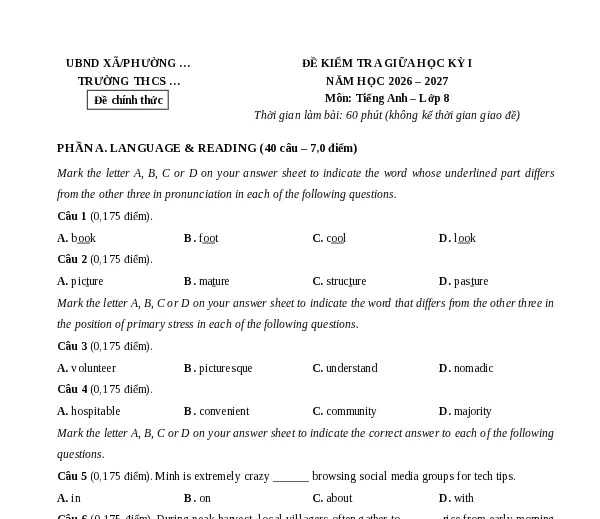
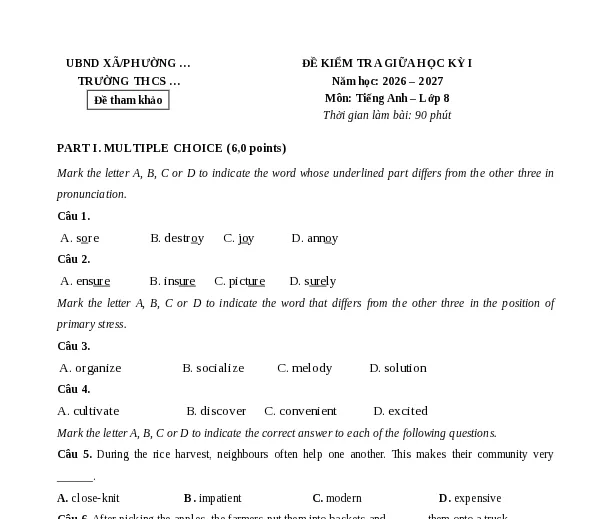
UBND XÃ/PHƯỜNG …
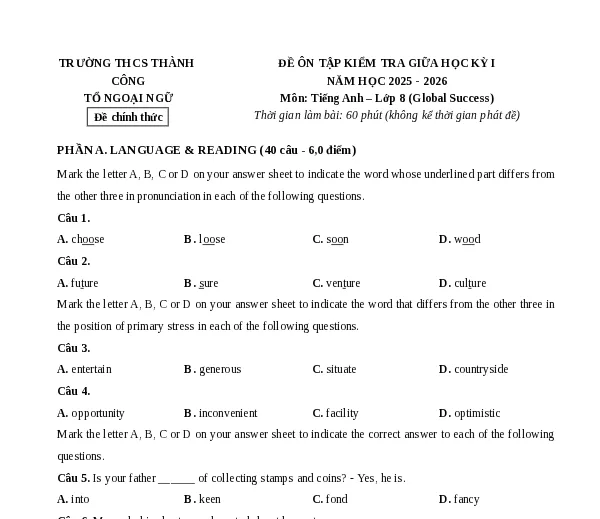
TRƯỜNG THCS …
Đề chính thức
ĐỀ KIỂM TRA GIỮA HỌC KỲ I
NĂM HỌC 2026 – 2027
Môn: Tiếng Anh – Lớp 8 (Chương trình nâng cao)
Thời gian làm bài: 60 phút (không kể thời gian phát đề)
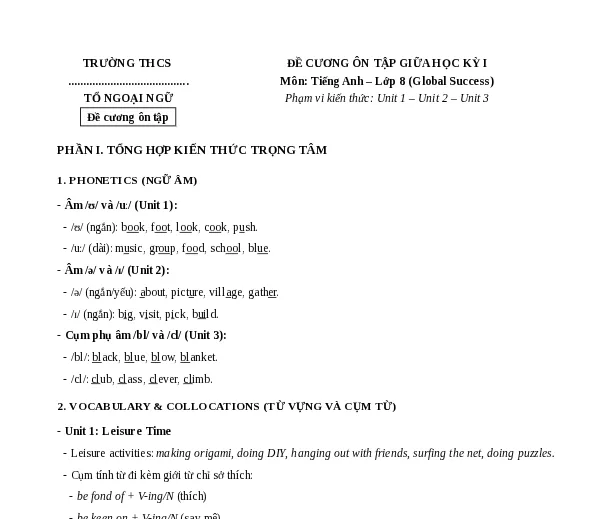
TÓM TẮT LÝ THUYẾT TRỌNG TÂM & BẪY NGỮ PHÁP HAY GẶP
1. Ngữ âm & Trọng âm:
- Phân biệt âm /ʊ/ (ngắn, lướt: put, full, push, butcher) và /uː/ (dài, tròn môi: blue, spoon, routine, neutral). Bẫy thường gặp ở chữ cái "oo" (foot, look, wood, cook phát âm là /ʊ/, trong khi food, pool, mood, smooth phát âm là /uː/).
- Nguyên âm /ə/ (unstressed: about, modern, balance) và /ɪ/ (village, pretty, baggage, active).
- Trọng âm từ 2 âm tiết: Đa số danh từ, tính từ rơi vào âm tiết 1 ('leisure, 'harvest, 'pasture); động từ rơi vào âm tiết 2 (en'joy, con'nect). Bẫy các từ ngoại lệ: 'promise, 'offer, 'visit, 'happen, 'canal, ma'chine, tech'nique.
2. Động từ chỉ sở thích (Verbs of liking/disliking):
- Động từ chỉ đi với V-ing: fancy, adore, detest, mind, enjoy, dislike, avoid.
- Động từ đi với cả V-ing và To-V mà không đổi nghĩa nhiều: love, like, hate, prefer. Tuy nhiên, cấu trúc would like / would love / would prefer BẮT BUỘC dùng To-infinitive (Ví dụ: I would like to stay at home).
- Bẫy cấu trúc sở thích mở rộng: be hooked on / be keen on / be fond of / be crazy about + V-ing.
3. So sánh hơn của trạng từ (Comparative forms of adverbs):
- Trạng từ ngắn (1 âm tiết): adverb + -er (faster, harder, earlier, sooner).
- Trạng từ dài (tận cùng -ly do biến đổi từ tính từ): more + adverb (more slowly, more fluently, more generously).
- Bẫy ngoại lệ: well -> better; badly -> worse; far -> farther/further; little -> less; much -> more. Chú ý các từ vừa là tính từ vừa là trạng từ: hard, fast, early, late, near (không dùng hardlier, fastly). Hardly và lately mang nghĩa hoàn toàn khác (hardly: hầu như không; lately: dạo gần đây).
4. Câu đơn và Câu ghép (Simple and Compound sentences):
- Câu ghép dùng liên từ đẳng lập (FANBOYS: for, and, nor, but, or, yet, so). Giữa hai mệnh đề độc lập có dấu phẩy trước liên từ.
- Trạng từ liên kết (Conjunctive adverbs): however, therefore, moreover, otherwise. Quy cách dấu câu chuẩn: Mệnh đề 1; conjunctive adverb, mệnh đề 2. hoặc Mệnh đề 1. Conjunctive adverb, mệnh đề 2.
PHẦN I. TRẮC NGHIỆM KHÁCH QUAN (40 câu · 8,0 điểm)
PRONUNCIATION
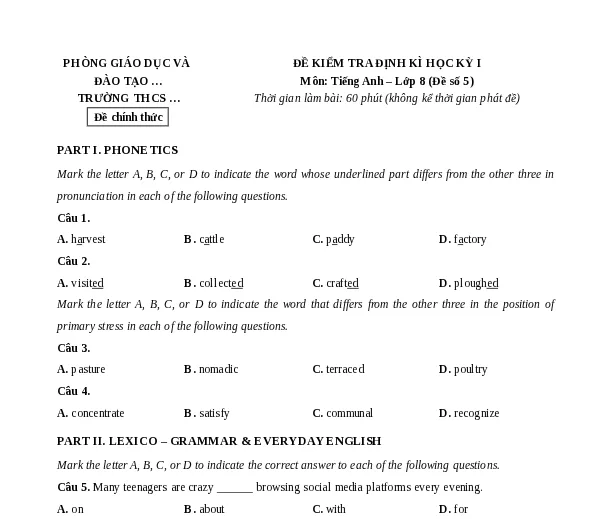
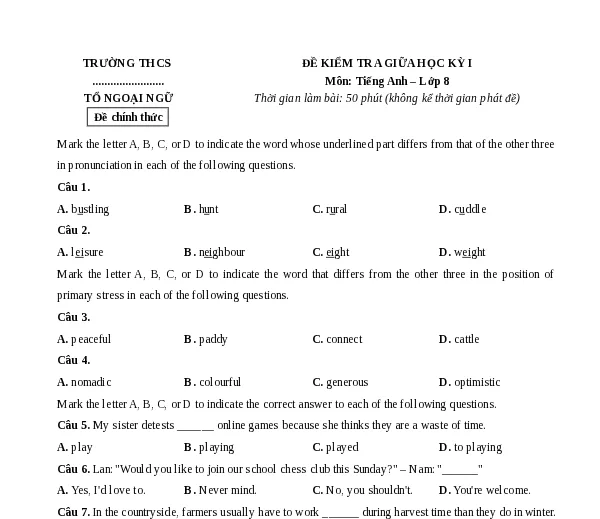
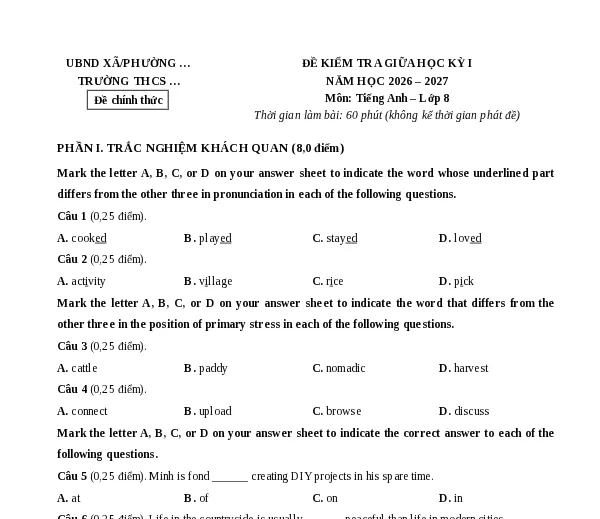
Mark the letter A, B, C, or D to indicate the word whose underlined part differs from the other three in pronunciation in each of the following questions.
Câu 1 (0,2 điểm).
A. foot
B. book
C. cook
D. food
Câu 2 (0,2 điểm).
A. push
B. rude
C. put
D. butcher
Câu 3 (0,2 điểm).
A. village
B. luggage
C. fantastic
D. damage
Câu 4 (0,2 điểm).
A. tour
B. sour
C. pour
D. court
STRESS
Mark the letter A, B, C, or D to indicate the word that differs from the other three in the position of primary stress in each of the following questions.
Câu 5 (0,2 điểm).
A. leisure
B. cattle
C. canal
D. pasture
Câu 6 (0,2 điểm).
A. harvest
B. adore
C. nomad
D. orchard
Câu 7 (0,2 điểm).
A. practical
B. picturesque
C. poisonous
D. generous
Câu 8 (0,2 điểm).
A. nomadic
B. convenient
C. historical
D. optimistic
VOCABULARY & GRAMMAR
Mark the letter A, B, C, or D to indicate the correct answer to each of the following questions.
Câu 9 (0,2 điểm). Although she loves socializing with friends on weekends, she ______ staying at home tonight because she feels exhausted.
A. would prefer
B. detests
C. adores
D. fancies
Câu 10 (0,2 điểm). Modern combine harvesters help local farmers load and transport crops much ______ than they used to do by hand.
A. more heavily
B. more efficiently
C. efficiently
D. as efficiently
Câu 11 (0,2 điểm). Life in mountainous regions can be tough; ______, the ethnic minorities always maintain their optimism and hospitality.
A. therefore
B. so
C. however
D. although
Câu 12 (0,2 điểm). My brother is ______ addicted to computer games that he hardly ever goes outside for physical activities.
A. so
B. very
C. such
D. too
Câu 13 (0,2 điểm). Unlike his slow brother, Minh solved the puzzle ______ and was praised by the teacher.
A. much faster
B. more fastly
C. fastly
D. more faster
Câu 14 (0,2 điểm). Nomadic children are taught how to ride horses and herd cattle from an early age, ______ they are very independent and resilient.
A. but
B. so
C. yet
D. for
Câu 15 (0,2 điểm). You must finish loading the hay into the barn before sunset; ______, the sudden rain will ruin it all.
A. otherwise
B. moreover
C. however
D. therefore
Câu 16 (0,2 điểm). Many urban teenagers are now fond of ______ DIY projects to make eco-friendly household accessories.
A. doing
B. making
C. taking
D. creating
Câu 17 (0,2 điểm). During peak harvest seasons, rural workers have to get up ______ earlier than usual to avoid the scorching noon sun.
A. far
B. more
C. very
D. quite
Câu 18 (0,2 điểm). While living in the countryside offers fresh air, teenagers often complain about the ______ of recreational facilities.
A. wealth
B. lack
C. existence
D. expansion
Câu 19 (0,2 điểm). She could ______ hear what the speaker was saying over the loud noises from the tractor.
A. hard
B. hardly
C. harder
D. hardlier
Câu 20 (0,2 điểm). We all ______ to visit the open-air market in Sapa this upcoming autumn break.
A. fancy
B. would like
C. enjoy
D. dislike
Câu 21 (0,2 điểm). Traditional folk games encourage teenagers to connect ______ their cultural heritage more deeply.
A. to
B. with
C. on
D. for
Câu 22 (0,2 điểm). The new highway was completed last month, so commuters can travel between the two provinces ______ than before.
A. more smoothly
B. smoothlier
C. smoothly
D. most smoothly
COMMUNICATION
Mark the letter A, B, C, or D to indicate the most suitable response to complete each of the following exchanges.
Câu 23 (0,2 điểm). Nam: "Would you fancy coming with us to pick wild strawberries in the orchard this Sunday?" — Lan: "______"
A. Yes, I'd love to, but I have an English exam on Monday.
B. No, I don't fancy.
C. Not at all, I'm fine.
D. Never mind, it doesn't matter.
Câu 24 (0,2 điểm). David: "Living in a Mongolian yurt must be such an unforgettable cultural experience!" — Mai: "______! The nomads are extremely warm-hearted and skilled."
A. I doubt it
B. You can say that again
C. I don't think so
D. It is none of my business
ERROR IDENTIFICATION
Mark the letter A, B, C, or D to indicate the underlined part that needs correction in each of the following questions.
Câu 25 (0,2 điểm). Despite having (A) lived in the city for over ten years, grandfather still prefers (B) to plant (C) vegetables in his hometown to buying (D) them in supermarkets.
A. having
B. prefers
C. to plant
D. to buying
Câu 26 (0,2 điểm). Jack ran much (A) more fastly (B) than any other contestant, so (C) he easily won the first prize (D).
A. much
B. more fastly
C. so
D. prize
Câu 27 (0,2 điểm). The villagers were (A) warned about the upcoming blizzard; therefore (B), some careless herders failed (C) to shelter their livestock in time (D).
A. were
B. therefore
C. failed
D. in time
Câu 28 (0,2 điểm). I would adore (A) to join (B) your cycling club around West Lake, but my bicycle is being (C) repaired at the moment (D).
A. would adore
B. to join
C. is being
D. at the moment
CLOZE TEST
Read the following passage and mark the letter A, B, C, or D to indicate the correct word or phrase that best fits each of the numbered blanks from 29 to 32.
Life for nomadic families on the vast Central Asian steppes has remained unchanged for centuries, yet it is currently undergoing subtle shifts. Herders move their livestock several times a year in search of greener (29)______ for their sheep, goats, and cattle. Unlike permanent brick buildings in urban centers, their portable, dome-shaped tents called yurts can be dismantled and packed onto camel carts or trucks (30)______ than most modern observers might imagine.
Even though traditional rituals are preserved, modern technology has steadily penetrated nomadic daily routines. Today, many pastoralists utilize solar panels to generate electricity, (31)______ allows them to charge smartphones and track meteorological warnings. They no longer rely exclusively on ancient intuition; (32)______, they consult digital weather forecasts to shield their flocks against sudden severe blizzards.
Câu 29 (0,2 điểm).
A. pastures
B. plantations
C. orchards
D. suburbs
Câu 30 (0,2 điểm).
A. more rapidly
B. rapidlier
C. as rapidly
D. most rapidly
Câu 31 (0,2 điểm).
A. that
B. which
C. what
D. who
Câu 32 (0,2 điểm).
A. moreover
B. instead
C. however
D. otherwise
READING COMPREHENSION
Read the following passage and mark the letter A, B, C, or D to indicate the correct answer to each of the questions from 33 to 40.
Over the past decade, the rapid surge of digital entertainment has drastically transformed the leisure habits of adolescents worldwide. In previous generations, teenagers typically spent their free time outdoors—playing sports, riding bicycles through quiet neighborhoods, or congregating in community parks. In stark contrast, modern youngsters are increasingly drawn to virtual environments, spending upwards of five hours daily glued to luminous screens. While digital games and social platforms provide instant connectivity and endless stimulation, pediatric psychologists caution that an over-reliance on sedentary leisure activities carries profound repercussions.
One of the most noticeable impacts of this sedentary lifestyle is the steep decline in physical well-being. Excessive screen time fosters a passive state, often accompanied by irregular sleep cycles, poor posture, and unhealthy snacking habits. Consequently, rates of juvenile obesity and chronic eye fatigue have soared dramatically in many industrialized nations. Furthermore, constant immersion in virtual gaming leaves little time for authentic face-to-face interaction, depriving teenagers of the crucial opportunities required to hone verbal communication and emotional empathy.
Nevertheless, it would be overly simplistic to condemn technology entirely. Online communities and multiplayer gaming can promote strategic teamwork, global cultural exchange, and high levels of technological literacy when managed prudently. In addition, many creative adolescents utilize digital tools to learn musical instruments, edit educational video content, or master computer coding autonomously during their leisure hours.
The paramount challenge, therefore, lies not in completely eliminating digital engagement, but in cultivating intentional balance. School curricula and parental guidelines should encourage young individuals to allocate dedicated periods for physical pursuits and nature exploration. Only by balancing virtual curiosity with tangible real-world experiences can the youth develop both physical vigor and holistic mental wellness.
Câu 33 (0,2 điểm). What is the main idea of the passage?
A. The total failure of modern parents in restricting screen time.
B. The complete superiority of traditional outdoor games over modern gaming.
C. The shift in teenage leisure activities and the need for a balanced lifestyle.
D. The devastating health crisis caused exclusively by computer programming.
Câu 34 (0,2 điểm). The word "sedentary" in paragraph 1 is closest in meaning to ______.
A. physically inactive
B. energetic and lively
C. intellectually demanding
D. socially isolated
Câu 35 (0,2 điểm). According to paragraph 2, which of the following is NOT mentioned as a negative consequence of excessive screen time?
A. Juvenile obesity
B. Impaired face-to-face interaction
C. Eye fatigue and sleep disruption
D. Complete memory loss in adolescence
Câu 36 (0,2 điểm). The word "it" in paragraph 3 refers to ______.
A. technology
B. virtual gaming
C. digital entertainment
D. to condemn technology entirely
Câu 37 (0,2 điểm). The word "paramount" in paragraph 4 is closest in meaning to ______.
A. minor
B. supreme
C. negligible
D. temporary
Câu 38 (0,2 điểm). Which of the following is stated in the passage as a positive aspect of digital tools?
A. They guarantee that children sleep earlier every night.
B. They enable self-directed learning in skills like coding and music.
C. They eliminate the need for physical education classes in schools.
D. They prevent young people from ever feeling lonely or anxious.
Câu 39 (0,2 điểm). What can be inferred about the author's attitude towards teenagers using technology in their leisure time?
A. Fully dismissive and unsupportive.
B. Completely indifferent and detached.
C. Objective and advocating moderate balance.
D. Highly alarming and promoting a total ban.
Câu 40 (0,2 điểm). Which of the following recommendations would the author most likely support?
A. Banning all digital screens from households with teenagers.
B. Encouraging teens to balance screen time with active outdoor recreation.
C. Replacing traditional schooling with online multiplayer video games.
D. Allowing adolescents to decide their leisure activities without parental guidance.
PHẦN II. TỰ LUẬN (10 câu · 2,0 điểm)
WORD FORMATION & VERB FORMS
Supply the correct form of the word or verb in brackets to complete each sentence.
Câu 41 (0,2 điểm). Unlike the crowded metropolis, life in the mountainous hamlets remains surprisingly peaceful and ______ (POLLUTE).
Câu 42 (0,2 điểm). The local village elders are proud of their ancient pottery craft and are committed to ______ (PRESERVATION) it for younger generations.
Câu 43 (0,2 điểm). The harvest was collected much ______ (EXPEDIENT) than expected thanks to the automated tractors.
Câu 44 (0,2 điểm). Do you mind ______ (LEND) me your tool kit so that I can assemble my DIY bookshelf?
Câu 45 (0,2 điểm). He would prefer ______ (STAY) at home and read scientific journals rather than hang out at noisy shopping malls.
SENTENCE TRANSFORMATION
Rewrite each of the following sentences in such a way that it means exactly the same as the original sentence, using the cues provided.
Câu 46 (0,2 điểm). Peter drives his delivery truck more recklessly than Tom does.
-> Tom does not ___________________________________________________________________.
Câu 47 (0,2 điểm). My sister finds it unbearable to listen to heavy metal rock music. (DETESTS)
-> My sister ________________________________________________________________________.
Câu 48 (0,2 điểm). Although the drought was severe, the villagers managed to protect their grain stocks. (HOWEVER)
-> The drought was _________________________________________________________________.
Câu 49 (0,2 điểm). It is not a good idea for you to stay up late browsing social media feeds, or you will feel dizzy tomorrow. (OTHERWISE)
-> You should ______________________________________________________________________.
Câu 50 (0,2 điểm). John enjoys building miniature wooden models more than playing digital video games. (PREFERS)
-> John ____________________________________________________________________________.
--------- HẾT ---------
Họ và tên thí sinh: ................................................ Số báo danh: ........................
HƯỚNG DẪN CHẤM VÀ ĐÁP ÁN CHI TIẾT
A. BẢNG ĐÁP ÁN TRẮC NGHIỆM (Phần I: 8,0 điểm · 0,2 điểm/câu)
Câu | Đ.án | Câu | Đ.án | Câu | Đ.án | Câu | Đ.án | Câu | Đ.án |
|---|---|---|---|---|---|---|---|---|---|
1 | D | 9 | A | 17 | A | 25 | C | 33 | C |
2 | B | 10 | B | 18 | B | 26 | B | 34 | A |
3 | C | 11 | C | 19 | B | 27 | B | 35 | D |
4 | B | 12 | A | 20 | B | 28 | A | 36 | D |
5 | C | 13 | A | 21 | B | 29 | A | 37 | B |
6 | B | 14 | B | 22 | A | 30 | A | 38 | B |
7 | B | 15 | A | 23 | A | 31 | B | 39 | C |
8 | D | 16 | A | 24 | B | 32 | B | 40 | B |
B. BAREM VÀ ĐÁP ÁN TỰ LUẬN (Phần II: 2,0 điểm · 0,2 điểm/câu)
Câu | Nội dung đáp án chuẩn / Chấp nhận phương án tương đương | Điểm |
|---|---|---|
41 | unpolluted | 0,2 |
42 | preserving | 0,2 |
43 | more expediently | 0,2 |
44 | lending | 0,2 |
45 | to stay | 0,2 |
46 | Tom does not drive his delivery truck as/so recklessly as Peter (does). | 0,2 |
47 | My sister detests listening to heavy metal rock music. | 0,2 |
48 | The drought was severe; however, the villagers managed to protect their grain stocks. | 0,2 |
49 | You should not stay up late browsing social media feeds; otherwise, you will feel dizzy tomorrow. | 0,2 |
50 | John prefers building miniature wooden models to playing digital video games. | 0,2 |
C. GIẢI THÍCH CHI TIẾT VÀ PHÂN TÍCH BẪY NGỮ PHÁP
Câu 1: Đáp án D.
- foot /fʊt/, book /bʊk/, cook /kʊk/ đều phát âm là /ʊ/ ngắn.
- food /fuːd/ phát âm là /uː/ dài.
Câu 2: Đáp án B.
- push /pʊʃ/, put /pʊt/, butcher /ˈbʊtʃ.ər/ đều chứa âm /ʊ/.
- rude /ruːd/ chứa âm /uː/.
Câu 3: Đáp án C.
- Hậu tố "-age" trong danh từ 2 âm tiết thường đọc là /ɪdʒ/: village /ˈvɪl.ɪdʒ/, luggage /ˈlʌɡ.ɪdʒ/, damage /ˈdæm.ɪdʒ/.
- fantastic phát âm là /æ/ (/fænˈtæs.tɪk/).
Câu 4: Đáp án B.
- tour /tʊər/ (nguyên âm đôi /ʊə/).
- sour /ˈsaʊ.ər/ (nguyên âm đôi /aʊ/). pour /pɔːr/ và court /kɔːrt/ chứa âm /ɔː/. Từ khác biệt rõ về nhóm nguyên âm đôi bài học là B.
Câu 5: Đáp án C.
- canal /kəˈnæl/ trọng âm rơi vào âm tiết 2 (ngoại lệ danh từ mượn gốc Pháp).
- leisure /ˈleʒ.ər/, cattle /ˈkæt.l/, pasture /ˈpɑːs.tʃər/ đều có trọng âm rơi vào âm tiết 1.
Câu 6: Đáp án B.
- adore /əˈdɔːr/ trọng âm rơi vào âm tiết 2 (động từ 2 âm tiết bắt đầu bằng /ə/).
- harvest /ˈhɑː.vɪst/, nomad /ˈnəʊ.mæd/, orchard /ˈɔː.tʃəd/ có trọng âm rơi vào âm tiết 1.
Câu 7: Đáp án B.
- Hậu tố -esque luôn nhận trọng âm: picturesque /ˌpɪk.tʃərˈesk/ (trọng âm rơi vào âm tiết 3).
- practical /ˈpræk.tɪ.kəl/, poisonous /ˈpɔɪ.zən.əs/, generous /ˈdʒen.ər.əs/ có trọng âm rơi vào âm tiết 1.
Câu 8: Đáp án D.
- optimistic /ˌɒp.tɪˈmɪs.tɪk/ (hậu tố -ic trọng âm rơi ngay trước nó: âm tiết 3).
- nomadic /nəʊˈmæd.ɪk/ (âm tiết 2), convenient /kənˈviː.ni.ənt/ (âm tiết 2), historical /hɪˈstɒr.ɪ.kəl/ (âm tiết 2).
Câu 9: Đáp án A.
- Bẫy: Mặc dù love, adore, fancy đi với V-ing, nhưng vế sau diễn tả ý muốn cụ thể ở một thời điểm (tonight) và sau chỗ trống là V-ing (staying). Cấu trúc would prefer + V-ing hoàn toàn khả dụng khi đi kèm lựa chọn ngầm, hoặc diễn tả sở thích mang tính thời điểm. Tuy nhiên chú ý detest không hợp ngữ cảnh nghĩa ("cảm thấy kiệt sức nên thích ở nhà hơn").
Câu 10: Đáp án B.
- Động từ thường load and transport cần trạng từ efficiently. So sánh hơn của trạng từ dài là more efficiently. Trạng từ chỉ mức độ much đứng trước để nhấn mạnh.
Câu 11: Đáp án C.
- Quy tắc dấu câu: Sau chỗ trống có dấu phẩy và trước nó có dấu chấm phẩy (;) -> Dùng trạng từ liên kết chỉ sự tương phản however. Although là liên từ phụ thuộc không đứng độc lập giữa dấu chấm phẩy và dấu phẩy như vậy.
Câu 12: Đáp án A.
- Cấu trúc: be + so + adj + that + clause (quá đến nỗi mà). Hardly ever mang nghĩa hầu như không.
Câu 13: Đáp án A.
- Bẫy: Fast vừa là tính từ vừa là trạng từ, KHÔNG có từ fastly. Dạng so sánh hơn của trạng từ fast là faster. Nhấn mạnh dùng much faster.
Câu 14: Đáp án B.
- Liên từ so dùng để nối mệnh đề chỉ kết quả (bọn trẻ học cưỡi ngựa chăn bò từ nhỏ, vì vậy chúng rất tự lập).
Câu 15: Đáp án A.
- Otherwise (nếu không thì) đứng sau dấu chấm phẩy và trước dấu phẩy, cảnh báo hậu quả nếu không chất cỏ khô vào kho trước hoàng hôn.
Câu 16: Đáp án A.
- Collocation chuẩn: do DIY projects (làm đồ tự chế / thủ công).
Câu 17: Đáp án A.
- Để nhấn mạnh so sánh hơn của trạng từ (earlier), ta dùng các từ bổ trợ: much, far, a lot. Không dùng more trước tính từ/trạng từ ngắn đã thêm -er.
Câu 18: Đáp án B.
- Collocation: the lack of something (sự thiếu thốn cái gì). "Teenagers often complain about the lack of recreational facilities" (thanh thiếu niên thường phàn nàn về sự thiếu thốn các khu vui chơi giải trí).
Câu 19: Đáp án B.
- Bẫy: Hardly là trạng từ chỉ tần suất/mức độ mang nghĩa phủ định: "hầu như không" (could hardly hear = hầu như không thể nghe thấy).
Câu 20: Đáp án B.
- Theo sau chỗ trống là động từ nguyên mẫu có to (to visit) -> Loại fancy, enjoy, dislike (chỉ đi với V-ing). Chọn would like to visit.
Câu 21: Đáp án B.
- Cấu trúc: connect with something/somebody (gắn kết, kết nối với ai/cái gì).
Câu 22: Đáp án A.
- Smoothly là trạng từ dài -> So sánh hơn là more smoothly.
Câu 23: Đáp án A.
- Lời mời mọc lịch sự bằng Do you fancy + V-ing? -> Đáp lại bằng lời nhận lời/từ chối khéo léo và nêu lý do: Yes, I'd love to, but....
Câu 24: Đáp án B.
- Thành ngữ giao tiếp: "You can say that again!" = I totally agree with you (Tôi hoàn toàn đồng ý với bạn).
Câu 25: Đáp án C.
- Bẫy: Cấu trúc prefer doing sth to doing sth (thích làm gì hơn làm gì). Vế sau đã dùng to buying (D), do đó phần C phải sửa to plant thành planting.
Câu 26: Đáp án B.
- Sửa more fastly thành faster vì fast là trạng từ ngắn, không tồn tại từ fastly.
Câu 27: Đáp án B.
- Bẫy liên từ: Dân làng đã được cảnh báo bão tuyết, NHƯNG một số người chăn gia súc bất cẩn vẫn không che chắn kịp -> Quan hệ tương phản đối lập, phải sửa therefore thành however.
Câu 28: Đáp án A.
- Động từ adore KHÔNG kết hợp với would để đi với to V (would like/would love mới đi với to V). Sửa would adore thành would love hoặc would like.
Câu 29: Đáp án A.
- pastures (đồng cỏ chăn thả gia súc). Các từ khác: plantations (đồn điền), orchards (vườn cây ăn quả), suburbs (ngoại ô) không hợp ngữ cảnh.
Câu 30: Đáp án A.
- Trạng từ so sánh hơn: more rapidly.
Câu 31: Đáp án B.
- Đại từ quan hệ which đứng sau dấu phẩy thay thế cho cả mệnh đề phía trước ("sử dụng tấm pin mặt trời để tạo ra điện").
Câu 32: Đáp án B.
- Vế trước: "Họ không còn chỉ dựa vào trực giác cổ xưa nữa"; vế sau: "thay vào đó (instead), họ tham khảo dự báo thời tiết kỹ thuật số".
Câu 33: Đáp án C.
- Bài đọc phân tích sự thay đổi trong thói quen giải trí của thanh thiếu niên từ ngoài trời sang kỹ thuật số, nêu mặt lợi và hại, kết luận bằng việc cần lối sống cân bằng (a balanced lifestyle).
Câu 34: Đáp án A.
- sedentary = physically inactive (ít vận động, ngồi nhiều).
Câu 35: Đáp án D.
- Đoạn 2 liệt kê béo phì (obesity), gián đoạn giấc ngủ và mỏi mắt (eye fatigue, irregular sleep), giảm tương tác mặt đối mặt (decline in authentic face-to-face interaction). Mất trí nhớ hoàn toàn (complete memory loss) không được đề cập.
Câu 36: Đáp án D.
- Cấu trúc chủ ngữ giả: "it would be overly simplistic to condemn technology entirely" -> it đại diện cho hành động to condemn technology entirely.
Câu 37: Đáp án B.
- paramount = supreme / most important (tối quan trọng, hàng đầu).
Câu 38: Đáp án B.
- Đoạn 3 chỉ rõ: "many creative adolescents utilize digital tools to learn musical instruments... or master computer coding autonomously".
Câu 39: Đáp án C.
- Tác giả giữ góc nhìn khách quan, nhìn nhận cả mặt tích cực lẫn rủi ro và khuyên nên cân bằng có chừng mực (objective and advocating moderate balance).
Câu 40: Đáp án B.
- Xuyên suốt bài viết, tác giả ủng hộ việc kết hợp hài hòa giữa không gian mạng và các hoạt động thể chất ngoài trời.