UBND XÃ CAM LÂM
TRƯỜNG THCS CAM LÂM
Đề tham khảo
ĐỀ KIỂM TRA GIỮA HỌC KỲ I
Năm học: 2026 – 2027
Môn: Tiếng Anh – Lớp 8
Thời gian làm bài: 60 phút
PART A. LISTENING (2.0 points)
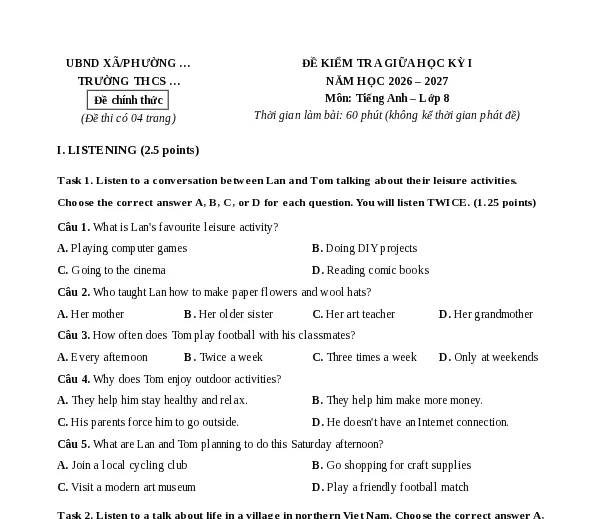
I. Listen to a conversation between Lan and Minh. Choose the correct answer A, B, C or D. You will listen TWICE.
Question 1. Why did Lan join the gardening project?
A. She wanted to spend more time outdoors and learn a practical skill.
B. Her teacher asked every student to join.
C. She needed vegetables for a cooking competition.
D. Her friends wanted to sell flowers online.
Question 2. What was the group’s first difficulty?
A. They had no place to grow vegetables.
B. They forgot to water some of the plants.
C. They did not have enough members.
D. They chose vegetables that grew too slowly.
Question 3. How did the group solve the problem?
A. They bought an automatic watering system.
B. They asked a teacher to do all the gardening.
C. They made a schedule and shared the watering tasks.
D. They moved the plants into the classroom.
Question 4. What will Minh probably do on Saturday?
A. Help prepare the garden for new plants.
B. Give a talk about healthy food.
C. Visit his grandparents in the countryside.
D. Take vegetables to the local market.
II. Listen to Hoa talking about managing her time. Decide whether the statements are True (T) or False (F). You will listen TWICE.
Statements | T | F |
|---|---|---|
Question 5. Hoa used to start her homework as soon as she arrived home. | ||
Question 6. Hoa now puts her phone away while completing important tasks. | ||
Question 7. Hoa believes that taking breaks always wastes study time. | ||
Question 8. Hoa sometimes changes her plan when an unexpected task appears. |
PART B. KNOWLEDGE OF LANGUAGE (3.0 points)
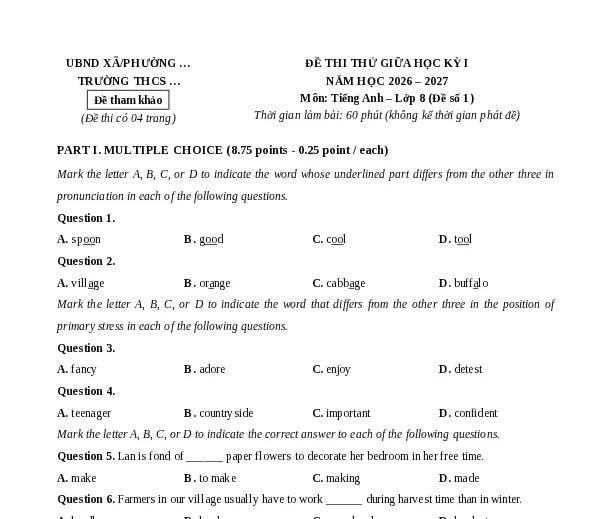
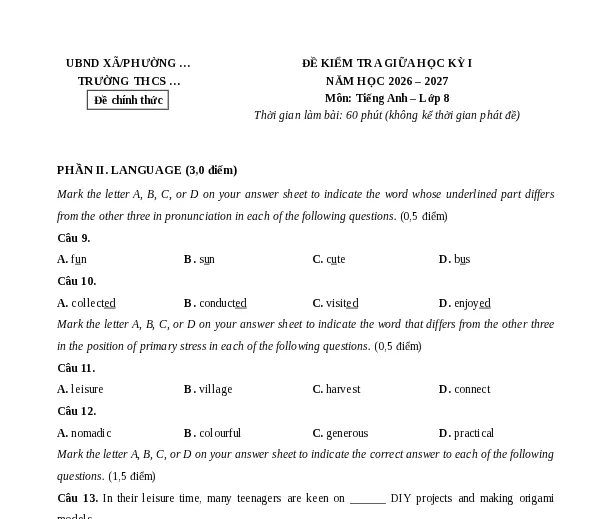
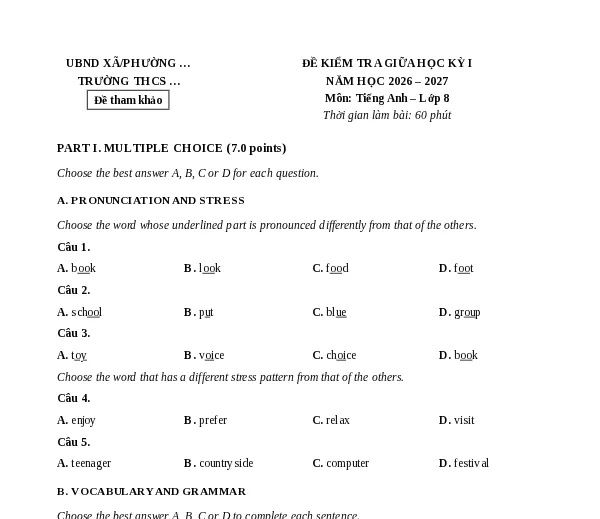
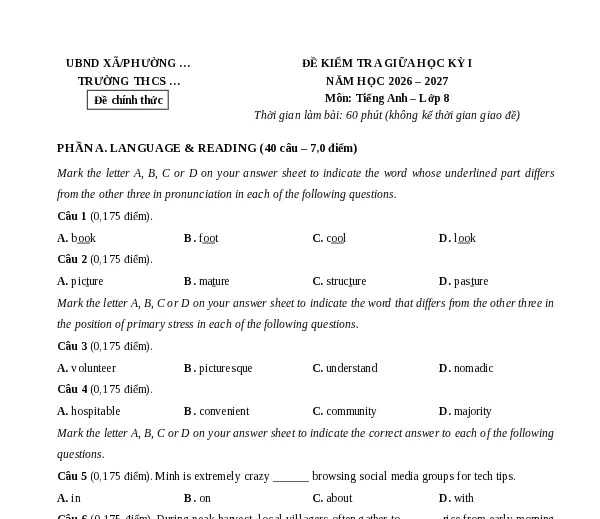
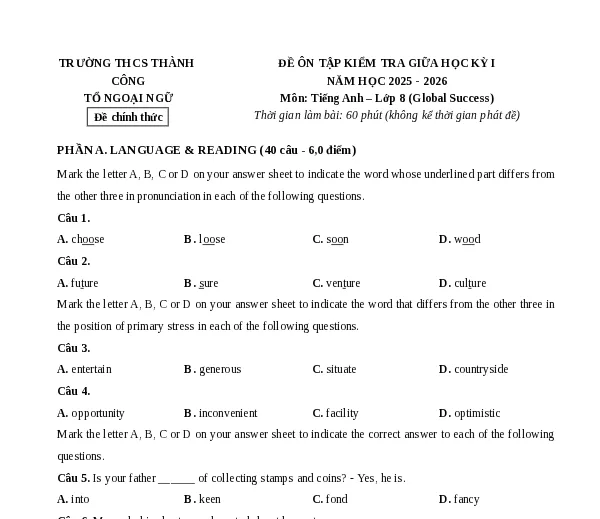
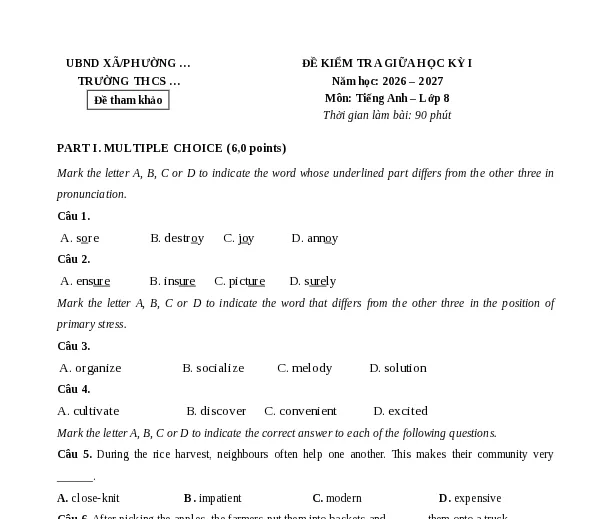
Question 9. Choose the word whose underlined part is pronounced differently from that of the others.
A. wanted
B. needed
C. decided
D. finished
Question 10. Choose the word that differs from the other three in the position of primary stress.
A. collect
B. relax
C. village
D. enjoy
Questions 11–14. Choose the correct answer to each question.
Question 11. Although she was nervous about the competition, Mai was determined ______ taking part.
A. on
B. in
C. at
D. with
Question 12. After practising for several weeks, Phong could play the piece ______ than before.
A. more confident
B. most confidently
C. confidently
D. more confidently
Question 13. You should make a realistic study plan, ______ you may feel overwhelmed by unfinished tasks.
A. or
B. but
C. because
D. so
Question 14. When the pressure of exams becomes too great, talking to someone you trust can help you ______ stress.
A. raise
B. collect
C. reduce
D. increase
Question 15. Choose the word CLOSEST in meaning to the underlined word.
The villagers worked together to preserve their traditional crafts for future generations.
A. forget
B. protect
C. change
D. replace
Question 16. Choose the word OPPOSITE in meaning to the underlined word.
Unlike the busy city centre, the path along the river is usually peaceful in the early morning.
A. crowded
B. attractive
C. noisy
D. narrow
Question 17. Choose the underlined part that needs correction.
My cousin prefers to spend her weekends outdoors to sit in front of a screen all day.
A. prefers
B. to spend
C. to sit
D. all day
Question 18. Choose the most suitable response.
An: “I have so many tasks to do that I don’t know where to start.”
Binh: “______”
A. How about listing them and doing the most urgent one first?
B. I started my homework two hours ago.
C. That’s the reason the library is closed.
D. Yes, you have finished everything already.
Question 19. What does the sign mean?
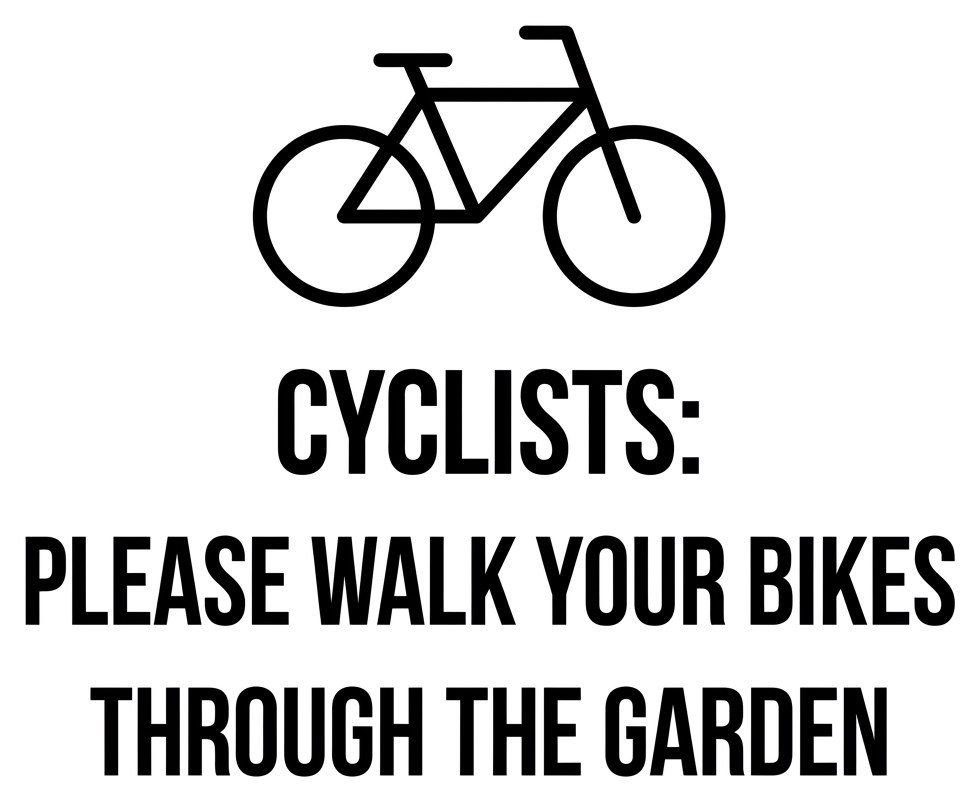
A. Cyclists must leave their bikes outside the garden.
B. Cyclists should get off and push their bikes through the garden.
C. Cyclists can ride quickly through the garden.
D. Cyclists must not enter the garden on foot.
Question 20. What should members do according to the notice?

A. Attend the meeting at school on Thursday.
B. Send their designs after the Friday meeting.
C. Send their designs by Thursday evening and join the meeting online on Friday.
D. Bring their designs to the club room on Friday.
PART C. READING (2.5 points)
Questions 21–25. Read the passage and choose the best option for each blank.
Last month, our class visited a village famous for making bamboo baskets. Before the trip, I thought the work would be simple. However, after watching a craftsperson carefully, I realised that making a strong basket requires both skill and patience. She showed us how to choose bamboo that was neither too old nor too young. We then tried (21) ______ the thin strips together. My first basket looked uneven, (22) ______ I was tempted to give up. Instead, the craftsperson encouraged me to try again and explained what I had done wrong. On my second attempt, I worked more (23) ______ and the strips stayed in place. At the end of the day, I understood why local people are proud (24) ______ their craft. The visit also taught me that improvement often comes from paying attention to mistakes rather than being afraid (25) ______ them.
Question 21.
A. weave
B. weaving
C. woven
D. to weaving
Question 22.
A. although
B. because
C. but
D. so
Question 23.
A. careful
B. care
C. carefully
D. careless
Question 24.
A. of
B. on
C. at
D. with
Question 25.
A. make
B. made
C. to making
D. of making
Questions 26–30. Read the passage and choose the correct answer to each question.
At the beginning of the term, students at Green Hill School were invited to suggest ways to improve their school grounds. Most groups wanted to add more flowers or benches. However, a group of eighth graders noticed that the area behind the library was often empty, even at break time. They interviewed students and discovered that some wanted a quiet place to read or talk, away from the noise of the playground.
The group’s first plan included a small pond and several expensive seats. Their teacher pointed out that the school could not afford everything. Instead of abandoning the idea, the students changed it. They collected used wooden boxes, checked that they were safe and turned them into seats with help from parents. They also planted herbs in old containers. The project took longer than expected because the group had to ask permission and organise the work around lessons.
A month after the space opened, the students asked their schoolmates for feedback. Many enjoyed the quieter area, but some said there was not enough shade on sunny days. The group could not solve every problem immediately, so they decided to begin by adding a few shade plants. They plan to ask for more feedback later. For the team, the project was not simply about completing a beautiful space; it was also about listening, making practical choices and improving their work over time.
Question 26. What is the main idea of the passage?
A. Students created and continued improving a quiet school space.
B. Students built a pond without help from adults.
C. The school replaced its library with a garden.
D. The most expensive school project was the most successful.
Question 27. Why did the eighth graders choose the area behind the library?
A. It already had plenty of seats and shade.
B. Students needed another place to play sports.
C. It was required by their teacher.
D. It was little used and could meet a need for a quieter place.
Question 28. The word “it” in the second paragraph refers to ______.
A. the teacher’s advice
B. the students’ plan
C. the library
D. the school’s budget
Question 29. What can be inferred about the group from the changes to their first plan?
A. They refused to accept any help from adults.
B. They thought money was more important than safety.
C. They were willing to adapt their idea to available resources.
D. They no longer wanted students to use the area.
Question 30. Which statement is supported by the passage?
A. The group considered feedback useful even after the space opened.
B. All students were satisfied with every feature of the space.
C. The project was completed sooner than the group expected.
D. The group solved the shade problem before asking for feedback.
PART D. WRITING (2.5 points)
Questions 31–32. Choose the best answer.
Question 31. Choose the best arrangement of the sentences to make a meaningful text.
a. Finally, we compared the results and discussed which activities helped us concentrate.
b. First, our class decided to test different ways of spending a short study break.
c. For a week, each group tried an activity, such as walking or listening to music.
A. c – a – b
B. b – a – c
C. a – b – c
D. b – c – a
Question 32. Choose the most appropriate sentence to end the text in Question 31.
A. The school library has a large collection of books.
B. The experiment helped us choose breaks that worked for us.
C. Our class will travel to the mountains next summer.
D. There are many kinds of musical instruments.
Questions 33–36. Complete the second sentence so that it has a similar meaning to the first one. Use the word given. Do not change the word given.
Question 33. My sister likes making paper flowers in her free time. (ENJOYS)
My sister ________________________________________________.
Question 34. The task was difficult, but our group completed it on time. (ALTHOUGH)
________________________________________________.
Question 35. Mai speaks English more confidently than Lan. (LESS)
Lan ________________________________________________.
Question 36. Minh was tired because he stayed up late to finish his project. (SO)
Minh ________________________________________________.
Questions 37–40. Write a paragraph of 80–100 words about how teenagers can deal with pressure from schoolwork. Give at least two suggestions and explain how each suggestion can help.
...........................................................................................................
...........................................................................................................
...........................................................................................................
...........................................................................................................
...........................................................................................................
--------- HẾT ---------
Họ và tên thí sinh: ................................................ Số báo danh: ........................
HƯỚNG DẪN CHẤM VÀ THANG ĐIỂM
A. HƯỚNG DẪN CHUNG
Mỗi câu từ Question 1 đến Question 36 được 0,25 điểm. Bài viết Questions 37–40 được 1,0 điểm. Tổng điểm toàn bài: 10,0 điểm.
Chấp nhận các câu trả lời khác đúng ngữ pháp, phù hợp ngữ cảnh và đáp ứng yêu cầu của đề.
B. ĐÁP ÁN VÀ THANG ĐIỂM
PART A. LISTENING: 2,0 điểm
Câu | 1 | 2 | 3 | 4 | 5 | 6 | 7 | 8 |
|---|---|---|---|---|---|---|---|---|
Đáp án | A | B | C | A | F | T | F | T |
Mỗi câu đúng được 0,25 điểm.
PART B. KNOWLEDGE OF LANGUAGE: 3,0 điểm
Câu | 9 | 10 | 11 | 12 | 13 | 14 | 15 | 16 | 17 | 18 |
|---|---|---|---|---|---|---|---|---|---|---|
Đáp án | D | C | A | D | A | C | B | C | C | A |
Câu | 19 | 20 |
|---|---|---|
Đáp án | B | C |
Mỗi câu đúng được 0,25 điểm. Question 9: đuôi “-ed” trong “finished” phát âm /t/, các từ còn lại phát âm /ɪd/. Question 10: “village” nhấn âm thứ nhất, các từ còn lại nhấn âm thứ hai. Question 17: sửa “to sit” thành “sitting”.
PART C. READING: 2,5 điểm
Câu | 21 | 22 | 23 | 24 | 25 | 26 | 27 | 28 | 29 | 30 |
|---|---|---|---|---|---|---|---|---|---|---|
Đáp án | B | D | C | A | D | A | D | B | C | A |
Mỗi câu đúng được 0,25 điểm. Question 28: “it” thay cho kế hoạch của nhóm. Question 29: việc điều chỉnh kế hoạch và tái sử dụng vật liệu cho thấy nhóm biết thích ứng với nguồn lực sẵn có.
PART D. WRITING: 2,5 điểm
Câu | 31 | 32 |
|---|---|---|
Đáp án | D | B |
Mỗi câu đúng được 0,25 điểm.
Câu | Đáp án mẫu | Điểm |
|---|---|---|
33 | My sister enjoys making paper flowers in her free time. | 0,25 |
34 | Although the task was difficult, our group completed it on time. | 0,25 |
35 | Lan speaks English less confidently than Mai. | 0,25 |
36 | Minh stayed up late to finish his project, so he was tired. | 0,25 |
Chấp nhận các câu trả lời khác đúng ngữ pháp và giữ nguyên nghĩa của câu gốc.
Questions 37–40: Đoạn văn 1,0 điểm
Tiêu chí | Yêu cầu | Điểm |
|---|---|---|
Nội dung (Task completion) | Nêu ít nhất hai gợi ý phù hợp và giải thích tác dụng của từng gợi ý trong việc giảm áp lực học tập. | 0,25 |
Bố cục, liên kết (Organization) | Đoạn văn có trình tự hợp lí và sử dụng từ nối phù hợp. | 0,25 |
Từ vựng - ngữ pháp (Vocabulary & Grammar) | Dùng từ và cấu trúc phù hợp, diễn đạt nhìn chung rõ nghĩa. | 0,25 |
Chính tả, dấu câu (Spelling & Punctuation) | Phần lớn từ viết đúng chính tả; viết hoa và dùng dấu câu phù hợp. | 0,25 |
Bài viết tham khảo:
Teenagers can deal with school pressure in several ways. First, they should make a weekly plan and divide large assignments into smaller tasks. This makes the work less overwhelming and helps them meet deadlines. Second, they can talk to a trusted friend, teacher or family member when they feel worried. Sharing a problem may help them find a practical solution and feel less alone. Finally, regular exercise and enough sleep can improve concentration. By looking after their health and asking for support, students can manage their responsibilities more effectively.
C. AUDIO SCRIPTS
Giáo viên cho học sinh đọc câu hỏi trước khi nghe. Mỗi bài nghe hai lần, có khoảng dừng giữa hai lượt.
Listening I: Questions 1–4
Minh: Hi, Lan. I heard you joined the school gardening project. Why did you decide to take part?
Lan: I wanted to spend less time indoors, and I thought growing vegetables would be a useful skill.
Minh: Has it been easy?
Lan: Not at first. We were excited, but some plants didn’t get enough water because everyone thought someone else would do it.
Minh: So what did you do?
Lan: We made a weekly schedule. Now each member is responsible for watering on a particular day.
Minh: That sounds sensible. Do you need any more help?
Lan: Yes. This Saturday morning we’re preparing the garden for some new plants. Would you like to join us?
Minh: I’d love to. I’ll be there.
Listening II: Questions 5–8
Hello, I’m Hoa. Last term, I often spent a long time on my phone after arriving home, so I started my homework quite late. I felt stressed when I still had work to do at bedtime. Now I choose the most important tasks and put my phone in another room while I do them. I also take a short break after working for a while. A walk or a glass of water helps me return to my work with more energy; I don’t think those breaks are a waste of time. Of course, plans do not always go perfectly. If an unexpected task appears, I move less urgent work to another time. Being flexible helps me stay calm.