ĐỀ CƯƠNG ÔN TẬP GIỮA HỌC KỲ I-NĂM HỌC 2026–2027
MÔN: TIẾNG ANH 8
A. Topics: Unit 1-2-3
LEISURE TIME LIFE IN THE COUNTRYSIDE TEENAGERS
B. Language input focus:
I/ Phonetics
- Pronunciation: /ʊ/ and /uː/; /ə/ and /i/; /ʊə/ and /ɔɪ/
II/ Use of language
1. Vocabulary
- Leisure Time - Life in the countryside - Teenagers
2. Grammar
- Verbs of liking / disliking + gerund - Verbs of liking / disliking + to infinitives.
- Comparative form of adverbs - Simple sentences and compound sentences
REFERENCE EXERCISES
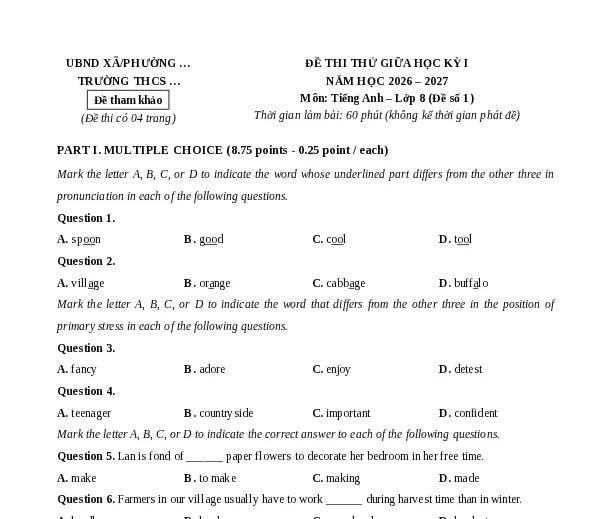
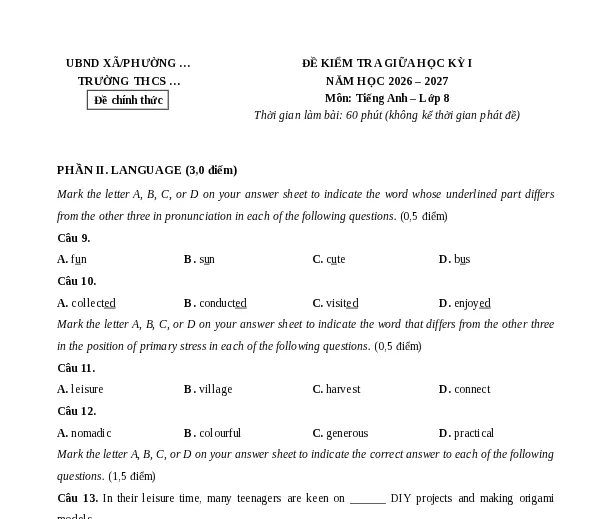
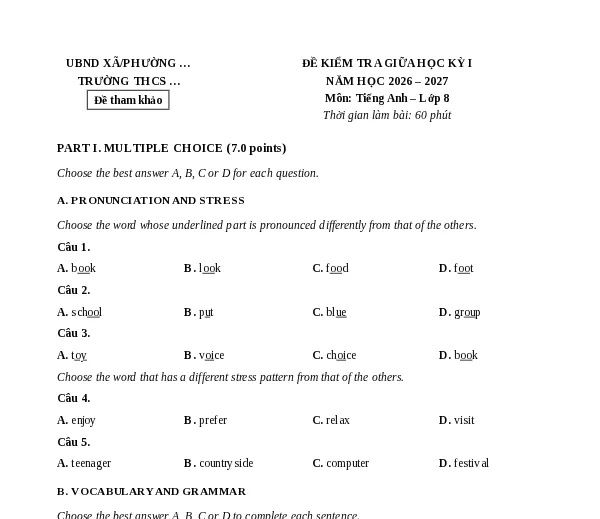
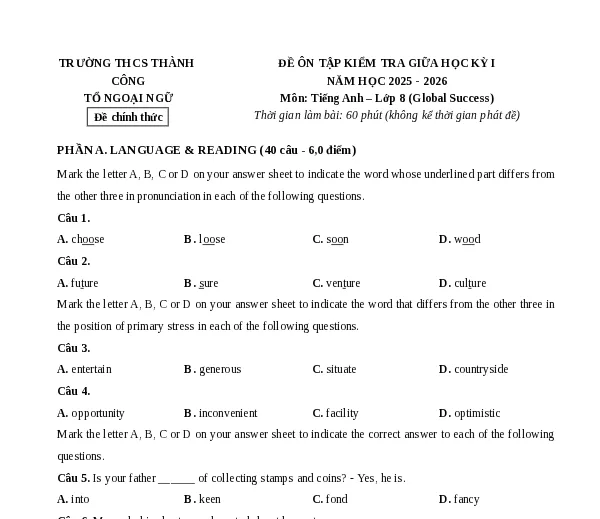
Mark the letter A, B, C or D on your answer sheet to indicate the word whose underlined part differs from the other three in pronunciation in each of the following questions.
Question 1.
A. choose
B. loose
C. soon
D. wood
Question 2.
A. future
B. sure
C. venture
D. culture
Mark the letter A, B, C or D on your answer sheet to indicate the word that differs from the other three in the position of primary stress in each of the following questions.
Question 3.
A. entertain
B. generous
C. situate
D. countryside
Question 4.
A. opportunity
B. inconvenient
C. facility
D. optimistic
Mark the letter A, B, C or D on your answer sheet to indicate the correct answer to each of the following questions.
Question 5. Is your father ___________ of collecting stamps and coins? – Yes, he is.
A. into
B. keen
C. fond
D. fancy
Question 6. My uncle hired extra workers to help at harvest ___________.
A. period
B. point
C. time
D. season
Question 7. My dad doesn’t mind ___________ my mom from work every day.
A. pick up
B. picked out
C. picking up
D. picks up
Question 8. He did the test ___________ I did.
A. as bad as
B. badder than
C. more badly than
D. worse than
Question 9. Quang helps his parents ______________ the rice onto the ox-drawn cart.
A. load
B. collect
C. dry
D. ride
Question 10. Life in a small town is ___________ than that in a big city.
A. peaceful
B. much peaceful
C. less peaceful
D. much more peaceful
Question 11. Mike felt stressed, ___________ he watched a comedy on YouTube.
A. although
B. so
C. but
D. or
Question 12. “What an attractive hair style you have got, Mary!” - “___________”
A. Thank you very much. I’m afraid
B. You are telling a lie
C. Thank you for your compliment.
D. I don’t like your sayings.
Read the following announcement and mark the letter A, B, C, or D on your answer sheet to indicate the correct option that best fits each of the numbered blanks from 13 to 16.
Make the Most of Your Leisure Time: Tips for Young Adults
● Spend your leisure (13) _______ wisely.
● 87% of young adults (14) _______ 13 to 19 use the Internet daily.
● Go out with friends! 42% say going to the cinema is their favorite evening activity.
● Watch TV, but limit your screen time—82% watch for (15) _______ than 10 hours weekly.
● Listen to music or, better yet, learn (16) _______ an instrument—30% can play one.
● Stay active! Only 32% play sports—football, swimming, and cycling are great choices.
Question 13.
A. activities
B. time
C. activity
D. times
Question 14.
A. aged
B. age
C. years
D. year
Question 15.
A. much
B. many
C. little
D. more
Question 16.
A. playing
B. played
C. to play
D. to be playing
Mark the letter A, B, C, or D on your answer sheet to indicate the correct answer to each of the following questions from 17 to 18.
Question 17. Put the sentences (a-c) in the correct order, then fill in the blank to make a logical text.
Board games are a great way to have fun with friends and family. Here’s what you should know about them.......
a. Many board games require strategy and teamwork, making them enjoyable for people of all ages.
b. They come in different types, such as quiz games, strategy games, and word games.
c. Playing board games can help improve communication skills and provide screen-free entertainment.
A. b - a – c
B. a - c – b
C. c - b - a
D. a - b - c
Question 18. Choose the sentence that most appropriately ends the text (in Question 17).
A. Board games are often played during family gatherings or social events.
B. You can find board games in most toy stores or online.
C. Some games are designed for large groups, while others are better for smaller gatherings.
D. New board games are continually being developed to keep the experience fresh.
Mark the letter A, B, C, or D on your answer sheet to indicate the correct option that best fits each of the numbered blanks from 19 to 24.
We know that nowadays students (19) ______________ from test stress, and there are a few of the biggest causes. First, it is important to do your best and study hard, but you may push yourself too much to get a high grade, and (20) ______________ can be hard to deal with. Second, many schools want to show their students’ high-test grades to prove that they are doing a good job of educating them; (21) ______________, they have high expectations for the teachers, who then have high expectations for the students. In addition, most parents want to see great school reports, and they can start pushing their children when test time comes around. Moreover, if you had a bad time with a test in the past, or if you have (22) ______________ poorly on one or more tests, you could feel anxious about the next one. Finally, sometimes other students can spread rumors about a test, (23) ______________ you might hear things from older friends or siblings. Rumors like “That teacher’s tests are (24) ______________ impossible to pass!” can make you a lot more nervous.
Question 19.
A. prevent
B. suffer
C. experience
D. show
Question 20.
A. force
B. causes
C. grades
D. pressure
Question 21.
A. therefore
B. however
C. otherwise
D. but
Question 22.
A. come
B. taken
C. made
D. done
Question 23.
A. or
B. and
C. so
D. but
Question 24.
A. totally
B. total
C. totaled
D. totalled
Mark the letter A, B, C, or D on your answer sheet to indicate the sentence that is closest in meaning to the original sentence in each of the following questions.
Question 25. Nam is a more attractive storyteller than Mai.
A. Nam tells stories more attractively than Mai is.
B. Nam tells more attractive stories than Mai does.
C. Mai tells more attractive stories than Nam does.
D. Mai tells stories less attractively than Nam does.
Question 26. All of the children of the Smiths really like playing rackets.
A. All of the children of the Smiths really detest playing rackets.
B. All of the children of the Smiths really hate playing rackets.
C. All of the children of the Smiths really aren’t interested in playing rackets.
D. All of the children of the Smiths are really keen on playing rackets.
Mark the letter A, B, C, or D on your answer sheet to indicate the sentence that is made from the given cues in each of the following questions.
Question 27. millions / people / watch / popular TV programme / every week
A. Millions people watch the popular TV programme every week.
B. Millions of people are watching popular TV programme every week.
C. Millions of people watch this popular TV programme every week.
D. Millions people watched that popular TV programme every week.
Question 28. How much/ time/ day/ you/ spend/ playing games?
A. How much time a day do you spend on playing games?
B. How much time a day do you spend in playing games?
C. How much time a day did you spend in playing games?
D. How much time a day did you spend on playing games?
Read the following sign or notice and mark the letter A, B, C, or D on your answer sheet to indicate the correct answer to each of the following questions.
Question 29. What does the sign mean?
[Biển báo tam giác viền đỏ, bên trong có hình cây cầu đang nâng lên]
A. Crossroads ahead.
B. Road widens
C. Residential areas
D. Opening bridge ahead.
Question 30. What does this notice say?
All lost car park tickets will result in a £20 fee.
A. It always costs £20 to park here.
B. You will be fined £20 if you park here.
C. You must pay £20 if you lose your tickets.
D. You can park for free if you lose your ticket.
Read the following passage and mark the letter A, B, C, or D on your answer sheet to indicate the correct answer to each of the following questions from 31 to 36.
What should teenagers learn at high school?
A modern high school should teach teens important subjects and useful skills for today’s world. For subjects, schools should teach teens maths and science. These help with understanding the world and solving problems. Teens also need to improve their reading skills. Teens should know some history and geography – both of their own country and the world in general. Schools should also teach about computers, because computers are part of almost every activity now for both work and leisure.
Teens should learn about money – how to use it, save it and not spend too much. They should also know how to cook and how to fix things at home. These skills for life are as important as subjects.
Teens need to become good citizens of their own country. This means knowing about how their own country works, problems which it has and how to help their local community.
In addition, teens should learn how to stay healthy. This means exercising, eating good food and understanding their bodies. Also, they need to know how to deal with strong feelings and stress.
Teens need to know not to believe everything they see or read. This is very important, particularly when someone is on social media or watching television.
Lastly, schools should make time for teens to be creative and enjoy art and music. This is good for expressing themselves and coming up with new ideas.
Question 31. What should modern high schools teach teens according to the passage?
A. Only arts and music
B. Maths and science
C. Business and economics
D. Sports and physical education
Question 32. What should teens learn about money?
A. How to spend it all
B. How to use it, save it, and not spend too much
C. How to lend it to friends
D. How to hide it from parents
Question 33. What is one way that teens can stay healthy mentioned in the passage?
A. Watching television
B. Skipping meals
C. Playing video games
D. Eating good food
Question 34. Which of these areas of knowledge is NOT mentioned in the text?
A. What a particular area needs
B. How to manage time
C. How people lived in the past
D. Why we sometimes worry about things
Question 35. What do you think the writer is saying about this list of things for teens to learn?
A. Each school should decide which of these things to teach.
B. Normal school subjects are still the most important things.
C. They are all equally important in the modern world.
D. They are all equally important in the modern world.
Question 36. What is the OPPOSITE meaning of “creative” in the context of the passage?
A. unimaginative
B. original
C. artistic
D. innovative
Four phrases/sentences have been removed from the text below. For each question, mark the letter A, B, C or D on your answer sheet to indicate the correct option that fits each of the numbered blanks from 37 to 40 the most.
A. it’s a great way to spend time together
B. This can be frustrating for families with young children
C. These parks offer a lot of excitement
D. the experience with friends and family
Amusement parks are exciting places where people can have fun and enjoy different rides and games. Families often visit these parks during holidays or weekends. (37) ....... They have roller coasters, water slides, and other attractions for both kids and adults. People love the thrill of these rides and the variety of entertainment options available. People enjoy (38) ....... However, amusement parks can be crowded, especially during the summer. Visitors need to be prepared to wait in long lines. (39) ....... Some parks offer fast passes to skip the lines, but they cost extra. Despite these challenges, many people still visit because (40) .......... .
Question 37. .............. Question 38. .............. Question 39. .............. Question 40. ..............
The end
ĐÁP ÁN VÀ LỜI GIẢI THAM KHẢO
I. ĐÁP ÁN NHANH
1. D | 2. B | 3. A | 4. C | 5. C | 6. D | 7. C | 8. D |
|---|---|---|---|---|---|---|---|
9. A | 10. D | 11. B | 12. C | 13. B | 14. A | 15. D | 16. C |
17. A | 18. A | 19. B | 20. D | 21. A | 22. D | 23. A | 24. A |
25. D | 26. D | 27. C | 28. A | 29. D | 30. C | 31. B | 32. B |
33. D | 34. B | 35. C | 36. A | 37. C | 38. D | 39. B | 40. A |
II. PHONETICS – PHÁT ÂM VÀ TRỌNG ÂM
Câu 1. D. wood
Giải thích: choose /tʃuːz/, loose /luːs/, soon /suːn/ có âm /uː/; wood /wʊd/ có âm /ʊ/. Vì vậy D khác ba từ còn lại.
Câu 2. B. sure
Giải thích: Phần “ure” trong future, venture, culture được phát âm chủ yếu là /ə(r)/ sau âm /tʃ/; sure có âm /ʊə(r)/. Chọn B.
Câu 3. A. entertain
Giải thích: entertain nhấn âm cuối: enterTAIN. generous, situate và countryside đều nhấn âm đầu. Chọn A.
Câu 4. C. facility
Giải thích: opportunity, inconvenient và optimistic có trọng âm chính ở âm tiết thứ ba; facility /fəˈsɪləti/ nhấn âm tiết thứ hai. Chọn C.
III. USE OF LANGUAGE – TỪ VỰNG VÀ NGỮ PHÁP
Câu 5. C. fond
Giải thích: Cụm cố định be fond of + V-ing = thích làm gì. “Is your father fond of collecting stamps and coins?”
Câu 6. D. season
Giải thích: harvest season = mùa thu hoạch. “Harvest time” cũng có thể gặp trong thực tế, nhưng với các phương án của đề, season là lựa chọn chuẩn nhất.
Câu 7. C. picking up
Giải thích: mind + V-ing. pick up someone = đón ai. Vì vậy: doesn’t mind picking up my mom.
Câu 8. D. worse than
Giải thích: Động từ did cần trạng từ. Trạng từ badly có dạng so sánh hơn bất quy tắc là worse. → He did the test worse than I did.
Câu 9. A. load
Giải thích: load something onto… = chất/xếp cái gì lên…. → load the rice onto the ox-drawn cart.
Câu 10. D. much more peaceful
Giải thích: So sánh hơn của tính từ dài peaceful là more peaceful; much dùng để nhấn mạnh mức độ so sánh. → much more peaceful than.
Câu 11. B. so
Giải thích: Mike cảm thấy căng thẳng, vì vậy cậu ấy xem hài trên YouTube. Hai vế có quan hệ kết quả → so.
Câu 12. C. Thank you for your compliment.
Giải thích: Đây là lời đáp phù hợp khi nhận lời khen. Các phương án còn lại không lịch sự hoặc không đúng ngữ cảnh.
Câu 13. B. time
Giải thích: Cụm leisure time = thời gian rảnh. → Spend your leisure time wisely.
Câu 14. A. aged
Giải thích: aged 13 to 19 = trong độ tuổi từ 13 đến 19. “young adults aged 13 to 19”.
Câu 15. D. more
Giải thích: Cấu trúc more than + số lượng/thời gian. → watch for more than 10 hours weekly.
Câu 16. C. to play
Giải thích: learn + to-infinitive. → learn to play an instrument.
IV. SẮP XẾP ĐOẠN VĂN VÀ ĐỌC ĐIỀN
Câu 17. A. b – a – c
Giải thích: Sau câu mở đầu về board games, câu b giới thiệu các loại trò chơi; câu a nói đặc điểm chiến thuật/đồng đội; câu c nêu lợi ích. Trật tự b → a → c là mạch lạc nhất.
Câu 18. A. Board games are often played during family gatherings or social events.
Giải thích: Câu kết này quay lại ý mở đầu “have fun with friends and family”, nên liên kết tự nhiên nhất với toàn đoạn. Các lựa chọn khác chỉ bổ sung chi tiết, kém tính kết luận hơn.
Câu 19. B. suffer
Giải thích: Cụm suffer from + bệnh/vấn đề = chịu đựng, mắc phải. → students suffer from test stress.
Câu 20. D. pressure
Giải thích: “push yourself too much to get a high grade” tạo ra pressure = áp lực, và pressure can be hard to deal with.
Câu 21. A. therefore
Giải thích: Trường muốn điểm thi cao; vì vậy họ đặt kỳ vọng cao lên giáo viên. Quan hệ nguyên nhân – kết quả → therefore.
Câu 22. D. done
Giải thích: Cụm do poorly on a test = làm bài kiểm tra kém. Sau have dùng V3 → have done poorly.
Câu 23. A. or
Giải thích: Có thể nghe tin đồn từ học sinh khác, hoặc từ bạn lớn tuổi/anh chị em → or.
Câu 24. A. totally
Giải thích: Cần trạng từ bổ nghĩa cho tính từ impossible. totally impossible = hoàn toàn không thể.
Câu 25. D. Mai tells stories less attractively than Nam does.
Giải thích: “Nam is a more attractive storyteller than Mai” nghĩa là Nam kể chuyện hấp dẫn hơn Mai. Đảo chiều so sánh: Mai kể chuyện kém hấp dẫn hơn Nam → less attractively than.
Câu 26. D. are really keen on playing rackets.
Giải thích: really like + V-ing ≈ be keen on + V-ing. Ba phương án A, B, C đều mang nghĩa không thích.
Câu 27. C. Millions of people watch this popular TV programme every week.
Giải thích: Cần “millions of people”; every week là dấu hiệu hiện tại đơn → watch.
Câu 28. A. How much time a day do you spend on playing games?
Giải thích: Câu hỏi hiện tại đơn: How much time … do you spend …? Cụm spend time on + V-ing được chấp nhận. Trong các phương án, A đúng nhất.
V. SIGNS / NOTICES – BIỂN BÁO
Câu 29. D. Opening bridge ahead.
Giải thích: Biển tam giác viền đỏ có hình cầu nâng cảnh báo phía trước có cầu mở/cầu nâng.
Câu 30. C. You must pay £20 if you lose your tickets.
Giải thích: Notice ghi: “All lost car park tickets will result in a £20 fee.” → mất vé bãi đỗ xe phải trả phí £20.
VI. READING – WHAT SHOULD TEENAGERS LEARN AT HIGH SCHOOL?
Câu 31. B. Maths and science
Giải thích: Đoạn đầu nêu rõ: “schools should teach teens maths and science”.
Câu 32. B. How to use it, save it, and not spend too much
Giải thích: Đoạn 2 nói teens should learn about money – how to use it, save it and not spend too much.
Câu 33. D. Eating good food
Giải thích: Đoạn 4: stay healthy means exercising, eating good food and understanding their bodies.
Câu 34. B. How to manage time
Giải thích: Bài có lịch sử (C), nhu cầu/các vấn đề cộng đồng (A), stress và cảm xúc (D), nhưng không đề cập cách quản lý thời gian.
Câu 35. C. They are all equally important in the modern world.
Giải thích: Tác giả liệt kê cả môn học, kỹ năng sống, sức khỏe, công dân, tư duy phản biện và sáng tạo như những nội dung cần thiết. Lưu ý: trong đề, phương án C và D bị in trùng nguyên văn; vì vậy chọn C theo thứ tự xuất hiện.
Câu 36. A. unimaginative
Giải thích: creative = sáng tạo. Trái nghĩa là unimaginative = thiếu óc tưởng tượng/không sáng tạo.
VII. GHÉP CÂU VÀO ĐOẠN VĂN – AMUSEMENT PARKS
Câu 37. C. These parks offer a lot of excitement
Giải thích: Sau câu nói gia đình thường đến công viên giải trí, câu C khái quát sự hấp dẫn; ngay sau đó bài nêu roller coasters, water slides… làm ví dụ.
Câu 38. D. the experience with friends and family
Giải thích: Cấu trúc “People enjoy + noun phrase”. Nội dung phù hợp với chủ đề đi công viên cùng gia đình/bạn bè.
Câu 39. B. This can be frustrating for families with young children
Giải thích: Câu trước nói phải chờ hàng dài; “This” chỉ việc chờ lâu, điều này gây khó chịu cho gia đình có trẻ nhỏ.
Câu 40. A. it’s a great way to spend time together
Giải thích: Câu kết bắt đầu “Despite these challenges, many people still visit because…” cần một lý do tích cực tổng quát; A phù hợp nhất.