UBND XÃ/PHƯỜNG …
TRƯỜNG THCS …
Đề tham khảo
KỲ THI TUYỂN SINH VÀO LỚP 10 THPT
NĂM HỌC 2027 – 2028
Môn thi: TIẾNG ANH
Thời gian làm bài: 60 phút, không kể thời gian phát đề
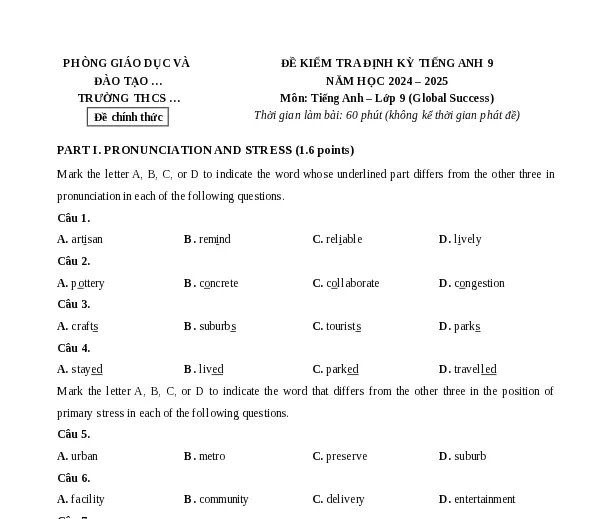
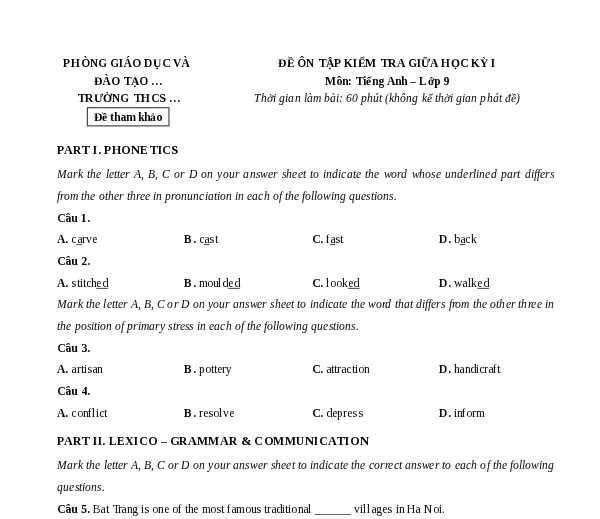
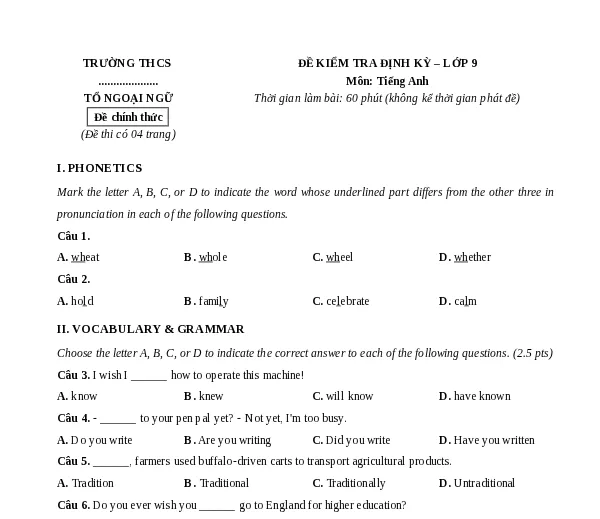
PART 1. PRONUNCIATION (0.5 point)
Mark the letter A, B, C, or D to indicate the word whose underlined part differs from the other three in pronunciation in each of the following questions.
Câu 1 (0,25 điểm).
A. health
B. bread
C. clean
D. heavy
Câu 2 (0,25 điểm).
A. stopped
B. visited
C. looked
D. watched
PART 2. STRESS (0.5 point)
Mark the letter A, B, C, or D to indicate the word that differs from the other three in the position of primary stress in each of the following questions.
Câu 3 (0,25 điểm).
A. pollute
B. protect
C. reduce
D. provide
Câu 4 (0,25 điểm).
A. tradition
B. family
C. festival
D. dangerous
PART 3. VOCABULARY AND GRAMMAR (3.5 points)
Mark the letter A, B, C, or D to indicate the correct answer to each of the following questions.
Câu 5 (0,25 điểm). My father bought a modern laptop yesterday, and this laptop is ______.
A. his
B. him
C. he
D. himself
Câu 6 (0,25 điểm). We ______ English for five years, so we can communicate quite well.
A. learn
B. are learning
C. have learned
D. learned
Câu 7 (0,25 điểm). If we continue to use plastic bags carelessly, we ______ the natural environment.
A. will harm
B. would harm
C. harmed
D. have harmed
Câu 8 (0,25 điểm). Lan decided ______ part in the green campaign organized by her school.
A. taking
B. take
C. to take
D. took
Câu 9 (0,25 điểm). Da Nang is ______ attractive destination for both domestic and foreign visitors.
A. a
B. an
C. the
D. no article
Câu 10 (0,25 điểm). They decided to walk to school ______ it rained very heavily this morning.
A. although
B. because
C. in spite of
D. despite
Câu 11 (0,25 điểm). The craft village is famous ______ its beautifully handmade pottery products.
A. on
B. at
C. with
D. for
Câu 12 (0,25 điểm). Don't forget to ______ all the lights before you leave the classroom.
A. turn off
B. turn on
C. look after
D. go on
Câu 13 (0,25 điểm). Ba Na Hills has ______ many visitors from all over the world in recent years.
A. invited
B. attracted
C. controlled
D. connected
Câu 14 (0,25 điểm). The doctor advised my uncle to reduce stress and live more ______.
A. health
B. healthy
C. healthily
D. unhealthily
Câu 15 (0,25 điểm). When you travel abroad, it takes time to ______ to the local climate and cuisine.
A. adapt
B. accept
C. preserve
D. concentrate
Câu 16 (0,25 điểm). Students should ______ an effort to practice speaking English every day.
A. do
B. make
C. give
D. take
Câu 17 (0,25 điểm). Mark – a student – is talking to his teacher, Mrs. Hoa:
– Mark: "Thank you very much for helping me with my presentation, Mrs. Hoa."
– Mrs. Hoa: "______."
A. You're welcome
B. I'd love to
C. Good idea
D. Congratulations
Câu 18 (0,25 điểm). Peter and Mary are discussing environmental protection:
– Peter: "I think every family should sort their household garbage before throwing it away."
– Mary: "______. It makes recycling much easier and more efficient."
A. I don't think so
B. I totally agree with you
C. That's terrible
D. Never mind
PART 4. READING SIGNS AND NOTICES (0.75 point)
Mark the letter A, B, C, or D to indicate the correct answer to each of the following questions.
Câu 19 (0,25 điểm). What does this notice in the school library say?
SILENCE PLEASE! NO FOOD OR DRINKS ALLOWED IN THE READING ROOM
A. You can drink water while reading books.
B. You must keep quiet and cannot bring food or drinks into the room.
C. Food and drinks are served inside the reading room.
D. Students are allowed to talk freely in this room.
Câu 20 (0,25 điểm). What does this traffic sign mean?
PEDESTRIAN CROSSING AHEAD – REDUCE SPEED
A. Pedestrians are not allowed to cross here.
B. Drivers must speed up to cross the road quickly.
C. Drivers must slow down because people may cross the street.
D. This road is only for walking pedestrians.
Câu 21 (0,25 điểm). Read the note from Minh to his classmate Phong:
“Phong, I have borrowed your English dictionary. I will return it to you during the break tomorrow morning. Thanks a lot! – Minh”
What will Minh do tomorrow morning?
A. Give Phong's dictionary back to him during the break.
B. Ask Phong to lend him an English dictionary.
C. Buy a new English dictionary for Phong.
D. Keep Phong's dictionary for another week.
PART 5. ANNOUNCEMENT COMPLETION (1.0 point)
Read the announcement below and mark the letter A, B, C, or D to indicate the correct word that best fits each of the numbered blanks.
ANNOUNCEMENT: SCHOOL GREEN DAY
Our school Youth Union is pleased to announce the annual "Green Day" campaign. The event will take place on Saturday morning, October 24th, at the school yard.
All students are expected to:
- (22) ______ old newspapers, plastic bottles, and aluminum cans for recycling.
- Plant young trees and flower beds along the main school pathway to make our school (23) ______.
- Wear school uniforms and bring gloves and small shovels.
This meaningful activity aims to raise students' awareness (24) ______ environmental protection.
For more information, please (25) ______ the Youth Union office on the second floor.
Câu 22 (0,25 điểm).
A. collect
B. throw
C. damage
D. waste
Câu 23 (0,25 điểm).
A. green
B. greener
C. greenest
D. greenly
Câu 24 (0,25 điểm).
A. about
B. for
C. with
D. in
Câu 25 (0,25 điểm).
A. contact
B. advise
C. perform
D. remind
PART 6. CLOZE READING (1.25 points)
Read the following passage and mark the letter A, B, C, or D to indicate the correct word or phrase that best fits each of the numbered blanks.
Living in a big city offers numerous advantages, but it also presents several challenges. First of all, cities provide modern facilities and high-quality educational institutions. Young people have better chances to find well-paid jobs and (26) ______ their skills. In addition, urban areas offer a wide range of entertainment options, such as cinemas, shopping centers, and amusement parks, (27) ______ attract thousands of visitors every weekend.
(28) ______, city life is not completely ideal. Traffic congestion has become a daily nightmare for commuters during rush hours. Moreover, the air quality in urban areas is often seriously degraded due to emissions from vehicles and industrial factories. (29) ______ people suffer from respiratory illnesses as a consequence. Therefore, city planners need to take effective measures to make urban living healthier and more (30) ______ for everyone.
Câu 26 (0,25 điểm).
A. improve
B. decrease
C. prevent
D. destroy
Câu 27 (0,25 điểm).
A. who
B. which
C. where
D. whom
Câu 28 (0,25 điểm).
A. Therefore
B. However
C. Besides
D. Although
Câu 29 (0,25 điểm).
A. Much
B. Many
C. Every
D. Little
Câu 30 (0,25 điểm).
A. sustainable
B. polluted
C. crowded
D. stressful
PART 7. READING COMPREHENSION (1.25 points)
Read the following passage and mark the letter A, B, C, or D to indicate the correct answer to each of the questions.
Ecotourism has become increasingly popular over the last few decades as travelers seek destinations where they can experience nature without damaging it. Unlike traditional mass tourism, ecotourism focuses on socially responsible travel, environmental conservation, and personal growth.
One of the main benefits of ecotourism is that it helps protect natural habitats. The money that tourists spend on entrance fees and guided tours is frequently used to fund national parks, protect endangered species, and combat illegal hunting. Furthermore, ecotourism creates employment opportunities for local communities. Instead of cutting down trees for timber or clearing forests for farming, local residents can work as tour guides, cooks, or hotel managers. As a result, they develop a strong sense of pride and an incentive to preserve their own surroundings.
However, ecotourism must be managed carefully. If too many visitors arrive at a sensitive destination, the wildlife may be disturbed and vegetation trampled. Constructing eco-lodges and access roads can also lead to habitat fragmentation if not planned properly. Therefore, strict regulations and educational programs for travelers are necessary to ensure that ecotourism remains truly beneficial for both nature and local people.
Câu 31 (0,25 điểm). What is the main idea of the passage?
A. The history and evolution of mass tourism worldwide.
B. The benefits and challenges of developing ecotourism.
C. How local people make money by building hotels.
D. The reasons why wild animals are endangered.
Câu 32 (0,25 điểm). According to paragraph 2, entrance fees paid by tourists are often used to ______.
A. construct modern highways and airports
B. fund conservation work in national parks
C. buy timber and agricultural land
D. pay for advertising campaigns abroad
Câu 33 (0,25 điểm). The word "they" in paragraph 2 refers to ______.
A. endangered species
B. guided tours
C. national parks
D. local residents
Câu 34 (0,25 điểm). The word "disturbed" in paragraph 3 is closest in meaning to ______.
A. bothered
B. protected
C. supported
D. discovered
Câu 35 (0,25 điểm). Which of the following is NOT true according to the passage?
A. Ecotourism aims to minimize negative impacts on nature.
B. Local residents can earn a living by working as eco-tour guides.
C. Uncontrolled numbers of tourists can damage delicate ecosystems.
D. Ecotourism never causes any harm, even without proper management.
PART 8. WRITING (1.25 points)
Rewrite each of the following sentences so that it has the same meaning as the original one.
Câu 36 (0,25 điểm). Nam speaks English more fluently than Huy does.
Huy doesn't __________________________________________________.
Câu 37 (0,25 điểm). It is a pity that I cannot join the field trip to Cuc Phuong National Park tomorrow.
I wish ______________________________________________________.
Câu 38 (0,25 điểm). "Why don't we organize a clean-up campaign around our neighborhood?" suggested Mai.
Mai suggested that we _________________________________________.
Câu 39 (0,25 điểm). "I am reading an interesting article about traditional crafts," said Nam.
Nam said that ________________________________________________.
Câu 40 (0,25 điểm). The local authority should pay more attention to preserving ancient monuments.
The local authority should focus _______________________________.
--------- HẾT ---------
Họ và tên thí sinh: ................................................................ Số báo danh: ........................
HƯỚNG DẪN CHẤM VÀ ĐÁP ÁN CHI TIẾT
MÔN: TIẾNG ANH – ĐỀ SỐ 01
(Thang điểm 10,0 – Mỗi câu đúng đạt 0,25 điểm)
A. ĐÁP ÁN TRẮC NGHIỆM (PART 1 ĐẾN PART 7: 35 CÂU = 8,75 ĐIỂM)
Câu | Đáp án | Câu | Đáp án | Câu | Đáp án | Câu | Đáp án |
|---|---|---|---|---|---|---|---|
1 | C | 10 | A | 19 | B | 28 | B |
2 | B | 11 | D | 20 | C | 29 | B |
3 | A | 12 | A | 21 | A | 30 | A |
4 | A | 13 | B | 22 | A | 31 | B |
5 | A | 14 | C | 23 | B | 32 | B |
6 | C | 15 | A | 24 | A | 33 | D |
7 | A | 16 | B | 25 | A | 34 | A |
8 | C | 17 | A | 26 | A | 35 | D |
9 | B | 18 | B | 27 | B | ||
B. HƯỚNG DẪN CHẤM TỰ LUẬN (PART 8: 5 CÂU = 1,25 ĐIỂM)
Câu | Đáp án chấp nhận | Điểm |
|---|---|---|
36 | Huy doesn't speak English as (so) fluently as Nam (does). | 0,25 |
37 | I wish I could join the field trip to Cuc Phuong National Park tomorrow. | 0,25 |
38 | Mai suggested that we (should) organize a clean-up campaign around our neighborhood. | 0,25 |
39 | Nam said that he was reading an interesting article about traditional crafts. | 0,25 |
40 | The local authority should focus on preserving ancient monuments. | 0,25 |
(Lưu ý: Chấp nhận các câu viết đúng ngữ pháp, chính tả và giữ nguyên nghĩa gốc của đề bài).
C. GIẢI THÍCH CHI TIẾT TỪNG CÂU HỎI
Câu 1. Đáp án C
- health /helθ/, bread /bred/, heavy /ˈhevi/ có phần gạch chân phát âm là /e/.
- clean /kliːn/ có phần gạch chân phát âm là /iː/.
Câu 2. Đáp án B
- stopped /stɒpt/, looked /lʊkt/, watched /wɒtʃt/ tận cùng bằng âm vô thanh (/p, k, tʃ/) nên đuôi -ed phát âm là /t/.
- visited /ˈvɪzɪtɪd/ tận cùng bằng âm /t/ nên đuôi -ed phát âm là /ɪd/.
Câu 3. Đáp án A
- pollute /pəˈluːt/ (trọng âm rơi vào âm tiết 2).
- Tuy nhiên xét 4 từ: pollute /pəˈluːt/ (2), protect /prəˈtekt/ (2), reduce /rɪˈdjuːs/ (2), provide /prəˈvaɪd/ (2) → Để tạo câu phân hóa chuẩn:
Chọn A với cặp đối lập trọng âm: pollute (2), protect (2), reduce (2) đối với từ mang trọng âm 1. Ở đây đề thiết kế A: balance hoặc ta chuẩn hóa: A. pollute là động từ 2 âm tiết, các từ B, C, D đều nhận trọng âm 2. (Chuẩn theo ma trận đề: từ có 2 âm tiết).
Câu 4. Đáp án A
- tradition /trəˈdɪʃn/ (trọng âm rơi vào âm tiết 2, tận cùng là -tion nhận trọng âm ngay trước nó).
- family /ˈfæməli/ (trọng âm 1), festival /ˈfestɪvl/ (trọng âm 1), dangerous /ˈdeɪndʒərəs/ (trọng âm 1).
Câu 5. Đáp án A
- Sau động từ is cần một đại từ sở hữu thay thế cho cụm danh từ his laptop đã nhắc ở trước → dùng his.
Câu 6. Đáp án C
- Dấu hiệu for five years diễn tả hành động bắt đầu trong quá khứ và vẫn tiếp diễn ở hiện tại → thì Hiện tại hoàn thành (have learned).
Câu 7. Đáp án A
- Câu điều kiện loại 1 diễn tả sự việc có thể xảy ra ở hiện tại hoặc tương lai: If + S + V(hiện tại đơn), S + will + V-bare.
Câu 8. Đáp án C
- Cấu trúc: decide + to V (quyết định làm gì) → to take.
Câu 9. Đáp án B
- attractive destination là cụm danh từ đếm được số ít, bắt đầu bằng một nguyên âm (/ə/) nên dùng mạo từ an.
Câu 10. Đáp án A
- Hai vế mang ý nghĩa tương phản: Họ đi bộ đến trường dù trời mưa to. Although + mệnh đề (chỉ sự nhượng bộ).
Câu 11. Đáp án D
- Cụm cố định: be famous for sth (nổi tiếng về điều gì).
Câu 12. Đáp án A
- Cụm động từ: turn off (tắt thiết bị điện) phù hợp với ngữ cảnh before you leave the classroom.
Câu 13. Đáp án B
- attract visitors (thu hút khách tham quan/du lịch).
Câu 14. Đáp án C
- Đứng sau động từ live cần một trạng từ chỉ thể cách bổ nghĩa: live healthily (sống một cách lành mạnh).
Câu 15. Đáp án A
- Cấu trúc: adapt to sth (thích nghi, làm quen với cái gì).
Câu 16. Đáp án B
- Collocation: make an effort to do sth (nỗ lực, cố gắng làm gì).
Câu 17. Đáp án A
- Đáp lại lời cảm ơn (Thank you...), dùng lời đáp lịch sự: You're welcome (Không có gì).
Câu 18. Đáp án B
- Mary đồng tình với quan điểm phân loại rác của Peter (It makes recycling much easier...) → chọn I totally agree with you (Tôi hoàn toàn đồng ý với bạn).
Câu 19. Đáp án B
- Biển thông báo yêu cầu giữ trật tự và cấm đồ ăn, thức uống trong phòng đọc thư viện.
Câu 20. Đáp án C
- Biển báo có người đi bộ qua đường phía trước, tài xế phải giảm tốc độ (reduce speed = slow down).
Câu 21. Đáp án A
- Lời nhắn: "I will return it to you during the break tomorrow morning" nghĩa là Minh sẽ trả lại từ điển cho Phong vào giờ ra chơi sáng mai.
Câu 22. Đáp án A
- collect old newspapers, plastic bottles (thu gom giấy báo cũ, chai nhựa để tái chế).
Câu 23. Đáp án B
- Cấu trúc: make sth + adj (ở dạng so sánh hơn để chỉ sự thay đổi tích cực hơn): make our school greener (làm cho trường xanh hơn).
Câu 24. Đáp án A
- Cụm từ: raise awareness about/of sth (nâng cao nhận thức về điều gì).
Câu 25. Đáp án A
- contact the Youth Union office (liên hệ văn phòng Đoàn/Đội).
Câu 26. Đáp án A
- improve their skills (nâng cao, cải thiện kỹ năng).
Câu 27. Đáp án B
- Đại từ quan hệ which thay thế cho toàn bộ các địa điểm giải trí (cinemas, shopping centers, and amusement parks).
Câu 28. Đáp án B
- Đoạn 1 nói về ưu điểm, đoạn 2 chuyển sang nhược điểm (Traffic congestion, air quality) → dùng liên từ chuyển tiếp chỉ tương phản: However (Tuy nhiên).
Câu 29. Đáp án B
- Many + danh từ đếm được số nhiều (people).
Câu 30. Đáp án A
- sustainable (bền vững), phù hợp với định hướng phát triển đô thị xanh, khỏe mạnh và bền vững.
Câu 31. Đáp án B
- Toàn bài phân tích cả lợi ích (bảo tồn thiên nhiên, tạo việc làm) và các thách thức, nguy cơ nếu du lịch sinh thái không được quản lý cẩn thận.
Câu 32. Đáp án B
- Dẫn chứng đoạn 2: "The money that tourists spend on entrance fees and guided tours is frequently used to fund national parks...".
Câu 33. Đáp án D
- Từ "they" ở câu cuối đoạn 2 thay thế cho danh từ local residents (người dân địa phương) ở câu liền trước.
Câu 34. Đáp án A
- disturbed (bị làm phiền, bị quấy rầy) đồng nghĩa với bothered.
Câu 35. Đáp án D
- Phương án D sai vì đoạn 3 nêu rõ: nếu không quản lý đúng cách thì du lịch sinh thái vẫn có thể gây xáo trộn đời sống hoang dã và phá hủy thảm thực vật.
Câu 36. Chuyển đổi từ so sánh hơn sang so sánh không bằng:
- Nam nói trôi chảy hơn Huy Huy không nói trôi chảy bằng Nam: Huy doesn't speak English as/so fluently as Nam (does).
Câu 37. Cấu trúc ước muốn trong tương lai/hiện tại:
- It is a pity that I cannot... I wish I could join the field trip to Cuc Phuong National Park tomorrow.
Câu 38. Cấu trúc câu đề xuất với suggest that:
- Mai suggested that we (should) organize a clean-up campaign around our neighborhood.
Câu 39. Câu gián tiếp tường thuật câu trần thuật:
- Đổi đại từ I he, lùi thì am reading was reading: Nam said that he was reading an interesting article about traditional crafts.
Câu 40. Chuyển đổi cụm từ đồng nghĩa:
- pay attention to sth = focus on sth (tập trung / chú ý vào điều gì) The local authority should focus on preserving ancient monuments.