PHÒNG GIÁO DỤC VÀ ĐÀO TẠO …
TRƯỜNG THCS …
Đề tham khảo
ĐỀ ÔN TẬP KIỂM TRA GIỮA HỌC KỲ I
Môn: Tiếng Anh – Lớp 9
Thời gian làm bài: 60 phút (không kể thời gian phát đề)
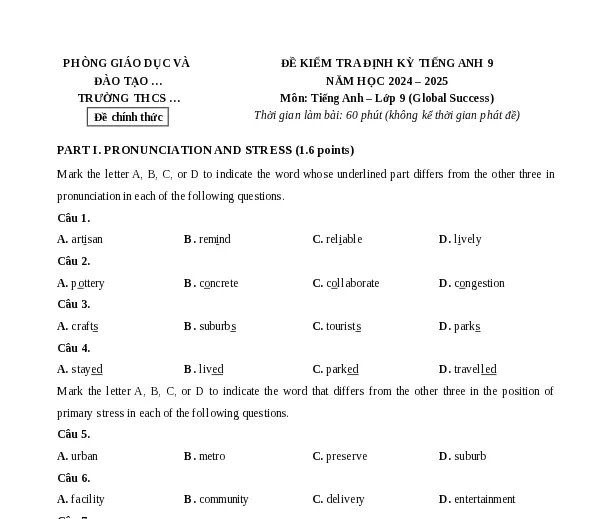
PART I. PHONETICS
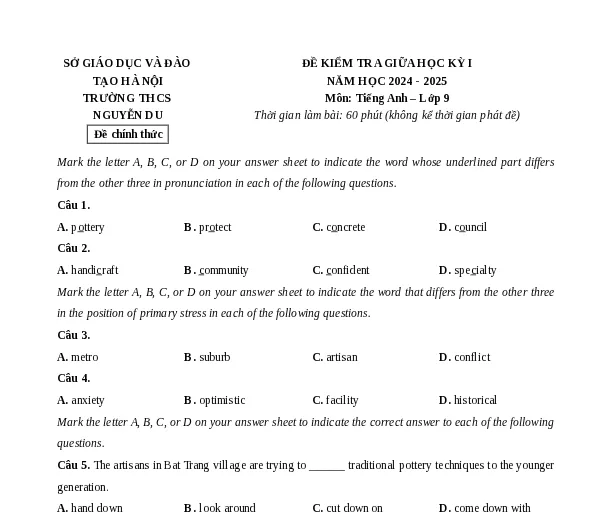
Mark the letter A, B, C or D on your answer sheet to indicate the word whose underlined part differs from the other three in pronunciation in each of the following questions.
Câu 1.
A. carve
B. cast
C. fast
D. back
Câu 2.
A. stitched
B. moulded
C. looked
D. walked
Mark the letter A, B, C or D on your answer sheet to indicate the word that differs from the other three in the position of primary stress in each of the following questions.
Câu 3.
A. artisan
B. pottery
C. attraction
D. handicraft
Câu 4.
A. conflict
B. resolve
C. depress
D. inform
PART II. LEXICO – GRAMMAR & COMMUNICATION
Mark the letter A, B, C or D on your answer sheet to indicate the correct answer to each of the following questions.
Câu 5. Bat Trang is one of the most famous traditional ______ villages in Ha Noi.
A. craft
B. crafting
C. crafted
D. crafter
Câu 6. The local artisans have to ______ the clay carefully before putting it into the kiln.
A. carve
B. mould
C. knit
D. weave
Câu 7. Many youth today suffer from ______ because of heavy study pressure and expectations from their parents.
A. delightful
B. stress
C. stressful
D. stressed
Câu 8. The government has decided to ______ the old conical hat workshop to attract more foreign tourists.
A. close down
B. pass down
C. set up
D. turn down
Câu 9. She has lived in this modern city for ten years, so she has ______ with the fast pace of life here.
A. got on well
B. kept up
C. run out
D. looked forward
Câu 10. Many teenagers do not know ______ to deal with stress and anxiety before important examinations.
A. what
B. when
C. how
D. why
Câu 11. ______ the artisan was quite old and weak, he still tried to teach the traditional skills to the younger generation.
A. Because
B. Although
C. In order that
D. In spite of
Câu 12. They decided to leave the village early ______ they could avoid the rush hour traffic.
A. so that
B. because
C. although
D. in order to
Câu 13. My grandfather told me that the embroidery technique had been ______ from generation to generation.
A. taken over
B. passed down
C. brought out
D. turned off
Câu 14. Living in a big city is much more ______ than living in the countryside.
A. convenient
B. conveniently
C. convenience
D. inconveniently
Câu 15. The artisans in Van Phuc village are famous for ______ silk products of premium quality.
A. weaving
B. knitting
C. carving
D. moulding
Câu 16. You should take a break after studying for hours; otherwise, you will easily get ______.
A. exhaust
B. exhaustion
C. exhausted
D. exhausting
Câu 17. The craft village was established in the 16th century, and it has maintained its reputation ______ then.
A. since
B. for
C. until
D. while
Câu 18. He asked his teacher ______ advice on how to improve his English pronunciation.
A. with
B. about
C. for
D. to
Câu 19. This brochure will give you some useful ______ about public transport in the city centre.
A. inform
B. information
C. informative
D. informatively
Câu 20. The doctor advised him to cut ______ on fast food to maintain a healthy lifestyle.
A. down
B. off
C. in
D. out
Mark the letter A, B, C or D on your answer sheet to indicate the most suitable response to complete each of the following exchanges.
Câu 21. Nam and Lan are talking about traditional handicrafts.
– Nam: "I think traditional craft villages should be preserved for future generations."
– Lan: "______! They reflect our national cultural identity."
A. You can say that again
B. I don't think so
C. It's not my problem
D. That's terrible
Câu 22. Mai is asking a shop assistant in a souvenir shop.
– Mai: "Could you show me how this lacquerware vase is made?"
– Shop assistant: "______"
A. Yes, it costs fifty dollars.
B. Certainly. Follow me to the workshop, please.
C. You are very welcome.
D. No, I don't like it at all.
PART III. ERROR IDENTIFICATION
Mark the letter A, B, C or D on your answer sheet to indicate the underlined part that needs correction in each of the following questions.
Câu 23. Although he was tired after a long journey, but he still visited the pottery workshop.
A. was
B. after
C. but
D. workshop
Câu 24. The artisan showed us how to mould clay into bowls, plates, and differently shapes.
A. showed
B. how
C. into
D. differently
Câu 25. You should talk to your parents about your problem because of they can give you helpful advice.
A. should
B. about
C. because of
D. you
PART IV. GUIDED CLOZE
Read the following passage and mark the letter A, B, C, or D on your answer sheet to indicate the correct word or phrase that best fits each of the numbered blanks from 26 to 30.
Doi Tam is a peaceful village situated at the foot of Doi Mountain in Ha Nam Province. It is widely known for its traditional craft of (26) ______ drums, which has existed for over a thousand years. According to historical records, the craft was first introduced to the village by two brothers, Nguyen Duc Nang and Nguyen Duc Dat, in the 10th century.
Making a high-quality drum requires great patience and skillful hands. The body of the drum is made (27) ______ jackfruit wood because this type of wood is durable and does not warp under changing weather conditions. The drumhead is made of carefully treated buffalo skin. Stretching the drumhead is the most challenging stage (28) ______ it directly determines the sound quality of the drum.
Nowadays, despite the rapid growth of modern musical instruments, Doi Tam drums are still in high (29) ______ across the country. They are used in traditional festivals, schools, and religious ceremonies. Many young villagers are enthusiastic about continuing the craft, which helps (30) ______ the precious cultural heritage of their ancestors.
Câu 26.
A. doing
B. making
C. producing
D. carving
Câu 27.
A. from
B. of
C. with
D. by
Câu 28.
A. although
B. so that
C. because
D. while
Câu 29.
A. demand
B. supply
C. order
D. interest
Câu 30.
A. preserve
B. demolish
C. turn down
D. pass away
PART V. READING COMPREHENSION
Read the following passage and mark the letter A, B, C, or D on your answer sheet to indicate the correct answer to each of the questions from 31 to 35.
Urbanisation is taking place at a rapid pace in many developing countries, including Viet Nam. Every year, thousands of people move from rural areas to major cities such as Ha Noi and Ho Chi Minh City in search of better employment opportunities, higher education, and improved living standards.
However, living in large metropolitan areas also brings numerous challenges. One of the most obvious drawbacks is traffic congestion. During peak hours, main streets and intersections are frequently packed with motorbikes, cars, and buses, leading to prolonged delays and high levels of stress for commuters. Furthermore, the immense volume of vehicles and industrial activities significantly contributes to severe air and noise pollution, which negatively impacts public health.
Another major issue is the lack of affordable housing. Due to the high density of population, house prices and rental costs have skyrocketed, making it extremely difficult for low-income workers and fresh graduates to find suitable accommodation. In addition, many people suffer from a lack of green spaces such as parks and recreational centres where they can relax after intense working hours.
In order to create a more livable urban environment, municipal authorities need to invest more in public transit systems, upgrade infrastructure, and expand public green spaces. At the same time, rural development should be promoted so that people can enjoy decent jobs and social services right in their hometowns without having to migrate to overcrowded cities.
Câu 31. What is the main idea of the passage?
A. Solutions to improve the economy in rural areas.
B. The benefits and drawbacks of living in modern cities.
C. Why people prefer living in the countryside to living in cities.
D. The history of urbanisation in Viet Nam.
Câu 32. According to paragraph 1, why do people move to major cities?
A. To enjoy clean air and quiet green spaces.
B. To seek better jobs, higher education, and living standards.
C. To experience traffic jams during peak hours.
D. To avoid working in agricultural production.
Câu 33. The word "skyrocketed" in paragraph 3 is closest in meaning to ______.
A. decreased slightly
B. stayed unchanged
C. increased rapidly
D. fallen sharply
Câu 34. According to paragraph 2, what is a direct consequence of heavy traffic and industrial activities?
A. Severe air and noise pollution.
B. The reduction of living expenses.
C. An increase in green parks and gardens.
D. Better public health conditions.
Câu 35. Which of the following is NOT mentioned as a solution to urban problems?
A. Investing more in public transit systems.
B. Upgrading urban infrastructure.
C. Forbidding citizens from moving into large cities.
D. Promoting rural development.
PART VI. SENTENCE TRANSFORMATION
Mark the letter A, B, C or D on your answer sheet to indicate the sentence that is closest in meaning to the original sentence in each of the following questions.
Câu 36. Although the weather was terrible, the artisans still went to the workshop on time.
A. Despite the terrible weather, the artisans still went to the workshop on time.
B. In spite of the weather was terrible, the artisans still went to the workshop on time.
C. Because the weather was terrible, the artisans went to the workshop on time.
D. The artisans went to the workshop on time so that the weather was terrible.
Câu 37. Lan started learning how to knit woollen scarves two months ago.
A. Lan has learned how to knit woollen scarves since two months.
B. Lan has learned how to knit woollen scarves for two months.
C. Lan began to knit woollen scarves for two months ago.
D. Lan is learning how to knit woollen scarves since two months.
Câu 38. The craft village is very crowded; therefore, we cannot find a parking space easily.
A. Because the craft village is very crowded, we can find a parking space easily.
B. Although the craft village is very crowded, we cannot find a parking space easily.
C. Since the craft village is very crowded, we cannot find a parking space easily.
D. We cannot find a parking space easily so that the craft village is very crowded.
Mark the letter A, B, C or D on your answer sheet to indicate the sentence that best combines each pair of sentences in the following questions.
Câu 39. Minh wants to speak English fluently. He practices speaking with foreign tourists every weekend.
A. Minh practices speaking with foreign tourists every weekend so that he can speak English fluently.
B. Minh practices speaking with foreign tourists every weekend although he wants to speak English fluently.
C. Minh practices speaking with foreign tourists every weekend because he can speak English fluently.
D. Minh wants to speak English fluently in order that he practices speaking every weekend.
Câu 40. Nick didn't prepare well for his midterm test. He felt extremely stressed and worried.
A. Nick felt extremely stressed and worried because of he didn't prepare well for his midterm test.
B. As Nick didn't prepare well for his midterm test, he felt extremely stressed and worried.
C. Nick didn't prepare well for his midterm test although he felt extremely stressed and worried.
D. Nick felt extremely stressed and worried so that he prepared well for his midterm test.
--------- HẾT ---------
Họ và tên thí sinh: ................................................ Số báo danh: ........................
HƯỚNG DẪN CHẤM VÀ ĐÁP ÁN CHI TIẾT
A. BẢNG ĐÁP ÁN (Mỗi câu đúng đạt 0,25 điểm – Tổng điểm: 10,0 điểm)
Câu | Đáp án | Câu | Đáp án | Câu | Đáp án | Câu | Đáp án |
|---|---|---|---|---|---|---|---|
1 | D | 11 | B | 21 | A | 31 | B |
2 | B | 12 | A | 22 | B | 32 | B |
3 | C | 13 | B | 23 | C | 33 | C |
4 | A | 14 | A | 24 | D | 34 | A |
5 | A | 15 | A | 25 | C | 35 | C |
6 | B | 16 | C | 26 | B | 36 | A |
7 | B | 17 | A | 27 | B | 37 | B |
8 | C | 18 | C | 28 | C | 38 | C |
9 | B | 19 | B | 29 | A | 39 | A |
10 | C | 20 | A | 30 | A | 40 | B |
B. HƯỚNG DẪN GIẢI CHI TIẾT
Câu | Nội dung giải thích | Điểm |
|---|---|---|
1 | D. "back" phát âm là /æ/, các từ còn lại phát âm là /ɑː/. | 0,25 |
2 | B. "moulded" có đuôi -ed phát âm là /ɪd/, các từ còn lại có đuôi -ed phát âm là /t/. | 0,25 |
3 | C. "attraction" có trọng âm rơi vào âm tiết thứ 2, các từ còn lại có trọng âm rơi vào âm tiết thứ 1. | 0,25 |
4 | A. "conflict" (danh từ) có trọng âm rơi vào âm tiết thứ 1, các từ còn lại có trọng âm rơi vào âm tiết thứ 2. | 0,25 |
5 | A. Cụm danh từ: "traditional craft village" (làng nghề thủ công truyền thống). | 0,25 |
6 | B. "mould the clay": nặn/nhào đất sét; "carve": chạm khắc; "weave": dệt; "knit": đan. | 0,25 |
7 | B. Sau động từ "suffer from" cần một danh từ chỉ bệnh/trạng thái: "stress" (sự căng thẳng). | 0,25 |
8 | C. Phrasal verb: "set up" (thành lập, mở xưởng); "close down" (đóng cửa hẳn); "pass down" (truyền lại). | 0,25 |
9 | B. "keep up with": bắt kịp, theo kịp nhịp sống; "get on well with": hoà hợp với ai. | 0,25 |
10 | C. Cấu trúc từ để hỏi + to-V: "know how to deal with stress" (biết cách giải toả căng thẳng). | 0,25 |
11 | B. Mệnh đề chỉ sự nhượng bộ: "Although + S + V" (Mặc dù...). | 0,25 |
12 | A. Mệnh đề chỉ mục đích: "so that + S + could/can + V" (để mà...). | 0,25 |
13 | B. "pass down from generation to generation": được truyền từ thế hệ này sang thế hệ khác. | 0,25 |
14 | A. Cấu trúc so sánh hơn với tính từ dài sau động từ to be: "much more convenient than". | 0,25 |
15 | A. "weave silk": dệt lụa; "knit": đan len; "mould": nặn; "carve": điêu khắc. | 0,25 |
16 | C. Cấu trúc: "get + adj": "get exhausted" (trở nên kiệt sức). | 0,25 |
17 | A. Dấu hiệu thì hiện tại hoàn thành: "since then" (kể từ đó). | 0,25 |
18 | C. Cụm từ: "ask somebody for advice" (hỏi xin ai lời khuyên). | 0,25 |
19 | B. Sau tính từ "useful" cần một danh từ không đếm được: "information" (thông tin). | 0,25 |
20 | A. Cụm động từ: "cut down on something" (cắt giảm cái gì). | 0,25 |
21 | A. "You can say that again" dùng để thể hiện sự hoàn toàn đồng ý với ý kiến của đối phương. | 0,25 |
22 | B. Đáp lại lời đề nghị giúp đỡ/chỉ dẫn một cách lịch sự: "Certainly. Follow me to the workshop, please." | 0,25 |
23 | C. Sửa but -> bỏ "but", vì câu đã bắt đầu bằng liên từ "Although". | 0,25 |
24 | D. Sửa differently thành different (tính từ) để bổ nghĩa cho danh từ "shapes". | 0,25 |
25 | C. Sửa because of thành because do phía sau là một mệnh đề (they can give you...). | 0,25 |
26 | B. Collocation: "making drums" (nghề làm trống). | 0,25 |
27 | B. "made of" dùng khi chất liệu tạo thành vật phẩm vẫn giữ nguyên tính chất và hình dạng nhận biết được. | 0,25 |
28 | C. "because" (bởi vì) dùng để bắt đầu mệnh đề chỉ nguyên nhân giải thích vì sao công đoạn này thử thách nhất. | 0,25 |
29 | A. Cụm từ cố định: "in high demand" (được nhiều người có nhu cầu, đắt hàng). | 0,25 |
30 | A. "preserve the precious cultural heritage" (gìn giữ di sản văn hoá quý giá). | 0,25 |
31 | B. Đoạn văn nêu lên lý do người dân di cư lên thành phố và những thách thức/vấn đề kèm giải pháp. | 0,25 |
32 | B. Dẫn chứng ở đoạn 1: "...in search of better employment opportunities, higher education, and improved living standards." | 0,25 |
33 | C. "skyrocketed" = tăng vọt nhanh chóng (= increased rapidly). | 0,25 |
34 | A. Dẫn chứng ở đoạn 2: "...contributes to severe air and noise pollution, which negatively impacts public health." | 0,25 |
35 | C. Phương án C (cấm người dân chuyển vào thành phố) không hề được nhắc đến trong đoạn cuối. | 0,25 |
36 | A. Cấu trúc tương đương: "Although + S + V" = "Despite + Noun phrase". | 0,25 |
37 | B. Chuyển đổi từ quá khứ đơn ("started ... ago") sang hiện tại hoàn thành ("has learned ... for two months"). | 0,25 |
38 | C. Chuyển đổi câu chỉ nguyên nhân kết quả: S + V; therefore, S + V = Since + S + V, S + V. | 0,25 |
39 | A. Kết hợp hai câu chỉ mục đích: dùng "so that + S + can + V". | 0,25 |
40 | B. Kết hợp câu chỉ nguyên nhân: "As + S + V" (Vì Nick không chuẩn bị kỹ bài thi...). | 0,25 |