SỞ GIÁO DỤC VÀ ĐÀO TẠO …
KỲ THI TUYỂN SINH LỚP 10 THPT
Đề tham khảo
ĐỀ THI TUYỂN SINH VÀO LỚP 10 THPT
NĂM HỌC 2025 – 2026
Môn thi: TIẾNG ANH
Thời gian làm bài: 60 phút, không kể thời gian phát đề
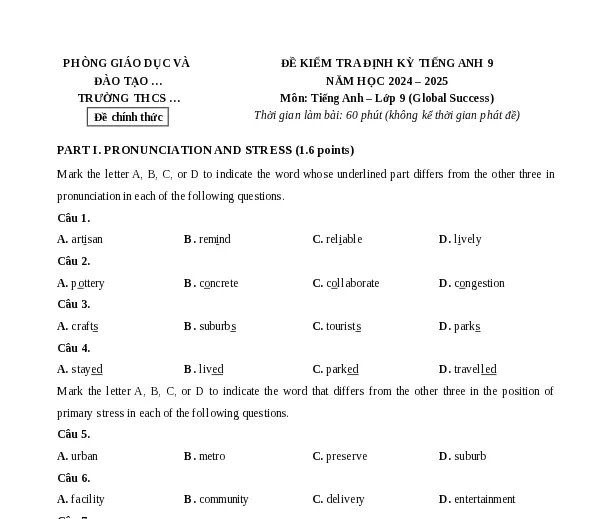
Mark the letter A, B, C, or D on your answer sheet to indicate the word whose underlined part differs from the other three in pronunciation in each of the following questions.
Câu 1.
A. looked
B. missed
C. decided
D. watched
Câu 2.
A. climate
B. primary
C. design
D. music
Mark the letter A, B, C, or D on your answer sheet to indicate the word that differs from the other three in the position of primary stress in each of the following questions.
Câu 3.
A. reduce
B. protect
C. cancel
D. provide
Câu 4.
A. traditional
B. environmental
C. communicate
D. congratulate
Mark the letter A, B, C, or D on your answer sheet to indicate the correct answer to each of the following questions.
Câu 5. She has been living in this modern city ______ 2018.
A. since
B. for
C. in
D. at
Câu 6. The historic temple ______ by thousands of foreign tourists every year.
A. visits
B. is visited
C. visited
D. was visiting
Câu 7. If we continue to pollute the ocean, many marine species ______ their habitats.
A. will lose
B. lost
C. would lose
D. have lost
Câu 8. The artisan ______ created this beautiful conical hat lives in Chuong village.
A. which
B. whom
C. whose
D. who
Câu 9. We decided to go on a picnic in the botanical garden ______ it was raining heavily.
A. because
B. although
C. in spite of
D. therefore
Câu 10. Many teenagers are passionate about ______ part in voluntary community projects.
A. take
B. taking
C. to take
D. took
Câu 11. You should remember to ______ the lights and electrical appliances before leaving the room.
A. turn off
B. look after
C. give up
D. go on
Câu 12. The government is making every effort to preserve local ______ and cultural heritage.
A. tradition
B. traditionally
C. traditions
D. traditionalist
Câu 13. Peter suggested ______ reusable bags instead of single-use plastic bags when shopping.
A. to use
B. using
C. used
D. use
Câu 14. This new mobile application is very ______ for students who want to improve their pronunciation.
A. useful
B. harmful
C. helpless
D. stressful
Mark the letter A, B, C, or D on your answer sheet to indicate the most suitable response to complete each of the following exchanges.
Câu 15. Jane and Mark are talking about their weekend plans.
Jane: "Would you like to join our green club cleanup campaign this Sunday?"
Mark: "______"
A. Yes, I'd love to. Thanks!
B. Never mind.
C. You're welcome.
D. It's not my fault.
Câu 16. David is complimenting Linda on her presentation.
David: "Congratulations! You gave an excellent presentation on renewable energy."
Linda: "______"
A. Not at all.
B. It's very kind of you to say so.
C. I don't care about it.
D. Sure, go ahead.
Mark the letter A, B, C, or D on your answer sheet to indicate the word(s) CLOSEST in meaning to the underlined word(s) in each of the following questions.
Câu 17. The local authority decided to renovate the ancient pagoda to attract more visitors.
A. destroy
B. rebuild
C. repair
D. sell
Mark the letter A, B, C, or D on your answer sheet to indicate the word(s) OPPOSITE in meaning to the underlined word(s) in each of the following questions.
Câu 18. Modern electric cars are considered highly economical because they consume much less energy.
A. costly
B. cheap
C. effective
D. convenient
Mark the letter A, B, C, or D on your answer sheet to indicate the underlined part that needs correction in each of the following questions.
Câu 19. My younger sister enjoys to read science-fiction novels in her free time.
A. younger sister
B. enjoys
C. read
D. her
Câu 20. The doctor advised him exercising regularly and eat a well-balanced diet.
A. advised
B. exercising
C. eat
D. well-balanced
Read the following passage and mark the letter A, B, C, or D on your answer sheet to indicate the correct word or phrase that best fits each of the numbered blanks from 21 to 25.
Living in a smart city offers numerous advantages for modern citizens. In these urban areas, digital technology is applied to improve public services and make better use of resources. For example, intelligent traffic systems can reduce congestion (21) ______ providing real-time data to commuters. Furthermore, street lights automatically dim when there are no pedestrians, (22) ______ helps save a significant amount of electricity.
Citizens can also access administrative services online without having to wait in long queues. (23) ______, smart cities face some major challenges. One of the primary concerns is cybersecurity, as massive amounts of personal information are stored on central servers. If these networks are attacked, residents' private data could be (24) ______. Therefore, local governments must invest heavily in high-tech security systems to protect their people. In conclusion, while smart cities make life more comfortable, ensuring data safety remains a top (25) ______ for city planners.
Câu 21.
A. by
B. with
C. on
D. for
Câu 22.
A. who
B. which
C. where
D. that
Câu 23.
A. Although
B. However
C. Because
D. Moreover
Câu 24.
A. stolen
B. restored
C. improved
D. produced
Câu 25.
A. danger
B. interest
C. priority
D. problem
Read the following passage and mark the letter A, B, C, or D on your answer sheet to indicate the correct answer to each of the questions from 26 to 33.
Coral reefs are among the most diverse and valuable ecosystems on Earth. Often referred to as the "rainforests of the sea", they occupy less than one percent of the ocean floor, yet they provide a home for more than twenty-five percent of all marine species. A healthy coral reef supports thousands of fish species, crustaceans, mollusks, and sea turtles.
In addition to their ecological richness, coral reefs play a crucial role in protecting coastlines. They act as natural barriers, reducing the impact of strong waves, tropical storms, and coastal erosion. By absorbing wave energy, reefs prevent property damage and save coastal communities millions of dollars each year. Furthermore, millions of people worldwide depend on coral reefs for food and employment, especially in the fishing and tourism industries.
Unfortunately, coral reefs are facing severe threats from human activities and global climate change. Rising ocean temperatures cause coral bleaching, a phenomenon where corals expel the beneficial algae living in their tissues, causing them to turn completely white. If water temperatures remain high for too long, the corals eventually die. In addition, water pollution, destructive fishing practices, and plastic waste have caused irreversible damage to these fragile habitats.
Scientists estimate that if global warming continues at the current rate, most of the world's coral reefs could be destroyed within the next few decades. To prevent this catastrophe, international cooperation is urgently needed. Countries must reduce greenhouse gas emissions, establish marine protected areas, and ban harmful fishing methods. Individuals can also contribute by reducing plastic consumption and supporting ecotourism.
Câu 26. What is the best title for the passage?
A. The Development of the World's Fishing Industry
B. Coral Reefs: Importance, Threats, and Conservation
C. How Global Climate Change Affects Coastal Tourism
D. The Marine Species of the Deep Pacific Ocean
Câu 27. According to paragraph 1, coral reefs occupy ______ of the ocean floor.
A. under 1%
B. exactly 25%
C. over 50%
D. nearly 75%
Câu 28. The phrase "rainforests of the sea" in paragraph 1 indicates that coral reefs are ______.
A. extremely cold and wet
B. full of tall trees and plants
C. rich in biological diversity
D. dangerous for humans to explore
Câu 29. The word They in paragraph 2 refers to ______.
A. coastlines
B. coral reefs
C. strong waves
D. coastal communities
Câu 30. According to paragraph 2, how do coral reefs protect coastlines?
A. By warning local residents about sudden earthquakes
B. By generating electricity from ocean currents
C. By weakening the force of waves and storms
D. By preventing all marine animals from reaching the shore
Câu 31. The word catastrophe in paragraph 4 is closest in meaning to ______.
A. disaster
B. achievement
C. opportunity
D. tradition
Câu 32. Which of the following is NOT mentioned in paragraph 3 as a threat to coral reefs?
A. Rising water temperatures
B. Plastic waste
C. Destructive fishing methods
D. Noise from commercial ships
Câu 33. Which of the following can be inferred from the passage?
A. Corals can easily survive even if the ocean temperature rises continuously.
B. Only governments can help solve the problem of coral reef degradation.
C. Protecting coral reefs is essential for both nature and human communities.
D. Marine protected areas have completely eliminated ocean pollution.
Mark the letter A, B, C, or D on your answer sheet to indicate the sentence that is closest in meaning to each of the following questions.
Câu 34. "I will visit my grandparents in the countryside tomorrow," Peter said.
A. Peter said that he would visit his grandparents in the countryside the next day.
B. Peter said that I will visit my grandparents in the countryside tomorrow.
C. Peter said that he visited his grandparents in the countryside the following day.
D. Peter said that he will visit his grandparents in the countryside yesterday.
Câu 35. No student in our class is taller than Nam.
A. Nam is as tall as any student in our class.
B. Nam is the tallest student in our class.
C. Some students in our class are taller than Nam.
D. Nam is not as tall as other students in our class.
Câu 36. They last renovated this community hall five years ago.
A. They haven't renovated this community hall for five years.
B. They have renovated this community hall for five years.
C. They didn't renovate this community hall five years ago.
D. They renovated this community hall since five years.
Câu 37. You are not allowed to step on the grass in the park.
A. You shouldn't step on the grass in the park.
B. You needn't step on the grass in the park.
C. You mustn't step on the grass in the park.
D. You may not step on the grass in the park.
Mark the letter A, B, C, or D on your answer sheet to indicate the sentence that best combines each pair of sentences in the following questions.
Câu 38. The weather was very cold. The students still went on a camping trip.
A. Because the weather was very cold, the students went on a camping trip.
B. Despite the cold weather, the students still went on a camping trip.
C. In spite of the weather was very cold, the students still went on a camping trip.
D. The students went on a camping trip so that the weather was very cold.
Câu 39. The boy doesn't study hard. He doesn't get good grades.
A. If the boy studied hard, he would get good grades.
B. If the boy doesn't study hard, he won't get good grades.
C. Unless the boy studied hard, he would get good grades.
D. If the boy studies hard, he wouldn't get good grades.
Câu 40. The woman is a famous environmentalist. We met her at the conference yesterday.
A. The woman whom we met at the conference yesterday is a famous environmentalist.
B. The woman whose we met at the conference yesterday is a famous environmentalist.
C. The woman which we met at the conference yesterday is a famous environmentalist.
D. The woman where we met at the conference yesterday is a famous environmentalist.
--------- HẾT ---------
Họ và tên thí sinh: ................................................................ Số báo danh: ........................
HƯỚNG DẪN CHẤM VÀ ĐÁP ÁN
ĐỀ THI TUYỂN SINH VÀO LỚP 10 THPT – MÔN: TIẾNG ANH
BẢNG ĐÁP ÁN VÀ THANG ĐIỂM (0,25 điểm/câu)
Câu | Đáp án | Câu | Đáp án | Câu | Đáp án | Câu | Đáp án |
|---|---|---|---|---|---|---|---|
1 | C | 11 | A | 21 | A | 31 | A |
2 | D | 12 | C | 22 | B | 32 | D |
3 | C | 13 | B | 23 | B | 33 | C |
4 | B | 14 | A | 24 | A | 34 | A |
5 | A | 15 | A | 25 | C | 35 | B |
6 | B | 16 | B | 26 | B | 36 | A |
7 | A | 17 | C | 27 | A | 37 | C |
8 | D | 18 | A | 28 | C | 38 | B |
9 | B | 19 | C | 29 | B | 39 | A |
10 | B | 20 | B | 30 | C | 40 | A |
GIẢI THÍCH CHI TIẾT
- Câu 1. C. Đuôi -ed phát âm là /ɪd/ sau /d/ (decided); các từ còn lại phát âm là /t/ sau các âm vô thanh /k, s, tʃ/.
- Câu 2. D. Chữ "i" phát âm là /ɪ/ (music /ˈmjuːzɪk/); các từ còn lại phát âm là /aɪ/ (climate, primary, design).
- Câu 3. C. Trọng âm rơi vào âm tiết thứ nhất (/ˈkænsəl/); các từ còn lại rơi vào âm tiết thứ 2 (reduce /rɪˈdjuːs/, protect /prəˈtekt/, provide /prəˈvaɪd/).
- Câu 4. B. Trọng âm rơi vào âm tiết thứ 3 (/ɪnˌvaɪrənˈmentəl/); các từ còn lại rơi vào âm tiết thứ 2 (traditional /trəˈdɪʃənl/, communicate /kəˈmjuːnɪkeɪt/, congratulate /kənˈɡrætʃəleɪt/).
- Câu 5. A. Dấu hiệu thì hiện tại hoàn thành với mốc thời gian: since + mốc thời gian (2018).
- Câu 6. B. Câu bị động thì hiện tại đơn: is/am/are + V3/ed (chủ ngữ số ít The historic temple).
- Câu 7. A. Câu điều kiện loại 1: If + S + V(hiện tại đơn), S + will/can + V(nguyên mẫu).
- Câu 8. D. Đại từ quan hệ thay thế cho danh từ chỉ người (The artisan) đóng vai trò chủ ngữ trong mệnh đề quan hệ: dùng who.
- Câu 9. B. Liên từ chỉ sự nhượng bộ: although + clause (mặc dù trời mưa to).
- Câu 10. B. Giới từ đi với danh động từ: be passionate about + V-ing (đam mê tham gia).
- Câu 11. A. Cụm động từ: turn off (tắt đèn/thiết bị điện); look after (chăm sóc); give up (từ bỏ); go on (tiếp tục).
- Câu 12. C. Sau tính từ local cần một danh từ số nhiều tương ứng với liên từ and cultural heritage: local traditions (những truyền thống địa phương).
- Câu 13. B. Cấu trúc gợi ý: suggest + V-ing (gợi ý làm gì).
- Câu 14. A. Tính từ mang nghĩa tích cực phù hợp ngữ cảnh: useful for somebody (hữu ích cho ai).
- Câu 15. A. Đáp lại lời mời lịch sự "Would you like to...": "Yes, I'd love to. Thanks!".
- Câu 16. B. Đáp lại lời khen/chúc mừng: "It's very kind of you to say so." (Bạn thật tốt khi nói như vậy).
- Câu 17. C. renovate (sửa chữa, nâng cấp) đồng nghĩa với repair.
- Câu 18. A. economical (tiết kiệm, kinh tế) trái nghĩa với costly (đắt đỏ, tốn kém).
- Câu 19. C. Cấu trúc enjoy + V-ing -> sửa read thành reading.
- Câu 20. B. Cấu trúc advise somebody to do something -> sửa exercising thành to exercise.
- Câu 21. A. Giới từ chỉ phương thức: by + V-ing (bằng cách cung cấp dữ liệu).
- Câu 22. B. Đại từ quan hệ which đứng sau dấu phẩy dùng để thay thế cho cả mệnh đề phía trước.
- Câu 23. B. Trạng từ liên kết chỉ sự tương phản đứng đầu câu sau dấu chấm và trước dấu phẩy: However (Tuy nhiên).
- Câu 24. A. Ngữ cảnh bị tấn công mạng: dữ liệu cá nhân có nguy cơ bị đánh cắp (stolen).
- Câu 25. C. Cụm từ: a top priority (một ưu tiên hàng đầu).
- Câu 26. B. Tiêu đề bao quát toàn bài: rạn san hô về tầm quan trọng, các mối đe dọa và biện pháp bảo tồn.
- Câu 27. A. Chi tiết ở đoạn 1: "...they occupy less than one percent of the ocean floor".
- Câu 28. C. Rừng nhiệt đới nổi tiếng vì sự đa dạng sinh học phong phú, do đó san hô được ví như "rainforests of the sea" vì sự đa dạng sinh học biển của chúng.
- Câu 29. B. Đại từ They ở đầu đoạn 2 thay thế cho danh từ coral reefs ở câu trước đó.
- Câu 30. C. Thông tin ở đoạn 2: "...reducing the impact of strong waves, tropical storms... By absorbing wave energy...".
- Câu 31. A. catastrophe (thảm họa) đồng nghĩa với disaster.
- Câu 32. D. Trong đoạn 3 không đề cập đến tiếng ồn từ tàu thuyền (noise from commercial ships).
- Câu 33. C. Suy luận hợp lý: San hô bảo vệ bờ biển, cung cấp thức ăn, thu nhập và chỗ ở cho sinh vật biển, do đó bảo vệ san hô là cần thiết cho cả tự nhiên và con người.
- Câu 34. A. Câu gián tiếp dạng trần thuật: đổi ngôi I -> he, lùi thì will -> would, trạng từ tomorrow -> the next day.
- Câu 35. B. Chuyển đổi từ so sánh hơn sang so sánh nhất: "Không có ai cao hơn Nam" = "Nam là học sinh cao nhất lớp".
- Câu 36. A. Cấu trúc: S + last + V2/ed + ... + ago = S + have/has not + V3/ed + for + thời gian.
- Câu 37. C. be not allowed to + V (không được phép) = mustn't + V (cấm không được làm gì).
- Câu 38. B. Kết hợp câu chỉ sự tương phản: Despite + cụm danh từ (the cold weather), clause.
- Câu 39. A. Câu điều kiện loại 2 diễn tả sự việc trái ngược với thực tế ở hiện tại: If + S + V2/ed, S + would + V.
- Câu 40. A. Mệnh đề quan hệ xác định: whom thay thế cho tân ngữ chỉ người (the woman).