SỞ GIÁO DỤC VÀ ĐÀO TẠO HÀ NỘI
TRƯỜNG THCS NGUYỄN DU
Đề tham khảo
ĐỀ KHẢO SÁT CHẤT LƯỢNG HỌC KỲ I - LỚP 9
Môn: Tiếng Anh (Chương trình nâng cao)
Thời gian làm bài: 60 phút (Không kể thời gian phát đề)
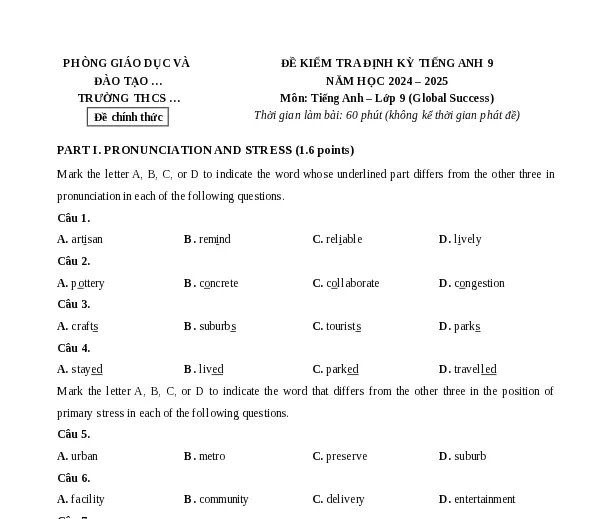
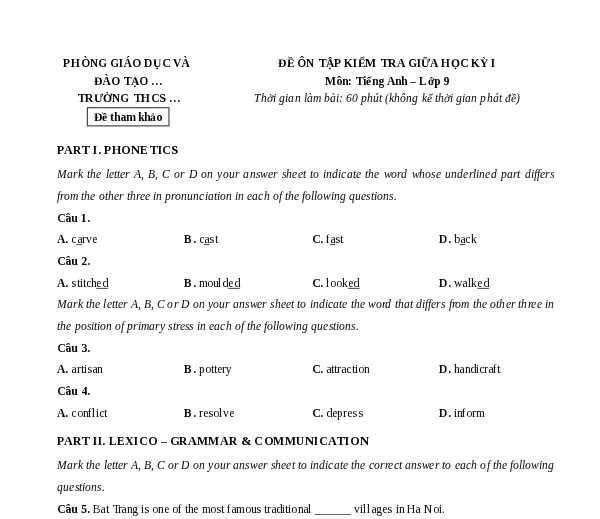
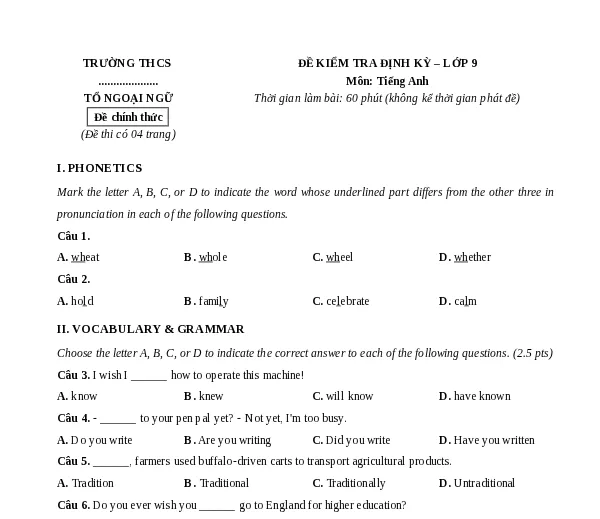
Mark the letter A, B, C, or D on your answer sheet to indicate the word whose underlined part differs from the other three in pronunciation in each of the following questions.
Câu 1.
A. looked
B. naked
C. laughed
D. booked
Câu 2.
A. beloved
B. wicked
C. hated
D. stopped
Câu 3.
A. breathes
B. bathes
C. clothes
D. breaths
Mark the letter A, B, C, or D on your answer sheet to indicate the word that differs from the other three in the position of primary stress in each of the following questions.
Câu 4.
A. canal
B. purpose
C. standard
D. surface
Câu 5.
A. politics
B. deposit
C. mechanic
D. semester
Câu 6.
A. photography
B. certificate
C. geothermal
D. eliminate
Mark the letter A, B, C, or D on your answer sheet to indicate the correct answer to each of the following questions.
Câu 7. The teacher, as well as all of his thirty students, ______ invited to the international educational symposium held in Da Nang yesterday.
A. were
B. was
C. have been
D. are
Câu 8. Not only the principal but also the board members ______ strongly opposed to adopting the new regulation at the last meeting.
A. was
B. has been
C. were
D. is
Câu 9. Physics, along with mathematics and chemistry, ______ considered a core subject in the STEM curriculum nowadays.
A. are
B. were
C. is
D. have been
Câu 10. On the top of the hill ______ the ancient pagoda which has attracted pilgrims for centuries.
A. does stand
B. stands
C. is standing
D. stand
Câu 11. Only after finishing all the household chores ______ allowed to hang out with his close classmates.
A. he was
B. was he
C. did he
D. had he been
Câu 12. The soup that your grandmother cooked smells exceptionally ______; everyone is eager to try it.
A. delicious
B. deliciously
C. more deliciously
D. being delicious
Câu 13. Despite running out of breath after the sprint, he tried to look ______ so as not to worry his coach.
A. calmly
B. calmness
C. calm
D. being calm
Câu 14. My father stopped ______ ten years ago because the doctor warned him about his severe lung condition.
A. to smoke
B. smoking
C. smoke
D. smoked
Câu 15. On her way home from the craft village, Linda stopped ______ a traditional conical hat as a souvenir for her mother.
A. buying
B. to buy
C. buy
D. bought
Câu 16. We deeply regret ______ you that your application for the high school scholarship has not been successful.
A. informing
B. to inform
C. inform
D. to have informed
Câu 17. I still remember ______ Hue Imperial City with my grandparents when I was merely seven years old.
A. visiting
B. to visit
C. visit
D. to visiting
Câu 18. Remember ______ off all electrical appliances before leaving the classroom, class monitor!
A. turning
B. to turn
C. turn
D. to be turned
Câu 19. This heavy wooden door is used ______ the inner sanctuary from intruders, not for regular entrance.
A. to protect
B. to protecting
C. protecting
D. protect
Câu 20. Having lived in London for five years, Nam is quite used ______ on the left side of the road.
A. to drive
B. driving
C. to driving
D. drive
Câu 21. It was in this small workshop ______ my grandfather created his very first ceramic masterpiece.
A. which
B. where
C. that
D. in that
Câu 22. Mr. Henderson, ______ opinion on urban architecture we all respect, has just published a new research paper.
A. whose
B. who
C. whom
D. that
Câu 23. Ha Long Bay, ______ is recognized as a UNESCO World Heritage site, attracts millions of travelers every year.
A. that
B. which
C. where
D. what
Câu 24. It is essential that every student ______ the school regulations carefully before the academic year begins.
A. reads
B. read
C. will read
D. reading
Câu 25. The local authorities suggested that historical relics in the village ______ immediately to prevent deterioration.
A. restore
B. must restore
C. be restored
D. are restored
Câu 26. But for his timely advice, I ______ into such a serious financial crisis during my startup project.
A. wouldn't fall
B. would have fallen
C. had fallen
D. will fall
Mark the letter A, B, C, or D on your answer sheet to indicate the underlined part that needs correction in each of the following questions.
Câu 27. Neither the teacher nor his students was aware of the unexpected schedule change yesterday.
A. Neither
B. nor
C. was
D. yesterday
Câu 28. The number of vehicles on Hanoi streets have increased dramatically over the past few years.
A. The number of
B. have
C. over
D. years
Câu 29. Because of his serious illness, the doctor advised that he stays in bed for at least three days.
A. Because of
B. stays
C. for
D. three days
Câu 30. It was yesterday morning when Jane accidentally met her former headmaster at the bus station.
A. It was
B. when
C. accidentally met
D. at the bus station
Câu 31. Lan has got used to wake up early in the morning to revise lessons for the entrance exam.
A. has got used to
B. wake
C. in the morning
D. for the entrance exam
Câu 32. The craftsman, whose you met at the trade fair last week, has been making lacquerware for three decades.
A. whose
B. last week
C. for
D. decades
Read the following passage and mark the letter A, B, C, or D on your answer sheet to indicate the correct word or phrase that best fits each of the numbered blanks from 33 to 37.
Bat Trang, an ancient pottery village located on the outskirts of Hanoi, boasts a long-standing history dating back to the 14th century. Unlike modern industrial production lines, the artisans here rely primarily on manual techniques passed down from generation to generation. Each ceramic product represents not merely craftsmanship, (33) ______ the profound spiritual values of Vietnamese folk culture.
Over the last few decades, the village has witnessed significant socio-economic transformations. In order to cater to contemporary aesthetic demands, local craftsmen have introduced diverse glaze formulas and modern kilns. (34) ______, maintaining traditional authenticity remains their utmost priority. A great number of foreign tourists visiting the village are fascinated (35) ______ how clay is shaped meticulously on the potter's wheel. Many young apprentices, (36) ______ passion for traditional arts is inspiring, have taken over their family workshops. It is crucial that the younger generation (37) ______ opportunities to preserve and promote this invaluable intangible cultural heritage in the era of globalization.
Câu 33.
A. but also
B. and also
C. as well
D. or else
Câu 34.
A. Therefore
B. However
C. Furthermore
D. In contrast
Câu 35.
A. with
B. at
C. by
D. about
Câu 36.
A. who
B. whose
C. whom
D. which
Câu 37.
A. is given
B. be given
C. are given
D. gives
Read the following passage and mark the letter A, B, C, or D on your answer sheet to indicate the correct answer to each of the questions from 38 to 42.
Urbanization in major Southeast Asian metropolises, including Hanoi and Ho Chi Minh City, has been accelerating at an unprecedented pace over recent decades. While this rapid transformation stimulates economic vitality and offers lucrative employment prospects, it inadvertently gives rise to multifaceted environmental and infrastructural dilemmas. Among the most pressing concerns are chronic traffic congestion, escalating air pollution levels, and severe shortages of public green spaces.
Airborne particulate matter, particularly PM2.5, has emerged as a detrimental hazard to public respiratory well-being. Epidemiological surveys indicate that vehicular emissions, rampant construction activities, and outdated industrial plants around suburban rings constitute the chief contributors to this airborne contamination. To mitigate these hazards, urban planners have proposed decentralizing governmental and educational institutions away from historical urban cores toward satellite townships.
Furthermore, shifting communal commuting habits from private motorbikes to eco-friendly mass transit systems—such as elevated skytrains and metro rail lines—is considered a strategic remedy. Nonetheless, persuading citizens to forgo personal vehicles proves arduous unless public transit networks achieve comprehensive punctuality, affordability, and seamless connectivity. Without synchronized structural reforms, environmental degradation will continually undermine the overall life quality of city inhabitants.
Câu 38. Which of the following best serves as the title for the passage?
A. The Advantages of Economic Growth in Hanoi and Ho Chi Minh City
B. Urbanization in Major Metropolises: Challenges and Mitigation Strategies
C. The History of Mass Transit Infrastructure in Southeast Asia
D. Air Pollution: The Sole Threat to Public Well-Being
Câu 39. The word "escalating" in paragraph 1 is closest in meaning to ______.
A. fluctuating
B. decreasing
C. mounting
D. disappearing
Câu 40. According to paragraph 2, which of the following is NOT cited as a major contributor to PM2.5 pollution?
A. Rampant construction projects
B. Exhaust emissions from transport vehicles
C. Outdated manufacturing facilities in outer districts
D. Decentralized educational campuses
Câu 41. The word "arduous" in paragraph 3 mostly means ______.
A. effortless
B. demanding
C. instantaneous
D. practical
Câu 42. Which can be inferred from the final paragraph regarding mass transit adoption?
A. Citizens will naturally stop using motorbikes regardless of metro convenience.
B. Public transport usage hinges upon its reliability, integration, and low cost.
C. Elevated skytrains have completely eliminated traffic jams in downtown areas.
D. Synchronized structural reforms have already been accomplished across all cities.
Mark the letter A, B, C, or D on your answer sheet to indicate the sentence that is closest in meaning to each of the following questions.
Câu 43. "Why don't we organize a workshop on preserving traditional folk songs this weekend?" said Mark.
A. Mark suggested that they should organize a workshop on preserving traditional folk songs that weekend.
B. Mark insisted on organizing a workshop on preserving traditional folk songs this weekend.
C. Mark asked why we didn't organize a workshop on preserving traditional folk songs that weekend.
D. Mark advised us not to organize a workshop on preserving traditional folk songs that weekend.
Câu 44. It is obligatory for all ninth-grade candidates to submit their examination registration forms before Friday.
A. All ninth-grade candidates may submit their examination registration forms before Friday.
B. All ninth-grade candidates must submit their examination registration forms before Friday.
C. All ninth-grade candidates shouldn't submit their examination registration forms before Friday.
D. All ninth-grade candidates need to have submitted their examination registration forms before Friday.
Câu 45. People believe that the artisan designed this bronze bell during the 18th century.
A. The bronze bell is believed to design during the 18th century.
B. The bronze bell is believed to have been designed during the 18th century.
C. The artisan was believed to design this bronze bell during the 18th century.
D. It was believed that the artisan designed this bronze bell during the 18th century.
Câu 46. I have never witnessed such an impressive fireworks display in my hometown before.
A. This is the most impressive fireworks display I had ever witnessed in my hometown.
B. This is the first time I have ever witnessed such an impressive fireworks display in my hometown.
C. Never before have I witnessed an impressive fireworks display like this last year.
D. I used to witness a more impressive fireworks display in my hometown before.
Mark the letter A, B, C, or D on your answer sheet to indicate the sentence that best combines each pair of sentences in the following questions.
Câu 47. The weather was extremely stormy. The salvage team managed to rescue all stranded fishermen safely.
A. Stormy though the weather was, the salvage team managed to rescue all stranded fishermen safely.
B. Despite the weather was stormy, the salvage team managed to rescue all stranded fishermen safely.
C. So stormy was the weather that the salvage team couldn't rescue any stranded fishermen safely.
D. But for the stormy weather, the salvage team could have rescued all stranded fishermen safely.
Câu 48. He did not realize how precious his health was. He only recognized it after his recovery from the severe surgery.
A. Not until he recovered from the severe surgery did he realize how precious his health was.
B. Only when did he recover from the severe surgery did he realize how precious his health was.
C. It was not until did he recover from the severe surgery that he realized how precious his health was.
D. No sooner had he realized how precious his health was than he recovered from the surgery.
Câu 49. The old craftsman lacked sufficient capital. He couldn't expand his family pottery workshop.
A. If the old craftsman had had sufficient capital, he couldn't have expanded his family pottery workshop.
B. Had the old craftsman had sufficient capital, he could have expanded his family pottery workshop.
C. Were the old craftsman to have sufficient capital, he could expand his family pottery workshop.
D. Unless the old craftsman had lacked capital, he could have expanded his family pottery workshop.
Câu 50. Nam has outstanding academic records. His twin brother consistently struggles with basic science concepts.
A. Nam has outstanding academic records; therefore, his twin brother consistently struggles with basic science concepts.
B. Whereas Nam has outstanding academic records, his twin brother consistently struggles with basic science concepts.
C. Because Nam has outstanding academic records, his twin brother consistently struggles with basic science concepts.
D. Nam has outstanding academic records in spite of his twin brother struggles with basic science concepts.
--------- HẾT ---------
Họ và tên thí sinh: ................................................................ Số báo danh: ........................
HƯỚNG DẪN CHẤM VÀ ĐÁP ÁN CHI TIẾT
A. BẢNG ĐÁP ÁN (0,2 điểm / câu)
Câu | Đ/A | Câu | Đ/A | Câu | Đ/A | Câu | Đ/A | Câu | Đ/A |
|---|---|---|---|---|---|---|---|---|---|
1 | B | 11 | B | 21 | C | 31 | B | 41 | B |
2 | D | 12 | A | 22 | A | 32 | A | 42 | B |
3 | D | 13 | C | 23 | B | 33 | A | 43 | A |
4 | A | 14 | B | 24 | B | 34 | B | 44 | B |
5 | A | 15 | B | 25 | C | 35 | C | 45 | B |
6 | C | 16 | B | 26 | B | 36 | B | 46 | B |
7 | B | 17 | A | 27 | C | 37 | B | 47 | A |
8 | C | 18 | B | 28 | B | 38 | B | 48 | A |
9 | C | 19 | A | 29 | B | 39 | C | 49 | B |
10 | B | 20 | C | 30 | B | 40 | D | 50 | B |
B. PHÂN TÍCH VÀ GIẢI MÃ CÁC "BẪY NGỮ PHÁP"
Câu 1. Chọn B.
- Bẫy: Học sinh thấy từ kết thúc bằng "k" (`look`, `laugh` /f/, `book`) thường áp dụng quy tắc máy móc: sau âm vô thanh đọc là /t/.
- Giải mã: `naked` /ˈneɪkɪd/ là tính từ đặc biệt có đuôi -ed phát âm là /ɪd/. Các phương án còn lại đọc là /t/: `looked` /lʊkt/, `laughed` /lɑːft/, `booked` /bʊkt/.
Câu 2. Chọn D.
- Bẫy: Nhầm đuôi -ed của tính từ ngoại lệ với quy tắc động từ thường.
- Giải mã: `beloved` /bɪˈlʌvɪd/, `wicked` /ˈwɪkɪd/, `hated` /ˈheɪtɪd/ đều có đuôi -ed phát âm là /ɪd/. Riêng `stopped` /stɒpt/ phát âm là /t/.
Câu 3. Chọn D.
- Bẫy: Đuôi -es sau chữ cái "th".
- Giải mã: Danh từ số nhiều `breaths` phát âm là /breθs/ (kết thúc bằng âm /θ/ vô thanh nên thêm "s" đọc là /s/). Ba từ còn lại: `breathes` /briːðz/, `bathes` /beɪðz/, `clothes` /kləʊðz/ đều kết thúc bằng âm hữu thanh /ð/ nên đuôi đọc là /z/.
Câu 4. Chọn A.
- Bẫy: Nhìn từ `canal` hai âm tiết tưởng danh từ thì nhấn âm 1.
- Giải mã: `canal` /kəˈnæl/ trọng âm rơi vào âm tiết 2 (ngoại lệ). Ba từ còn lại: `purpose` /ˈpɜːpəs/, `standard` /ˈstændəd/, `surface` /ˈsɜːfɪs/ đều có trọng âm rơi vào âm tiết 1.
Câu 5. Chọn A.
- Bẫy: Nhầm hậu tố `-ics` luôn làm trọng âm rơi vào âm liền trước.
- Giải mã: `politics` /ˈpɒlətɪks/ có trọng âm rơi vào âm 1 (ngoại lệ danh từ đuôi -ics). Các từ còn lại: `deposit` /dɪˈpɒzɪt/, `mechanic` /mɪˈkænɪk/, `semester` /sɪˈmestə/ đều nhấn âm tiết 2.
Câu 6. Chọn C.
- Bẫy: Đếm âm tiết máy móc.
- Giải mã: `geothermal` /ˌdʒiːəʊˈθɜːml/ nhấn âm tiết 3. Các từ còn lại: `photography` /fəˈtɒɡrəfi/, `certificate` /səˈtɪfɪkət/, `eliminate` /ɪˈlɪmɪneɪt/ đều nhấn âm tiết 2.
Câu 7. Chọn B.
- Bẫy: Nhìn thấy `thirty students` ở ngay trước chỗ trống nên vội vàng chia số nhiều (`were`).
- Giải mã: Cấu trúc chủ ngữ nối bởi `S1 + as well as / along with / together with + S2`: động từ hòa hợp theo S1 (`The teacher` - số ít). Mốc thời gian `yesterday` nên dùng thì Quá khứ đơn: `was`.
Câu 8. Chọn C.
- Bẫy: Nhớ nhầm quy tắc hòa hợp của `not only... but also...`.
- Giải mã: Cấu trúc `Not only S1 but also S2 + V`: động từ chia theo S2 gần nhất (`the board members` - danh từ số nhiều) chia `were`.
Câu 9. Chọn C.
- Bẫy: Từ `Physics` có tận cùng bằng "s" và có cụm liệt kê `along with mathematics and chemistry` khiến học sinh nghĩ là số nhiều.
- Giải mã: `Physics` (môn Vật lý) là danh từ số ít chỉ môn học; hơn nữa cụm `along with...` không làm thay đổi số của chủ ngữ chính dùng `is`.
Câu 10. Chọn B.
- Bẫy: Thấy trạng ngữ chỉ nơi chốn đứng đầu câu tưởng là đảo ngữ có trợ động từ (`does stand`).
- Giải mã: Đảo ngữ với cụm giới từ chỉ địa điểm/phương hướng đứng đầu câu: mang toàn bộ động từ chính ra trước chủ ngữ, không mượn trợ động từ: `[Cụm giới từ] + V + S`. Chủ ngữ `the ancient pagoda` là số ít `stands`.
Câu 11. Chọn B.
- Bẫy: Đảo ngữ sai vị trí mệnh đề. Thấy `Only after...` vội đảo ngay mệnh đề `after`.
- Giải mã: Khi `Only after + S + V` (hoặc `Only after + V-ing`) đứng đầu câu, mệnh đề phụ sau `after` giữ nguyên trật tự, chỉ đảo ngữ ở mệnh đề chính. Mệnh đề chính ở quá khứ: `was he (allowed)`.
Câu 12. Chọn A.
- Bẫy: Thấy động từ thường `smells` nên học sinh có thói quen chọn trạng từ đuôi -ly (`deliciously`).
- Giải mã: `smell` là động từ chỉ giác quan (linking verb), theo sau nó phải là một tính từ miêu tả tính chất của chủ ngữ `delicious`. Trạng từ `exceptionally` đứng trước bổ nghĩa cho tính từ `delicious`.
Câu 13. Chọn C.
- Bẫy: Nhầm `look` là động từ hành động nên chọn trạng từ `calmly`.
- Giải mã: `look` ở đây là linking verb mang nghĩa "trông có vẻ", bổ ngữ phải là tính từ: `look calm`.
Câu 14. Chọn B.
- Bẫy: Nhầm giữa `stop to V` và `stop V-ing`.
- Giải mã: `stop V-ing` = từ bỏ, dừng hẳn một thói quen; `stop to V` = dừng việc đang làm để làm việc khác. Bố dừng hẳn hút thuốc vì bệnh phổi dùng `smoking`.
Câu 15. Chọn B.
- Bẫy: Nghĩ rằng cứ sau `stop` là dùng `V-ing`.
- Giải mã: Trên đường về nhà, Linda dừng lại (dừng hành trình) để mua nón lá chỉ mục đích, dùng `to buy`.
Câu 16. Chọn B.
- Bẫy: Thấy `regret` chọn ngay `V-ing` (hối hận vì đã làm gì).
- Giải mã: `regret to inform / announce / say` = lấy làm tiếc khi phải thông báo một tin buồn/chính thức dùng `to inform`.
Câu 17. Chọn A.
- Bẫy: Nhầm `remember to V` (nhớ phải làm gì) với `remember V-ing` (nhớ một kỷ niệm đã xảy ra trong quá khứ).
- Giải mã: Nhớ lại kỷ niệm thăm cố đô Huế lúc 7 tuổi việc đã diễn ra trong quá khứ dùng `visiting`.
Câu 18. Chọn B.
- Bẫy: Nhầm với cấu trúc `remember V-ing`.
- Giải mã: Lời dặn dò lớp trưởng: "Hãy nhớ tắt các thiết bị điện..." nhiệm vụ phải thực hiện trong tương lai dùng `to turn`.
Câu 19. Chọn A.
- Bẫy: Thấy `is used to` lập tức áp dụng công thức `be used to + V-ing` (quen với việc gì).
- Giải mã: Chủ ngữ là vật vô tri `This heavy wooden door` (cánh cửa này). Đây là thể bị động của động từ use: `S (vật) + be used to + V-infinitive` = được dùng để làm gì `to protect`.
Câu 20. Chọn C.
- Bẫy: Thấy `used to` chọn động từ nguyên mẫu `drive` (quen với thói quen trong quá khứ).
- Giải mã: Có động từ to be/get đứng trước (`is used to`) mang nghĩa "quen với việc gì ở hiện tại" cấu trúc: `be/get used to + V-ing` `to driving`.
Câu 21. Chọn C.
- Bẫy: Thấy trạng ngữ chỉ nơi chốn `in this small workshop` học sinh rất dễ chọn đại từ quan hệ `where` hoặc `which`.
- Giải mã: Đây là cấu trúc câu chẻ (Cleft sentence) nhấn mạnh: `It is/was + [thành phần nhấn mạnh] + THAT + S + V`. Do đó dù nhấn mạnh nơi chốn hay thời gian vẫn bắt buộc dùng `that` chọn `that`.
Câu 22. Chọn A.
- Bẫy: Thấy người `Mr. Henderson` và phía sau có đại từ `we` nên dễ chọn `whom` hoặc `who`.
- Giải mã: `opinion` (ý kiến) là danh từ thuộc quyền sở hữu của Mr. Henderson cụm danh từ `whose opinion` (ý kiến của ông ấy) đại từ quan hệ chỉ sở hữu là `whose`.
Câu 23. Chọn B.
- Bẫy: Học sinh hay dùng `that` thay cho `which` trong mọi trường hợp.
- Giải mã: Đây là mệnh đề quan hệ không xác định (có dấu phẩy bao quanh tên riêng `Ha Long Bay`). Quy tắc bất biến: Tuyệt đối không dùng `that` sau dấu phẩy chọn `which`.
Câu 24. Chọn B.
- Bẫy: Chủ ngữ `every student` là ngôi thứ ba số ít nên học sinh thường chia động từ thêm s/es (`reads`).
- Giải mã: Cấu trúc thức giả định (Subjunctive mood): `It is essential / vital / necessary that + S + (should) + V-bare`. Động từ giữ nguyên thể không chia chọn `read`.
Câu 25. Chọn C.
- Bẫy: Nhận ra giả định thức nhưng quên mất câu mang nghĩa bị động.
- Giải mã: Cấu trúc: `suggest that + S + (should) be + VpII`. Di tích lịch sử phải "được phục dựng" `be restored`.
Câu 26. Chọn B.
- Bẫy: Nhầm `But for` với điều kiện loại 2 do dịch nghĩa không chú ý ngữ cảnh.
- Giải mã: `But for + N` = `If it hadn't been for + N` (Nếu không vì/Nếu không có...). Ngữ cảnh dự án khởi nghiệp trong quá khứ câu điều kiện loại 3. Mệnh đề chính: `S + would have + VpII`. Do nghĩa phủ định: "Nếu không có lời khuyên của anh ấy thì tôi đã rơi vào khủng hoảng" chọn `would have fallen`.
Câu 27. Chọn C.
- Bẫy: Nghĩ rằng `Neither... nor...` luôn đi với động từ số ít.
- Giải mã: Hòa hợp theo chủ ngữ gần nhất: `Neither S1 nor S2 + V`. Ở đây `his students` là danh từ số nhiều sửa `was` thành `were`.
Câu 28. Chọn B.
- Bẫy: Nhầm lẫn giữa `The number of` và `A number of`.
- Giải mã: `A number of + N(số nhiều) + V(số nhiều)` nhưng `The number of + N(số nhiều) + V(số ít)`. Chủ ngữ ở đây là số lượng (`The number`) sửa `have` thành `has`.
Câu 29. Chọn B.
- Bẫy: Thấy chủ ngữ `he` tưởng chia hiện tại đơn `stays` là đúng.
- Giải mã: Sau `advised that + S + (should) + V-bare` (thức giả định) sửa `stays` thành `stay`.
Câu 30. Chọn B.
- Bẫy: Thấy thời gian `yesterday morning` nên dùng liên từ `when`.
- Giải mã: Đây là cấu trúc câu chẻ `It was + [trạng ngữ] + that...` sửa `when` thành `that`.
Câu 31. Chọn B.
- Bẫy: Thấy `used to` nên để động từ nguyên mẫu `wake`.
- Giải mã: Cấu trúc `get used to + V-ing` (quen với việc gì) sửa `wake` thành `waking`.
Câu 32. Chọn A.
- Bẫy: Nhầm `whose` với đại từ tân ngữ chỉ người `whom`.
- Giải mã: Phía sau là mệnh đề `you met...` (chỉ tân ngữ mà bạn đã gặp), không có danh từ sở hữu liền kề sửa `whose` thành `whom` (hoặc `who`).
Câu 33. Chọn A.
- Cấu trúc song hành: `not merely... but also...` (không chỉ... mà còn...).
Câu 34. Chọn B.
- Ý đối lập giữa việc đưa kỹ thuật hiện đại vào và việc duy trì giá trị truyền thống dùng liên từ chuyển tiếp `However` (Tuy nhiên).
Câu 35. Chọn C.
- Cụm tính từ bị động: `be fascinated by sth` = bị lôi cuốn, mê hoặc bởi điều gì.
Câu 36. Chọn B.
- Đại từ quan hệ sở hữu: `whose passion` = niềm đam mê của những người thợ học việc trẻ tuổi này.
Câu 37. Chọn B.
- Cấu trúc giả định thức thể bị động: `It is crucial that + S + (should) be + VpII` `be given`.
Câu 38. Chọn B.
- Tiêu đề bao quát toàn bộ nội dung bài: Quá trình đô thị hóa tại các đại đô thị cùng những thách thức và giải pháp giảm thiểu.
Câu 39. Chọn C.
- `escalating` = gia tăng, leo thang `mounting` (tăng lên). `fluctuating` = dao động; `decreasing` = giảm; `disappearing` = biến mất.
Câu 40. Chọn D.
- Đoạn 2 liệt kê 3 nguồn: khí thải phương tiện, xây dựng ồ ạt, nhà máy cũ kỹ. Việc di dời các cơ sở giáo dục ra ngoại thành là giải pháp đề xuất, không phải nguyên nhân gây ô nhiễm.
Câu 41. Chọn B.
- `arduous` = gian nan, đòi hỏi nhiều nỗ lực `demanding` (khó khăn, khắt khe).
Câu 42. Chọn B.
- Đoạn cuối nêu: việc thuyết phục người dân bỏ xe cá nhân rất khó nếu mạng lưới giao thông công cộng không đạt được sự đúng giờ, giá rẻ và kết nối thuận tiện việc người dân sử dụng phụ thuộc chặt chẽ vào các yếu tố này (`hinges upon...`).
Câu 43. Chọn A.
- Cấu trúc đề nghị: `"Why don't we...?"` `suggest that + S + should + V-bare`. Lưu ý lùi đại từ chỉ định `this weekend` `that weekend`.
Câu 44. Chọn B.
- `It is obligatory for sb to V` = Bắt buộc ai phải làm gì tương đương với động từ khuyết thiếu `must + V`.
Câu 45. Chọn B.
- Bị động của động từ tường thuật/chỉ ý kiến (Reporting verbs):
- Chủ động: `People believe (hiện tại) that the artisan designed (quá khứ)...`
- Vì hành động `designed` xảy ra trước hành động `believe`, khi chuyển bị động với chủ ngữ `The bronze bell` phải dùng to-infinitive hoàn thành: `is believed to have been designed`.
Câu 46. Chọn B.
- Chuyển đổi giữa thì Hiện tại hoàn thành với cấu trúc "Lần đầu tiên":
`S + have never + VpII + before` `This is the first time + S + have ever + VpII`.
Câu 47. Chọn A.
- Bẫy: Câu B dùng `Despite + mệnh đề` (sai ngữ pháp vì sau Despite phải là N/V-ing).
- Giải mã: Cấu trúc đảo ngữ chỉ sự nhượng bộ: `Adj + though/as + S + be, S + V` = Dù thời tiết bão bùng đến thế nào thì... A đúng.
Câu 48. Chọn A.
- Bẫy: Phương án B đảo ngữ sai ở mệnh đề `when`; phương án C dùng thừa trợ động từ `did` sau `It was not until`.
- Giải mã: Cấu trúc đảo ngữ chuẩn: `Not until + S + V (quá khứ đơn), DID + S + V-bare` chọn A.
Câu 49. Chọn B.
- Bẫy: Nhầm đảo ngữ loại 2 và loại 3. Tình huống trong quá khứ (`lacked`, `couldn't expand`) phải viết điều kiện loại 3.
- Giải mã: Đảo ngữ câu điều kiện loại 3: `Had + S + VpII, S + could have + VpII`. Ở đây `Had the old craftsman had...` B chuẩn xác.
Câu 50. Chọn B.
- Hai vế mang nghĩa đối lập tương phản giữa hai anh em sinh đôi dùng liên từ `Whereas` (Trong khi). Câu D sai vì sau `in spite of` không được dùng một mệnh đề.