SỞ GIÁO DỤC VÀ ĐÀO TẠO
ĐỀ ÔN TẬP CHUYÊN ĐỀ
Đề tham khảo
KỲ THI TUYỂN SINH LỚP 10 THPT
Môn: Tiếng Anh – Lớp 9 (Unit 1: Local Community)
Thời gian làm bài: 90 phút (không kể thời gian phát đề)
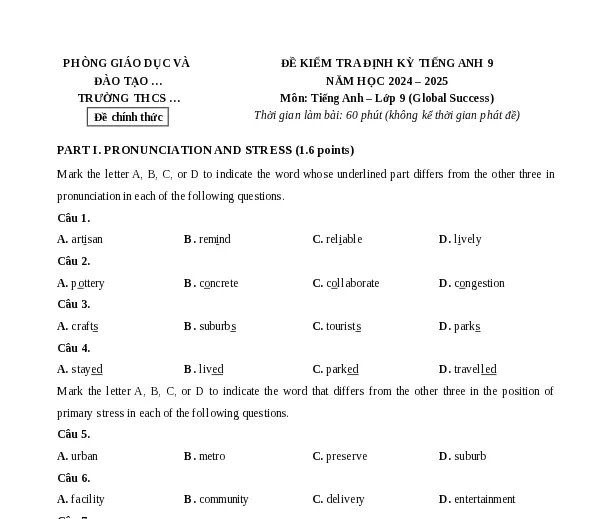
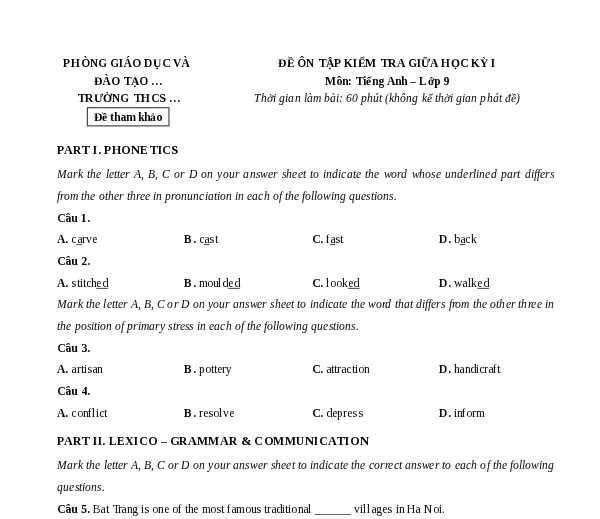
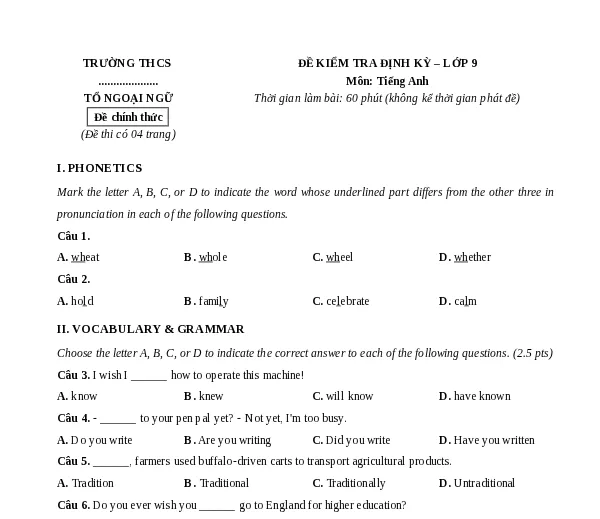
PART I. PHONETICS (1,2 điểm)
Mark the letter A, B, C, or D to indicate the word whose underlined part differs from the other three in pronunciation in each of the following questions.
Question 1 (0,2 điểm).
A. artisan
B. fragrance
C. handicraft
D. basket
Question 2 (0,2 điểm).
A. pottery
B. local
C. conical
D. product
Question 3 (0,2 điểm).
A. carved
B. moulded
C. preserved
D. weaved
Mark the letter A, B, C, or D to indicate the word that differs from the other three in the position of primary stress in each of the following questions.
Question 4 (0,2 điểm).
A. suburb
B. village
C.police
D.helper
Question 5 (0,2 điểm).
A. collector
B. consumer
C. attraction
D. handicraft
Question 6 (0,2 điểm).
A. community
B. Original
C. Craftsmanship
D. facility
PART II. VOCABULARY, GRAMMAR AND COMMUNICATION (3,6 điểm)
Mark the letter A, B, C, or D to indicate the correct answer to each of the following questions.
Question 7 (0,2 điểm). Dong Ho paintings are made with natural colours, so they are very ______ to the environment.
A. friendly
B. harmful
C. polluted
D. crowded
Question 8 (0,2 điểm). The skilled ______ in Bat Trang village have created many beautiful ceramic vases and bowls.
A. electricians
B. firefighters
C. artisans
D. garbage collectors
Question 9 (0,2 điểm). When we arrived at the craft village, they were demonstrating how ______ silk threads into fine cloth.
A. weave
B. to weave
C. weaving
D. wove
Question 10 (0,2 điểm). If you want to keep your neighbourhood clean, you should try to ______ the amount of plastic waste you produce every day.
A. cut down on
B. look around
C. pass down
D. come back
Question 11 (0,2 điểm). I really get ______ well with my new neighbours because they are always kind and helpful.
A. up
B. on
C. in
D. off
Question 12 (0,2 điểm). The children look forward to ______ the traditional pottery workshop this weekend.
A. visit
B. visited
C. visiting
D. be visited
Question 13 (0,2 điểm). This special technique of making conical hats has been ______ from generation to generation in Chuong village.
A. handed down
B. turned off
C. found out
D. run out of
Question 14 (0,2 điểm). My cousin moved to a new apartment last week, and she still doesn't know ______ to buy fresh groceries nearby.
A. what
B. who
C. where
D. why
Question 15 (0,2 điểm). Com (young sticky rice flakes) is a well-known ______ of Vong village in Hanoi, especially in autumn.
A. facility
B. speciality
C. suburb
D. function
Question 16 (0,2 điểm). ______ he was very busy with his schoolwork, he still spent Sunday morning cleaning up the local park.
A. Because
B. Since
C. Even though
D. In order that
Mark the letter A, B, C, or D to indicate the word(s) CLOSEST in meaning to the underlined word(s) in each of the following questions.
Question 17 (0,2 điểm). Many young people in the village work hard to preserve their traditional craft of bamboo weaving.
A. protect
B. destroy
C. forget
D. replace
Question 18 (0,2 điểm). Our local authorities always take care of the elderly who live alone in the neighbourhood.
A. look after
B. look for
C. look into
D. look up
Mark the letter A, B, C, or D to indicate the word(s) OPPOSITE in meaning to the underlined word(s) in each of the following questions.
Question 19 (0,2 điểm). The ceramic bowls made in this workshop are completely authentic and painted by hand.
A. real
B. fake
C. original
D. traditional
Question 20 (0,2 điểm). Living in the suburbs is much quieter and more peaceful than living in the city centre.
A. countryside
B. outskirts
C. downtown
D. villages
Mark the letter A, B, C, or D to indicate the most suitable response to complete each of the following exchanges.
Question 21 (0,2 điểm). Lan is new to the neighbourhood and is asking Nam for help.
- Lan: "Do you mind showing me the way to the nearest community centre?"
- Nam: "______"
A. Not at all. Follow me, please.
B. Yes, I mind it very much.
C. You're welcome. See you later.
D. Congratulations on your new house!
Question 22 (0,2 điểm). Mark and Hoa are at a traditional craft fair.
- Mark: "What a beautifully embroidered scarf you have bought, Hoa!"
- Hoa: "______"
A. Never mind. I can buy another one.
B. Thank you. It was made by artisans in Quat Dong village.
C. Yes, I would love to go there with you.
D. No, thanks. I don't need any help.
Mark the letter A, B, C, or D to indicate the underlined part that needs correction in each of the following questions.
Question 23 (0,2 điểm). The tourists were wondering where buying reliable traditional handicrafts in the town.
A. wondering
B. where
C. buying
D. handicrafts
Question 24 (0,2 điểm). We had to cancel our trip to the silk village although the weather became extremely bad yesterday.
A. trip
B. although
C. became
D. yesterday
PART III. READING (2,8 điểm)
Read the following passage and mark the letter A, B, C, or D to indicate the correct word or phrase that best fits each of the numbered blanks.
Bat Trang is one of the most famous traditional pottery villages in Vietnam. Located on the bank of the Red River, about 15 kilometres southeast of Hanoi centre, the village has a history of more than seven centuries. When visiting Bat Trang, tourists have a chance to (25) ______ the narrow brick-paved alleys and admire thousands of ceramic items on display.
To make a complete ceramic product, the local (26) ______ have to follow several strict steps. First, they select the best clay, treat it with water, and mould it into various shapes on a spinning wheel. Next, the products are decorated (27) ______ traditional patterns, covered with glaze, and baked in a kiln at high temperatures for days. In the past, people used wood and coal to heat the kilns, (28) ______ caused a lot of smoke and air pollution. Nowadays, most households have switched to modern gas kilns to protect the local environment and (29) ______ the quality of their products. Visitors to Bat Trang can also join a pottery-making workshop to learn how to shape clay by hand and bring home their own (30) ______ souvenirs.
Question 25 (0,2 điểm).
A. look around
B. pass down
C. give up
D. turn down
Question 26 (0,2 điểm).
A. delivery people
B. artisans
C. police officers
D. tourists
Question 27 (0,2 điểm).
A. for
B. on
C. with
D. at
Question 28 (0,2 điểm).
A. who
B. which
C. where
D. whose
Question 29 (0,2 điểm).
A. improve
B. reduce
C. remind
D. shorten
Question 30 (0,2 điểm).
A. unique
B. uniquely
C. uniqueness
D. uniqued
Read the following passage and mark the letter A, B, C, or D to indicate the correct answer to each of the questions.
A strong local community plays an essential role in making our lives safe, comfortable, and meaningful. In every neighbourhood, there are many community helpers who work quietly every day to keep things running smoothly. Garbage collectors wake up early in the morning to collect rubbish and keep the streets clean. Firefighters risk their lives to put out fires and rescue people from dangerous situations, while police officers patrol the streets to ensure public safety and order. Delivery people and electricians also provide important services that make modern life much more convenient.
Besides the efforts of these workers, the active participation of residents is equally important. In recent years, many neighbourhoods in Vietnam have started "Green Sunday" campaigns. Every weekend, residents of all ages gather to sweep the alleys, clear bushes, and plant colorful flowers along the roads. Local youth groups also organize workshops to teach children how to sort household waste into recyclable and non-recyclable items. Furthermore, community centres regularly host cultural events and charity fairs where neighbours can share homemade food, donate old books, and help disadvantaged families.
Living in a supportive community brings numerous benefits. When neighbours know and trust one another, they are more willing to lend a helping hand in times of need. Simply greeting the people next door or obeying neighbourhood rules can go a long way in building a friendly and harmonious living environment for everyone.
Question 31 (0,2 điểm). What is the passage mainly about?
A. The history of traditional craft villages in Vietnam.
B. The roles of community helpers and residents in building a good neighbourhood.
C. The difficulties faced by garbage collectors and firefighters in big cities.
D. How to sort household waste into recyclable and non-recyclable items.
Question 32 (0,2 điểm). According to paragraph 1, who is responsible for keeping the streets clean early in the morning?
A. Police officers
B. Electricians
C. Garbage collectors
D. Delivery people
Question 33 (0,2 điểm). The phrase "put out" in paragraph 1 is closest in meaning to ______.
A. stop a fire
B. start a fire
C. take place
D. look for
Question 34 (0,2 điểm). What do residents do during the "Green Sunday" campaigns?
A. They repair electrical wires for poor households.
B. They sweep the alleys, clear bushes, and plant flowers.
C. They sell traditional handicrafts to foreign tourists.
D. They build new sports facilities in the city centre.
Question 35 (0,2 điểm). The word "they" in paragraph 3 refers to ______.
A. benefits
B. rules
C. neighbours
D. workshops
Question 36 (0,2 điểm). According to paragraph 2, what do local youth groups teach children to do?
A. How to cook traditional dishes for charity fairs.
B. How to sort household waste properly.
C. How to patrol the streets at night.
D. How to deliver packages to local houses.
Question 37 (0,2 điểm). Which of the following is NOT true according to the passage?
A. Police officers help maintain public safety and order in the neighbourhood.
B. Community centres organize events where people can donate old books.
C. Only adults are allowed to take part in the "Green Sunday" campaigns.
D. Greeting neighbours helps build a friendly living environment.
Question 38 (0,2 điểm). What can be inferred from the passage?
A. A good community requires cooperation from both service workers and local residents.
B. Modern neighbourhoods no longer need community helpers because of technology.
C. People living in the suburbs do not care about environmental campaigns.
D. Charity fairs are the only way for neighbours to meet and talk to each other.
PART IV. WRITING (2,4 điểm)
Mark the letter A, B, C, or D to indicate the sentence that is closest in meaning to the original sentence in each of the following questions.
Question 39 (0,2 điểm). My mother cannot decide what she should buy as a souvenir from Phu Vinh bamboo village.
A. My mother cannot decide what buying as a souvenir from Phu Vinh bamboo village.
B. My mother cannot decide what to buy as a souvenir from Phu Vinh bamboo village.
C. My mother cannot decide what she buying as a souvenir from Phu Vinh bamboo village.
D. My mother cannot decide to buy what as a souvenir from Phu Vinh bamboo village.
Question 40 (0,2 điểm). If you read more books about local history, you will understand your community better.
A. The more books about local history you read, the better you will understand your community.
B. The more you read books about local history, the less you will understand your community.
C. The most books about local history you read, the best you will understand your community.
D. More books you read about local history, better you will understand your community.
Question 41 (0,2 điểm). The local artisans have no more clay to make pottery bowls this week.
A. The local artisans have passed down clay to make pottery bowls this week.
B. The local artisans have run out of clay to make pottery bowls this week.
C. The local artisans have cut down on clay to make pottery bowls this week.
D. The local artisans have looked around clay to make pottery bowls this week.
Question 42 (0,2 điểm). When did your family hand down this traditional silk-weaving loom?
A. How long did your family handed down this traditional silk-weaving loom?
B. When has your family handed down this traditional silk-weaving loom?
C. How long ago did your family hand down this traditional silk-weaving loom?
D. Since when did your family hand down this traditional silk-weaving loom?
Question 43 (0,2 điểm). "Where can we find the best conical hats in Hue?" the tourists asked the tour guide.
A. The tourists asked the tour guide where could they find the best conical hats in Hue.
B. The tourists asked the tour guide where to find the best conical hats in Hue.
C. The tourists asked the tour guide where finding the best conical hats in Hue.
D. The tourists asked the tour guide where can they find the best conical hats in Hue.
Question 44 (0,2 điểm). My grandparents returned to their hometown after a five-year stay in the city.
A. My grandparents came back to their hometown after a five-year stay in the city.
B. My grandparents took care of their hometown after a five-year stay in the city.
C. My grandparents found out their hometown after a five-year stay in the city.
D. My grandparents handed down their hometown after a five-year stay in the city.
Mark the letter A, B, C, or D to indicate the sentence that best combines each pair of sentences in the following questions.
Question 45 (0,2 điểm). The rain was very heavy. However, the volunteers continued cleaning the neighbourhood park.
A. Because the rain was very heavy, the volunteers continued cleaning the neighbourhood park.
B. Even though the rain was very heavy, the volunteers continued cleaning the neighbourhood park.
C. The rain was very heavy so that the volunteers continued cleaning the neighbourhood park.
D. Despite the rain was very heavy, the volunteers continued cleaning the neighbourhood park.
Question 46 (0,2 điểm). The students are practicing their presentation carefully. They want to introduce their local craft village to foreign visitors.
A. The students are practicing their presentation carefully so that they can introduce their local craft village to foreign visitors.
B. The students are practicing their presentation carefully although they want to introduce their local craft village to foreign visitors.
C. The students are practicing their presentation carefully because of they want to introduce their local craft village to foreign visitors.
D. The students are practicing their presentation carefully, so they didn't introduce their local craft village to foreign visitors.
Question 47 (0,2 điểm). Mr. Minh is a very skilful carpenter. All the people in our commune admire his wooden statues.
A. Since Mr. Minh is a very skilful carpenter, all the people in our commune admire his wooden statues.
B. Whereas Mr. Minh is a very skilful carpenter, all the people in our commune admire his wooden statues.
C. Mr. Minh is a very skilful carpenter, but all the people in our commune admire his wooden statues.
D. Unless Mr. Minh is a very skilful carpenter, all the people in our commune admire his wooden statues.
Question 48 (0,2 điểm). My sister has just moved to a new neighbourhood. She doesn't know who she can ask for advice about local services.
A. My sister has just moved to a new neighbourhood, so she doesn't know who asking for advice about local services.
B. Having just moved to a new neighbourhood, my sister doesn't know who to ask for advice about local services.
C. Because my sister has just moved to a new neighbourhood, she knows who to ask for advice about local services.
D. My sister has just moved to a new neighbourhood, though she doesn't know who to ask for advice about local services.
Question 49 (0,2 điểm). The neighbourhood becomes greener and cleaner. The residents feel happier and healthier.
A. The greener and cleaner the neighbourhood becomes, the happier and healthier the residents feel.
B. The more greener and cleaner the neighbourhood becomes, the happier and healthier the residents feel.
C. The greener and cleaner the neighbourhood becomes, the more happier and healthier the residents feel.
D. Greener and cleaner the neighbourhood becomes, happier and healthier the residents feel.
Question 50 (0,2 điểm). Non Nuoc marble village is famous for its stone sculptures. It attracts thousands of tourists every year.
A. Non Nuoc marble village, that is famous for its stone sculptures, attracts thousands of tourists every year.
B. Non Nuoc marble village, which is famous for its stone sculptures, attracts thousands of tourists every year.
C. Non Nuoc marble village, where is famous for its stone sculptures, attracts thousands of tourists every year.
D. Non Nuoc marble village, who is famous for its stone sculptures, attracts thousands of tourists every year.
--------- HẾT ---------
Thí sinh không được sử dụng tài liệu. Cán bộ coi thi không giải thích gì thêm.
Họ và tên thí sinh: ................................................ Số báo danh: ........................
SỞ GIÁO DỤC VÀ ĐÀO TẠO
KỲ THI TUYỂN SINH LỚP 10 THPT
Hướng dẫn chấm chính thức
HƯỚNG DẪN CHẤM VÀ ĐÁP ÁN CHI TIẾT
Môn: Tiếng Anh – Lớp 9 (Unit 1: Local Community)
Thời gian làm bài: 90 phút
A. HƯỚNG DẪN CHUNG
- Đề thi gồm 50 câu hỏi trắc nghiệm khách quan, thang điểm 10,0 điểm.
- Mỗi câu trả lời đúng được 0,2 điểm.
B. BẢNG ĐÁP ÁN TRẮC NGHIỆM
Câu | 1 | 2 | 3 | 4 | 5 | 6 | 7 | 8 | 9 | 10 |
|---|---|---|---|---|---|---|---|---|---|---|
Đáp án | B | B | B | C | D | C | A | C | B | A |
Câu | 11 | 12 | 13 | 14 | 15 | 16 | 17 | 18 | 19 | 20 |
|---|---|---|---|---|---|---|---|---|---|---|
Đáp án | B | C | A | C | B | C | A | A | B | C |
Câu | 21 | 22 | 23 | 24 | 25 | 26 | 27 | 28 | 29 | 30 |
|---|---|---|---|---|---|---|---|---|---|---|
Đáp án | A | B | C | B | A | B | C | B | A | A |
Câu | 31 | 32 | 33 | 34 | 35 | 36 | 37 | 38 | 39 | 40 |
|---|---|---|---|---|---|---|---|---|---|---|
Đáp án | B | C | A | B | C | B | C | A | B | A |
Câu | 41 | 42 | 43 | 44 | 45 | 46 | 47 | 48 | 49 | 50 |
|---|---|---|---|---|---|---|---|---|---|---|
Đáp án | B | C | B | A | B | A | A | B | A | B |
LỜI GIẢI CHI TIẾT
PART I. PHONETICS
Question 1. Chọn B.
- A. artisan /ˈɑːtɪzæn/
- B. fragrance /ˈfreɪɡrəns/
- C. handicraft /ˈhændikrɑːft/
- D. basket /ˈbɑːskɪt/ (hoặc /ˈbæskɪt/)
Phần gạch chân ở phương án B phát âm là nguyên âm đôi /eɪ/, các phương án còn lại phát âm là /ɑː/ hoặc /æ/.
Question 2. Chọn B.
- A. pottery /ˈpɒtəri/
- B. local /ˈləʊkl/
- C. conical /ˈkɒnɪkl/
- D. product /ˈprɒdʌkt/
Phần gạch chân ở phương án B phát âm là /əʊ/, các phương án còn lại phát âm là /ɒ/.
Question 3. Chọn B.
- A. carved /kɑːvd/
- B. moulded /ˈməʊldɪd/
- C. preserved /prɪˈzɜːvd/
- D. weaved /wiːvd/
Đuôi "-ed" ở phương án B đi sau âm /d/ nên phát âm là /ɪd/, các từ còn lại đi sau phụ âm hữu thanh /v/ nên phát âm là /d/.
Question 4. Chọn C.
- A. suburb /ˈsʌbɜːb/ (trọng âm rơi vào âm tiết thứ nhất)
- B. village /ˈvɪlɪdʒ/ (trọng âm rơi vào âm tiết thứ nhất)
- C. police /pəˈliːs/ (trọng âm rơi vào âm tiết thứ hai)
- D. helper /ˈhelpər/ (trọng âm rơi vào âm tiết thứ nhất)
Phương án C có trọng âm khác với các từ còn lại.
Question 5. Chọn D.
- A. collector /kəˈlektər/ (trọng âm rơi vào âm tiết thứ hai)
- B. consumer /kənˈsjuːmər/ (trọng âm rơi vào âm tiết thứ hai)
- C. attraction /əˈtrækʃn/ (trọng âm rơi vào âm tiết thứ hai)
- D. handicraft /ˈhændikrɑːft/ (trọng âm rơi vào âm tiết thứ nhất)
Phương án D có trọng âm rơi vào âm tiết 1, các từ còn lại rơi vào âm tiết 2.
Question 6. Chọn C.
- A. community /kəˈmjuːnəti/ (trọng âm rơi vào âm tiết thứ hai)
- B. original /əˈrɪdʒənl/ (trọng âm rơi vào âm tiết thứ hai)
- C. craftsmanship /ˈkrɑːftsmənʃɪp/ (trọng âm rơi vào âm tiết thứ nhất)
- D. facility /fəˈsɪləti/ (trọng âm rơi vào âm tiết thứ hai)
Phương án C có trọng âm rơi vào âm tiết thứ nhất, các từ còn lại có trọng âm rơi vào âm tiết thứ hai.
PART II. VOCABULARY, GRAMMAR AND COMMUNICATION
Question 7. Chọn A.
- Cụm từ: friendly to the environment / environmentally friendly (thân thiện với môi trường).
- Dịch nghĩa: Tranh Đông Hồ được làm bằng màu sắc tự nhiên, vì vậy chúng rất thân thiện với môi trường.
Question 8. Chọn C.
- Danh từ artisan (/ˈɑːtɪzæn/): nghệ nhân, thợ thủ công lành nghề.
- Electrician (thợ điện), firefighter (lính cứu hỏa), garbage collector (người thu gom rác).
- Dịch nghĩa: Những nghệ nhân lành nghề ở làng Bát Tràng đã tạo ra nhiều bình hoa và bát đĩa gốm sứ tuyệt đẹp.
Question 9. Chọn B.
- Cấu trúc: từ để hỏi (question words) + động từ nguyên mẫu có to (how to weave = cách dệt).
- Dịch nghĩa: Khi chúng tôi đến làng nghề, họ đang trình diễn cách dệt các sợi tơ tằm thành tấm vải mịn.
Question 10. Chọn A.
- Cụm động từ: cut down on (cắt giảm, giảm bớt).
- Look around (ngắm nhìn xung quanh), pass down (truyền lại), come back (quay trở về).
- Dịch nghĩa: Nếu bạn muốn giữ cho khu phố sạch sẽ, bạn nên cố gắng giảm lượng rác thải nhựa phát sinh mỗi ngày.
Question 11. Chọn B.
- Cụm động từ: get on well with someone (hoà thuận, ăn ý với ai).
- Dịch nghĩa: Tôi rất hòa thuận với những người hàng xóm mới vì họ luôn tốt bụng và hay giúp đỡ.
Question 12. Chọn C.
- Cấu trúc: look forward to + V-ing (mong đợi, trông ngóng điều gì).
- Dịch nghĩa: Lũ trẻ rất trông chờ được đến thăm xưởng gốm truyền thống vào cuối tuần này.
Question 13. Chọn A.
- Cụm động từ: hand down / pass down (truyền lại từ đời này sang đời khác).
- Turn off (tắt), find out (tìm ra, phát hiện), run out of (hết, cạn kiệt).
- Dịch nghĩa: Kỹ thuật làm nón lá đặc biệt này đã được truyền qua nhiều thế hệ ở làng Chuông.
Question 14. Chọn C.
- Cấu trúc: where to buy (mua ở đâu) phù hợp nhất về nghĩa với từ chỉ địa điểm "nearby".
- Dịch nghĩa: Em họ tôi mới chuyển đến căn hộ mới tuần trước và em ấy vẫn chưa biết mua thực phẩm tươi sống ở đâu gần đó.
Question 15. Chọn B.
- Danh từ speciality (đặc sản).
- Facility (cơ sở vật chất), suburb (khu ngoại ô), function (chức năng).
- Dịch nghĩa: Cốm là một đặc sản nổi tiếng của làng Vòng ở Hà Nội, đặc biệt là vào mùa thu.
Question 16. Chọn C.
- Even though + S + V: Mặc dù (chỉ sự tương phản giữa hai mệnh đề).
- Because / Since (bởi vì), in order that (để mà).
- Dịch nghĩa: Mặc dù rất bận rộn với bài vở ở trường, bạn ấy vẫn dành cả buổi sáng Chủ nhật để dọn dẹp công viên địa phương.
Question 17. Chọn A.
- Preserve (bảo tồn, giữ gìn) đồng nghĩa với protect (bảo vệ).
- Destroy (phá hủy), forget (quên), replace (thay thế).
- Dịch nghĩa: Nhiều bạn trẻ trong làng nỗ lực làm việc để giữ gìn nghề đan tre truyền thống của quê hương.
Question 18. Chọn A.
- Cụm từ: take care of (chăm sóc) đồng nghĩa với look after.
- Look for (tìm kiếm), look into (điều tra), look up (tra cứu).
- Dịch nghĩa: Chính quyền địa phương luôn chăm sóc những người già neo đơn sống trong khu phố.
Question 19. Chọn B.
- Authentic (chính gốc, thật) trái nghĩa với fake (giả, làm nhái).
- Real (thật), original (nguyên bản), traditional (truyền thống).
- Dịch nghĩa: Những chiếc bát gốm làm tại xưởng này hoàn toàn là đồ thật và được vẽ bằng tay.
Question 20. Chọn C.
- Suburbs (vùng ngoại ô) trái nghĩa với downtown / city centre (khu vực trung tâm thành phố).
- Countryside (nông thôn), outskirts (vùng rìa ngoài), villages (làng quê).
- Dịch nghĩa: Sống ở ngoại ô yên tĩnh và thanh bình hơn nhiều so với sống ở trung tâm thành phố.
Question 21. Chọn A.
- Đáp lại lời hỏi xin phép/nhờ vả lịch sự "Do you mind...?" (Bạn có phiền không?): "Not at all. Follow me, please." (Không hề phiền chút nào. Xin mời đi theo tôi).
Question 22. Chọn B.
- Đáp lại lời khen ngợi "What a beautifully embroidered scarf...!" là lời cảm ơn lịch sự kèm thông tin thêm: "Thank you. It was made by artisans in Quat Dong village."
Question 23. Chọn C.
- Cấu trúc: wonder + wh-word + to V. Do đó, "where buying" phải sửa thành "where to buy".
- Dịch nghĩa: Các du khách đang băn khoăn không biết nên mua đồ thủ công mỹ nghệ truyền thống đáng tin cậy ở đâu trong thị trấn.
Question 24. Chọn B.
- Mối quan hệ giữa hai vế là nguyên nhân - kết quả ("bão/thời tiết xấu" là nguyên nhân dẫn đến việc "hủy chuyến đi"), do đó phải dùng liên từ because / as / since thay cho although. Sửa although thành because.
- Dịch nghĩa: Chúng tôi phải hủy chuyến tham quan làng lụa vì hôm qua thời tiết trở nên vô cùng tồi tệ.
PART III. READING
Question 25. Chọn A.
- Cụm từ: look around (đi dạo ngắm nhìn, tham quan quanh nơi nào đó).
Question 26. Chọn B.
- Danh từ phù hợp ngữ cảnh nói về việc tạo ra sản phẩm gốm sứ là artisans (các nghệ nhân).
Question 27. Chọn C.
- Cấu trúc bị động: be decorated with sth (được trang trí bằng cái gì).
Question 28. Chọn B.
- Đại từ quan hệ which đứng sau dấu phẩy để thay thế cho toàn bộ sự việc ở mệnh đề trước ("In the past, people used wood and coal to heat the kilns").
Question 29. Chọn A.
- Động từ improve (cải thiện, nâng cao chất lượng sản phẩm). Cụm từ: improve the quality of products.
Question 30. Chọn A.
- Trước danh từ "souvenirs" cần một tính từ bổ nghĩa: unique (độc đáo, đặc sắc).
Question 31. Chọn B.
- Đoạn văn nói về vai trò của những người trợ giúp cộng đồng (community helpers: lính cứu hỏa, lao công, cảnh sát...) và sự chung tay của cư dân (residents: chiến dịch Chủ nhật Xanh, phân loại rác...) trong việc xây dựng khu dân cư văn minh.
Question 32. Chọn C.
- Dẫn chứng ở đoạn 1: "Garbage collectors wake up early in the morning to collect rubbish and keep the streets clean."
Question 33. Chọn A.
- Cụm từ put out fires nghĩa là dập lửa, tương đương với stop a fire.
Question 34. Chọn B.
- Dẫn chứng ở đoạn 2: "Every weekend, residents of all ages gather to sweep the alleys, clear bushes, and plant colorful flowers along the roads."
Question 35. Chọn C.
- Dẫn chứng ở đoạn 3: "When neighbours know and trust one another, they are more willing to lend a helping hand..." Từ "they" thay thế cho danh từ "neighbours" đứng ngay phía trước.
Question 36. Chọn B.
- Dẫn chứng ở đoạn 2: "Local youth groups also organize workshops to teach children how to sort household waste into recyclable and non-recyclable items."
Question 37. Chọn C.
- Phương án C khẳng định "Chỉ người lớn mới được tham gia chiến dịch Chủ nhật Xanh" là sai, vì đoạn 2 nêu rõ: "residents of all ages gather..." (người dân ở mọi lứa tuổi).
Question 38. Chọn A.
- Thông điệp suy ra từ toàn bài: Một cộng đồng tốt đẹp đòi hỏi sự phối hợp từ cả lực lượng dịch vụ công cộng và chính các cư dân địa phương.
PART IV. WRITING
Question 39. Chọn B.
- Cấu trúc rút gọn mệnh đề danh ngữ: wh-word + S + should + V chuyển thành wh-word + to V (what to buy).
Question 40. Chọn A.
- Cấu trúc so sánh kép (Double comparison):
The more + N + S + V, the + so sánh hơn (better) + S + V.
- Dịch nghĩa: Bạn càng đọc nhiều sách về lịch sử địa phương, bạn sẽ càng hiểu rõ hơn về cộng đồng của mình.
Question 41. Chọn B.
- Cụm từ: have no more sth = run out of sth (hết, cạn kiệt thứ gì).
- Dịch nghĩa: Các nghệ nhân địa phương đã hết sạch đất sét để làm bát gốm trong tuần này.
Question 42. Chọn C.
- Câu hỏi với When ở thì quá khứ đơn tương đương với câu hỏi How long ago + did + S + V?
- Phương án A sai ngữ pháp (handed sau trợ động từ did); B và D dùng sai thì.
Question 43. Chọn B.
- Câu tường thuật lời hỏi thông tin có thể rút gọn thành dạng: wh-word + to V (where to find).
- Phương án A và D sai trật tự từ (đảo ngữ); phương án C dùng V-ing là sai cấu trúc.
Question 44. Chọn A.
- Động từ returned to (trở về) đồng nghĩa với cụm động từ came back to.
Question 45. Chọn B.
- Hai câu thể hiện ý tương phản, nối bằng liên từ Even though + mệnh đề (Mặc dù mưa to, các tình nguyện viên vẫn tiếp tục dọn dẹp công viên). Phương án D sai vì sau Despite phải là cụm danh từ hoặc danh động từ.
Question 46. Chọn A.
- Nối hai câu chỉ mục đích bằng so that + S + can + V (để mà họ có thể giới thiệu làng nghề...).
Question 47. Chọn A.
- Nối hai câu chỉ nguyên nhân - kết quả: Since (= Because / As) Mr. Minh is a very skilful carpenter, all the people...
Question 48. Chọn B.
- Rút gọn mệnh đề đồng chủ ngữ ở dạng phân từ hoàn thành (Having just moved...) kết hợp rút gọn mệnh đề danh ngữ với từ để hỏi (who to ask).
Question 49. Chọn A.
- Cấu trúc so sánh kép với tính từ ngắn: The + adj-er and adj-er + S + V, the + adj-er and adj-er + S + V (The greener and cleaner ..., the happier and healthier ...).
Question 50. Chọn B.
- Đại từ quan hệ which thay thế cho danh từ chỉ vật/địa danh "Non Nuoc marble village" làm chủ ngữ trong mệnh đề quan hệ không xác định (có dấu phẩy ngăn cách). Không dùng that sau dấu phẩy; where phải làm trạng từ nơi chốn; who chỉ người.