PHÒNG GIÁO DỤC VÀ ĐÀO TẠO …
TRƯỜNG THCS …
Đề chính thức
ĐỀ KIỂM TRA GIỮA HỌC KỲ I
Năm học: 2024 – 2025
Môn: Tiếng Anh – Lớp 9
Thời gian làm bài: 60 phút (không kể thời gian phát đề)
SECTION 1. MULTIPLE CHOICE (12 questions)
Mark the letter A, B, C, or D on your answer sheet to indicate the correct answer to each of the following questions.
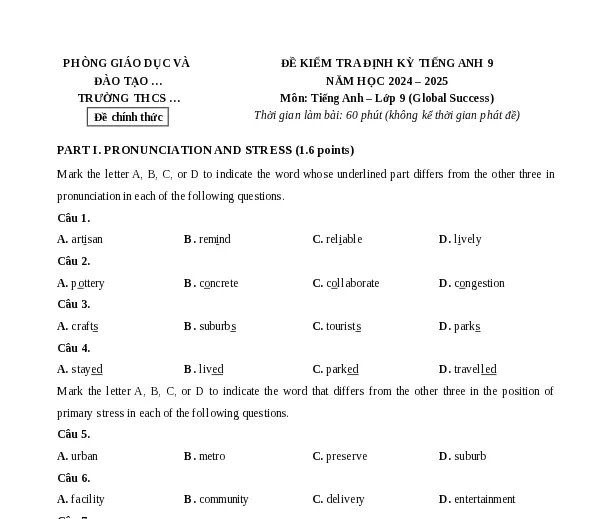
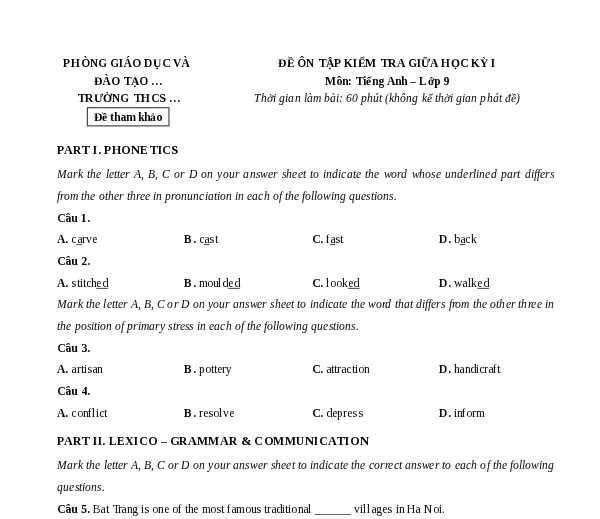
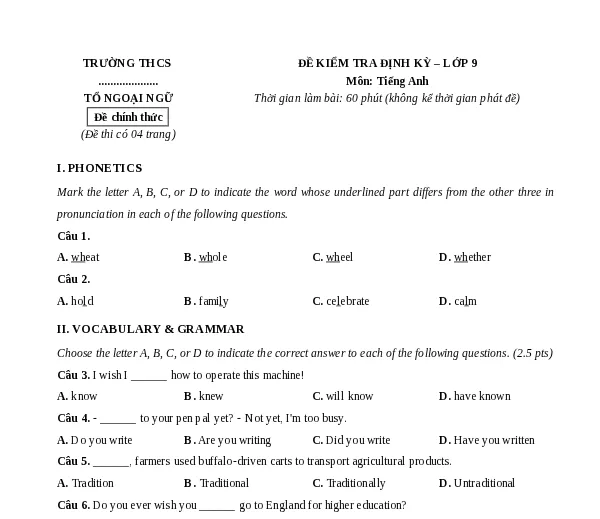
Câu 1. Which word has the underlined part pronounced differently from the others?
A. cable
B. fashion
C. carry
D. traffic
Câu 2. Which word has the underlined part pronounced differently from the others?
A. locked
B. watched
C. cooked
D. handed
Câu 3. Which word has a different stress pattern from the others?
A. remind
B. craftsperson
C. pottery
D. suburb
Câu 4. Which word has a different stress pattern from the others?
A. congested
B. metro
C. feature
D. concrete
Câu 5. Local ______ in Bat Trang village are skillful at making traditional ceramic pots and bowls.
A. commuters
B. artisans
C. pedestrians
D. counsellors
Câu 6. Mai is not sure ______ to deal with her stress before the mid-term examination.
A. how
B. what
C. when
D. which
Câu 7. The government is planning to ______ the old houses in this area to build a new metro line.
A. pull down
B. turn up
C. look after
D. come back
Câu 8. The ______ cities become, the ______ it is for people to find affordable accommodation.
A. more crowded / more difficult
B. crowded / difficult
C. most crowded / most difficult
D. more crowded / difficult
Câu 9. If you want to maintain a healthy lifestyle, you ______ avoid eating too much fast food and sugary drinks.
A. would
B. should
C. might
D. could
Câu 10. Many teenagers suffer from ______ because of heavy study pressure and high expectations from their parents.
A. anxiety
B. amenity
C. attraction
D. specialty
Câu 11. I don't know who ______ advice from when I feel overwhelmed with my school assignments.
A. seeking
B. to seek
C. sought
D. seek
Câu 12. Tom: "Would you like to visit Van Phuc silk village with me this Sunday?" - Peter: "______"
A. That sounds wonderful! I'd love to.
B. Never mind, it doesn't matter.
C. You are welcome.
D. I'm sorry, I don't know who made it.
SECTION 2. REARRANGEMENT (5 questions)
Mark the letter A, B, C, or D on your answer sheet to indicate the correct arrangement of sentences to make a meaningful exchange, letter, or paragraph.
Câu 13. Choose the correct arrangement of the sentences to make a meaningful conversation.
a. Nam: That's a good idea! How about going by electric bus?
b. Lan: Would you like to go to Bat Trang pottery village this weekend?
c. Lan: Great! It is eco-friendly and very convenient.
A. b - a - c
B. a - b - c
C. c - a - b
D. b - c - a
Câu 14. Choose the correct arrangement of the sentences to make a meaningful letter.
a. I am writing to ask for your advice on how to manage my time better.
b. Dear Mr. Brown,
c. Nowadays, I have so much homework that I rarely have time to do physical exercise.
d. I look forward to hearing from you soon.
e. Best regards,
A. b - a - c - d - e
B. b - c - a - d - e
C. a - b - c - d - e
D. b - a - d - c - e
Câu 15. Choose the correct arrangement of the sentences to form a coherent paragraph about life in the city.
a. In addition, the public transport system is well-developed with modern metro lines and buses.
b. Firstly, there are plenty of modern amenities such as hospitals, shopping malls, and recreational centres.
c. Living in a big city offers residents a wide variety of undeniable advantages.
d. However, city dwellers also have to deal with heavy traffic jams and air pollution every day.
A. c - b - a - d
B. b - a - d - c
C. c - a - b - d
D. d - c - b - a
Câu 16. Choose the correct arrangement of the sentences to make a meaningful conversation.
a. Phong: I've been feeling exhausted and stressed out recently.
b. Minh: You should get at least 8 hours of sleep each night and balance your study schedule.
c. Phong: What's the matter with you? You look so pale!
d. Minh: Thanks for your useful suggestion. I will try it right tonight.
A. c - a - b - d
B. a - c - b - d
C. c - b - a - d
D. a - b - c - d
Câu 17. Choose the correct order of the following sentences to make a paragraph about a craft village.
a. Consequently, tourists from all over the world visit the village to buy exquisite souvenirs.
b. For hundreds of years, local artisans have preserved traditional embroidery techniques passed down through generations.
c. Quat Dong is a famous craft village renowned for its delicate hand-embroidered products.
d. These skilled craftsmen put immense care and passion into every single piece of silk fabric.
A. c - b - d - a
B. b - c - a - d
C. c - a - b - d
D. b - d - c - a
SECTION 3. CLOZE TEST (6 questions)
Read the following passage and mark the letter A, B, C, or D on your answer sheet to indicate the correct word or phrase that best fits each of the numbered blanks from 18 to 23.
Maintaining a balanced lifestyle is vital for teenagers' physical and mental well-being. Today, many adolescents lead a sedentary lifestyle because they spend too much time on electronic devices. (18) ______ to experts, teens should participate in regular physical activities, such as playing sports or cycling, to improve their health. Furthermore, eating a diet rich in vegetables, fruits, and lean proteins helps the body develop properly. Adolescents also need to pay (19) ______ to their sleep habits. Sleeping for eight to nine hours every night allows the brain to rest and lowers the risk of depression. When teenagers face difficult situations at school or home, they should not (20) ______ their feelings inside. Instead, they can turn to school counsellors or trusted family members (21) ______ helpful guidance. Building healthy relationships with peers also plays an essential role (22) ______ reducing emotional pressure. In short, (23) ______ teens take care of their bodies and minds, they will enjoy a happier and more productive adolescence.
Câu 18.
A. According
B. Due
C. Next
D. In addition
Câu 19.
A. contribution
B. attention
C. attraction
D. impression
Câu 20.
A. put down
B. bottle up
C. give up
D. take off
Câu 21.
A. to
B. of
C. for
D. with
Câu 22.
A. on
B. at
C. by
D. in
Câu 23.
A. although
B. if
C. unless
D. because of
SECTION 4. READING COMPREHENSION 1 (7 questions)
Read the following passage and mark the letter A, B, C, or D on your answer sheet to indicate the correct answer to each of the questions from 24 to 30.
Chu Quyen communal house in Ba Vi, Hanoi, is one of the most prominent cultural relics representing northern Vietnamese traditional architecture. Built in the late 17th century, the communal house is dedicated to Tan Vien, one of the Four Immortals in Vietnamese mythology. Over centuries of historical upheavals, the structure has retained its exquisite architectural elements and original wooden carvings.
The communal house was constructed almost entirely of sturdy ironwood without using any metal nails. The main hall is supported by nearly fifty huge pillars, creating an imposing and spacious interior. What makes Chu Quyen unique is the decorative carvings on the wooden beams and rafters. Artisans carved lively depictions of everyday folk life: farmers plowing fields, children swimming, and women carrying water. These artworks reflect the optimistic spirit and deep harmony between humans and nature in traditional rural society.
In the past, the communal house served as both a sacred place for spiritual rituals and a gathering venue where villagers held administrative meetings. Today, although social practices have evolved, the communal house remains the spiritual heart of the local community. Every year, an annual village festival is held here to commemorate the deity and express gratitude for peaceful harvests.
Recognizing its historical value, local authorities and conservationists have carried out extensive restoration projects to preserve Chu Quyen from decay and termite damage. The preservation not only safeguards national cultural heritage but also educates younger generations on respecting ancient craftsmanship and communal roots.
Câu 24. What is the main topic of the passage?
A. The biography of deity Tan Vien in Vietnamese folklore.
B. The architectural and cultural significance of Chu Quyen communal house.
C. The history of traditional craft villages in Ba Vi, Hanoi.
D. Modern methods of preserving ancient wooden buildings.
Câu 25. What is special about the construction technique of Chu Quyen communal house?
A. It was built using metal nails and concrete walls.
B. It was constructed mainly of ironwood without metal nails.
C. It had only small wooden columns imported from foreign countries.
D. It took more than two hundred years to complete.
Câu 26. The word exquisite in paragraph 1 is CLOSEST in meaning to ______.
A. fragile
B. simple
C. beautiful and delicate
D. clumsy
Câu 27. The word sturdy in paragraph 2 is OPPOSITE in meaning to ______.
A. solid
B. weak
C. durable
D. magnificent
Câu 28. According to paragraph 2, what do the carvings on the wooden beams depict?
A. Fierce battles against foreign invaders.
B. Scenes of everyday village life and activities.
C. Portrayals of ancient kings and queens.
D. Scientific developments in northern Vietnam.
Câu 29. Which of the following is NOT true according to the passage?
A. Chu Quyen communal house was constructed in the late 17th century.
B. The communal house used to serve as a venue for community meetings.
C. Annual village festivals are no longer held at the communal house.
D. Modern restoration projects have been conducted to protect the structure.
Câu 30. It can be inferred from the passage that conserving ancient communal houses helps to ______.
A. connect modern people with their ancestral cultural traditions
B. convert sacred buildings into commercial shopping zones
C. replace traditional wooden materials with industrial metals
D. eliminate superstitious beliefs among local villagers
SECTION 5. READING COMPREHENSION 2 (7 questions)
Read the following passage and mark the letter A, B, C, or D on your answer sheet to indicate the correct answer to each of the questions from 31 to 37.
Urbanization is taking place at a breathtaking speed across the globe, especially in developing nations. Every year, millions of rural migrants move to major cities in search of higher education, lucrative careers, and improved living standards. However, the rapid expansion of urban centers presents a series of severe challenges to both local governments and residents.
One of the most noticeable downsides of city life is chronic traffic congestion. As populations surge, the number of private motorbikes and cars on the streets multiplies exponentially. During peak hours, commuters find themselves trapped in gridlocks for hours, which not only causes immense frustration but also leads to severe economic losses. Furthermore, vehicle exhaust fumes and industrial emissions discharge hazardous pollutants into the atmosphere, making respiratory illnesses increasingly prevalent among urban dwellers.
Another pressing concern is the acute shortage of affordable housing. Due to sky-rocketing land prices, finding a decent apartment in central districts has become virtually unattainable for low-income workers and young graduates. Many are forced to reside in cramped rental rooms with substandard living conditions in the suburbs. In addition, the competitive pace of urban life exerts significant mental pressure on individuals. City residents frequently struggle with work-related burnout and feelings of loneliness, despite being surrounded by crowds.
To build sustainable and liveable cities, urban planners are implementing smart solutions. Many metropolises are expanding public transportation networks, including underground metros and electric bus fleets, to cut down on carbon emissions. Governments are also creating more green public spaces, such as parks and community gardens, to alleviate stress and provide leisure areas for residents. In the long term, balanced regional development is necessary to lessen the burden on mega-cities by creating economic opportunities in rural areas.
Câu 31. What is the best title for the passage?
A. The Advantages of Rural Life over Urban Life
B. Urbanization: Pressing Issues and Sustainable Solutions
C. How Public Transport Can Save the Global Climate
D. Causes of Air Pollution in Developing Countries
Câu 32. The word prevalent in paragraph 2 is CLOSEST in meaning to ______.
A. uncommon
B. widespread
C. harmless
D. negligible
Câu 33. The word lucrative in paragraph 1 is OPPOSITE in meaning to ______.
A. profitable
B. poorly-paying
C. attractive
D. promising
Câu 34. The word they in paragraph 3 refers to ______.
A. urban dwellers
B. apartments
C. low-income workers and young graduates
D. vehicles
Câu 35. According to paragraph 2, traffic congestion results in ______.
A. lower prices for private motorbikes
B. emotional frustration and financial loss
C. decreased levels of toxic exhaust fumes
D. faster commute times during peak hours
Câu 36. Which of the following is NOT mentioned in the passage as a consequence of rapid urbanization?
A. Shortage of affordable housing for low-income citizens.
B. High levels of air pollution causing respiratory diseases.
C. Frequent natural disasters occurring in city downtowns.
D. Psychological pressure and mental exhaustion among workers.
Câu 37. Which of the following solutions is suggested in the last paragraph to mitigate city problems?
A. Prohibiting all rural citizens from moving to big cities.
B. Expanding public transit networks and developing green spaces.
C. Demolishing old buildings to create more parking lots.
D. Raising tax rates on low-income workers in suburban areas.
SECTION 6. SENTENCE TRANSFORMATION (3 questions)
Mark the letter A, B, C, or D on your answer sheet to indicate the sentence that is closest in meaning to each of the following questions.
Câu 38. Peter doesn't know who he should consult about his emotional problems.
A. Peter doesn't know who to consult about his emotional problems.
B. Peter doesn't know who consulting about his emotional problems.
C. Peter doesn't know where to consult about his emotional problems.
D. Peter doesn't know who he consulted about his emotional problems.
Câu 39. As the city becomes more populated, the cost of living gets higher.
A. The more populated the city becomes, the higher the cost of living gets.
B. The more populated the city is, the cost of living is higher.
C. The most populated the city becomes, the highest the cost of living gets.
D. The more the city becomes populated, the cost of living gets higher.
Câu 40. It is advisable for students to prioritize their tasks if they want to reduce academic stress.
A. Students should prioritize their tasks if they want to reduce academic stress.
B. Students must not prioritize their tasks unless they want to reduce academic stress.
C. Students might prioritize their tasks because they reduced academic stress.
D. Students would rather not prioritize their tasks to reduce academic stress.
--------- HẾT ---------
Họ và tên thí sinh: ................................................................ Số báo danh: ........................
HƯỚNG DẪN CHẤM VÀ ĐÁP ÁN CHI TIẾT
MÔN: TIẾNG ANH 9 – GIỮA HỌC KỲ I
A. BẢNG ĐÁP ÁN (0,25 điểm / câu)
Câu | Đ/a | Câu | Đ/a | Câu | Đ/a | Câu | Đ/a |
|---|---|---|---|---|---|---|---|
1 | A | 11 | B | 21 | C | 31 | B |
2 | D | 12 | A | 22 | D | 32 | B |
3 | A | 13 | A | 23 | B | 33 | B |
4 | A | 14 | A | 24 | B | 34 | C |
5 | B | 15 | A | 25 | B | 35 | B |
6 | A | 16 | A | 26 | C | 36 | C |
7 | A | 17 | A | 27 | B | 37 | B |
8 | A | 18 | A | 28 | B | 38 | A |
9 | B | 19 | B | 29 | C | 39 | A |
10 | A | 20 | B | 30 | A | 40 | A |
B. GIẢI THÍCH CHI TIẾT
Câu 1. A. cable phát âm là /eɪ/, các từ còn lại phát âm là /æ/.
Câu 2. D. handed tận cùng là /ɪd/ vì âm kết thúc là /d/, các từ còn lại phát âm là /t/.
Câu 3. A. remind trọng âm rơi vào âm tiết thứ 2 (/rɪˈmaɪnd/), các từ còn lại trọng âm thứ 1.
Câu 4. A. congested trọng âm rơi vào âm tiết thứ 2 (/kənˈdʒestɪd/), các từ còn lại trọng âm thứ 1.
Câu 5. B. artisans (thợ thủ công/nghệ nhân) phù hợp với ngữ cảnh làng gốm Bát Tràng (Unit 1).
Câu 6. A. Cấu trúc Question word + to V: "how to deal with" (làm thế nào để giải quyết).
Câu 7. A. Cụm động từ pull down nghĩa là phá bỏ, san phẳng (nhà cũ để làm công trình).
Câu 8. A. So sánh kép: The + comparative ..., the + comparative ... ("The more crowded ..., the more difficult ...").
Câu 9. B. Câu điều kiện loại 1 với động từ khuyết thiếu: dùng should đưa ra lời khuyên.
Câu 10. A. anxiety (sự lo âu, căng thẳng) phù hợp với áp lực học tập (Unit 3).
Câu 11. B. Rút gọn mệnh đề danh ngữ bằng to-infinitive: who to seek.
Câu 12. A. Lời đáp lại lời mời thân mật: "That sounds wonderful! I'd love to."
Câu 13. A. Trật tự hội thoại hợp lý: Lời mời (b) Đề xuất phương tiện (a) Nhất trí tán thành (c).
Câu 14. A. Bố cục thư chuẩn: Lời chào (b) Mục đích viết thư (a) Nêu vấn đề (c) Kết thư (d) Ký tên (e).
Câu 15. A. Mở đoạn giới thiệu lợi ích của thành phố (c) Lợi ích thứ nhất (b) Lợi ích thứ hai (a) Mặt trái/hạn chế (d).
Câu 16. A. Hội thoại: Hỏi thăm khi thấy bạn mệt (c) Trả lời nguyên nhân (a) Đưa lời khuyên (b) Cảm ơn (d).
Câu 17. A. Giới thiệu làng Quất Động (c) Lịch sử gìn giữ nghề thêu (b) Sự khéo léo của thợ (d) Thu hút du khách (a).
Câu 18. A. Cụm cố định: According to (theo như).
Câu 19. B. Cụm từ: pay attention to (chú ý đến).
Câu 20. B. Cụm động từ: bottle up feelings (kìm nén cảm xúc).
Câu 21. C. Cụm từ: turn to somebody for something (tìm đến ai để xin sự giúp đỡ/hướng dẫn).
Câu 22. D. Cấu trúc: play a role in doing something (đóng vai trò trong việc gì).
Câu 23. B. Liên từ chỉ điều kiện: if (nếu thanh thiếu niên chăm sóc bản thân...).
Câu 24. B. Toàn bộ bài nói về giá trị kiến trúc và văn hóa của đình Chu Quyến.
Câu 25. B. Dẫn chứng ở đoạn 2: "constructed almost entirely of sturdy ironwood without using any metal nails".
Câu 26. C. exquisite nghĩa là tinh tế, đẹp đẽ (= beautiful and delicate).
Câu 27. B. sturdy (vững chắc, bền bỉ) weak (yếu ớt, lỏng lẻo).
Câu 28. B. Dẫn chứng ở đoạn 2: "Artisans carved lively depictions of everyday folk life...".
Câu 29. C. Thông tin C sai vì đoạn 3 ghi rõ: "Every year, an annual village festival is held here...".
Câu 30. A. Dẫn chứng câu cuối: "safeguards national cultural heritage but also educates younger generations on respecting ancient craftsmanship and communal roots".
Câu 31. B. Tiêu đề bao quát đầy đủ cả hai ý của bài đọc: các vấn đề do đô thị hoá và các giải pháp bền vững.
Câu 32. B. prevalent (phổ biến) = widespread.
Câu 33. B. lucrative (sinh lợi, lương cao) poorly-paying (trả lương thấp).
Câu 34. C. Đại từ "they" ở đoạn 3 thay thế cho "low-income workers and young graduates".
Câu 35. B. Dẫn chứng đoạn 2: "... causes immense frustration but also leads to severe economic losses".
Câu 36. C. Bài đọc không nhắc đến thiên tai ở trung tâm thành phố.
Câu 37. B. Dẫn chứng đoạn cuối: "expanding public transportation networks... creating more green public spaces".
Câu 38. A. Rút gọn mệnh đề bằng Wh-word + to V: who he should consult who to consult.
Câu 39. A. Cấu trúc so sánh kép chuẩn: The more populated the city becomes, the higher the cost of living gets.
Câu 40. A. It is advisable for sb to do sth tương đương với sb should do sth.