UBND XÃ/PHƯỜNG …
TRƯỜNG THCS …
Đề luyện tập
ĐỀ LUYỆN THI HỌC SINH GIỎI LỚP 9
Môn: Tiếng Anh – Lớp 9
Thời gian làm bài: 120 phút (không kể thời gian phát đề)
Thang điểm: 100. Đề gồm 100 câu, mỗi câu 1,0 điểm. Học sinh làm bài trực tiếp vào đề.
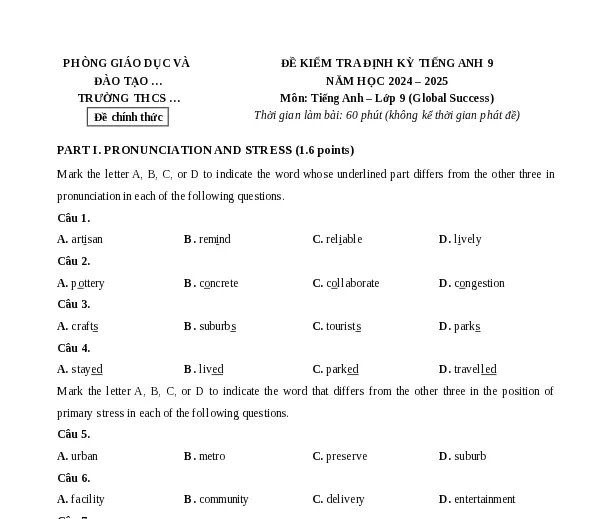
PHẦN 1. NGỮ ÂM VÀ TRỌNG ÂM (Câu 1 – 10)
A. Pronunciation (Câu 1 – 5)
Choose the word whose underlined part is pronounced differently from the others in each of the following questions.
Câu 1.
A. urban
B. unique
C. union
D. universe
Câu 2.
A. character
B. chemistry
C. chore
D. chaos
Câu 3.
A. honest
B. habit
C. honour
D. hour
Câu 4.
A. research
B. visit
C. desert
D. present
Câu 5.
A. food
B. moon
C. blood
D. school
B. Stress (Câu 6 – 10)
Choose the word that differs from the other three in the position of primary stress in each of the following questions.
Câu 6.
A. repeat
B. begin
C. enjoy
D. visit
Câu 7.
A. influence
B. develop
C. consist
D. arrive
Câu 8.
A. communicate
B. community
C. communicative
D. communication
Câu 9.
A. popularity
B. available
C. possible
D. reality
Câu 10.
A. musical
B. chemistry
C. physical
D. economics
PHẦN 2. TỪ VỰNG VÀ NGỮ PHÁP (Câu 11 – 50)
Choose the best answer to complete each of the following sentences.
A. Tenses and verb forms (Câu 11 – 15)
Câu 11. By the time the volunteers ______ the community centre, the children ______ for over an hour.
A. reached / had been waiting
B. had reached / were waiting
C. reached / have been waiting
D. were reaching / had waited
Câu 12. This time next month, our class ______ part of a tree-planting campaign in the suburbs.
A. takes
B. will be taking
C. has taken
D. took
Câu 13. She ______ three articles about urban sustainability since she ______ the club.
A. wrote / joined
B. has written / joined
C. wrote / has joined
D. has written / has joined
Câu 14. The company ______ its carbon footprint by 30% before the new regulations came into force.
A. was reducing
B. has reduced
C. had reduced
D. reduces
Câu 15. I ______ the report by 5 p.m. tomorrow, so I ______ you then.
A. will finish / am calling
B. have finished / will call
C. will be finishing / call
D. will have finished / will call
B. Cleft sentences (Câu 16 – 18)
Câu 16. ______ the local council that decided to ban single-use plastics in the town market last year.
A. It was
B. It is
C. There was
D. That was
Câu 17. ______ she enjoys most about volunteering is the chance to meet new people.
A. That
B. What
C. Which
D. It
Câu 18. It was not until 2019 ______ the city introduced a bike-sharing scheme.
A. when
B. which
C. that
D. then
C. Inversion (Câu 19 – 22)
Câu 19. Never ______ such a well-designed eco-friendly neighbourhood.
A. I have seen
B. have I seen
C. I saw
D. did I saw
Câu 20. Hardly ______ the announcement when the phone rang.
A. had she made
B. she had made
C. did she make
D. she made
Câu 21. Only after the volunteers had cleaned the beach ______ how much plastic had been dumped.
A. they realised
B. they had realised
C. did they realise
D. realised they
Câu 22. So ______ that the whole neighbourhood had to be evacuated.
A. the storm was severe
B. was the storm severe
C. severe the storm was
D. severe was the storm
D. Participle clauses (Câu 23 – 25)
Câu 23. ______ by the positive feedback, the organisers decided to make the event annual.
A. Encouraging
B. Encouraged
C. Having encouraged
D. To encourage
Câu 24. ______ the instructions carefully, she submitted her application for the internship.
A. Reading
B. To read
C. Having read
D. Read
Câu 25. The report ______ by the environmental agency last week warned about rising sea levels.
A. publishing
B. published
C. was published
D. to publish
E. Conditionals and conditional linkers (Câu 26 – 29)
Câu 26. If the city ______ more trees ten years ago, the temperature now ______ noticeably lower.
A. planted / would be
B. had planted / would have been
C. planted / would have been
D. had planted / would be
Câu 27. ______ you leave now, you will miss the opening ceremony.
A. Unless
B. If
C. Provided that
D. As long as
Câu 28. ______ I had known about the volunteer programme, I would have applied.
A. If
B. Should
C. Had
D. Were
Câu 29. The project will go ahead ______ the funding is approved by the end of this month.
A. unless
B. provided that
C. even if
D. otherwise
F. Concession (Câu 30 – 32)
Câu 30. ______ the high cost, the company installed solar panels on all its factories.
A. Despite
B. Although
C. Because of
D. However
Câu 31. No matter ______ hard she tried, she couldn't persuade the committee.
A. what
B. which
C. however
D. how
Câu 32. ______ as it may seem, the idea of a car-free city centre is gaining support.
A. Strange
B. Strangely
C. As strange
D. Strange though
G. Phrasal verbs, idioms and fixed phrases (Câu 33 – 37)
Câu 33. The new manager ______ the idea of flexible working hours at the meeting.
A. put off
B. put up
C. put forward
D. put down
Câu 34. The old factory was ______ to make way for a public park.
A. pulled off
B. pulled up
C. pulled through
D. pulled down
Câu 35. We need to ______ the amount of waste we produce if we want a sustainable city.
A. cut down on
B. cut off
C. cut in
D. cut out
Câu 36. The committee ______ the proposal because it was too expensive.
A. turned up
B. turned down
C. turned into
D. turned out
Câu 37. Donating a few books is just ______ compared with what the school library really needs.
A. a piece of cake
B. a storm in a teacup
C. a drop in the ocean
D. the tip of the iceberg
H. Word formation (Câu 38 – 41)
Supply the correct form of the word in brackets.
Câu 38. The new policy is expected to be highly ______ for small businesses. (BENEFIT)
A. beneficially
B. beneficent
C. benefit
D. beneficial
Câu 39. The ______ of the scheme was questioned by local residents. (VIABLE)
A. viability
B. viably
C. viable
D. viableness
Câu 40. Despite the ______, the volunteers managed to finish the clean-up. (HARD)
A. hardness
B. hardship
C. hardened
D. hardly
Câu 41. The proposal was rejected on the ______ that it was too costly. (GROUND)
A. grounding
B. grounded
C. grounds
D. groundless
I. Synonyms and antonyms (Câu 42 – 45)
Choose the word CLOSEST in meaning to the underlined word (Câu 42, 43) or OPPOSITE in meaning to it (Câu 44, 45).
Câu 42. The government has pledged to tackle air pollution in major cities.
A. ignore
B. postpone
C. avoid
D. address
Câu 43. The new housing project will cater for thousands of low-income families.
A. provide for
B. take over
C. look after
D. put up with
Câu 44. The company decided to expand its operations in rural areas.
A. enlarge
B. cut back
C. extend
D. develop
Câu 45. Her attitude towards the project was enthusiastic.
A. keen
B. eager
C. indifferent
D. passionate
J. Words with multiple meanings (Câu 46 – 48)
Choose the word that can fill ALL THREE gaps in each group.
Câu 46.
(1) Please write your name and ______ on the application form.
(2) The mayor will ______ the crowd at the opening ceremony.
(3) The government must ______ the root causes of pollution.
A. approach
B. address
C. solve
D. discuss
Câu 47.
(1) It doesn't ______ if we are a few minutes late.
(2) This is a serious ______ that needs our attention.
(3) What's the ______ with your bike?
A. problem
B. issue
C. concern
D. matter
Câu 48.
(1) The trade ______ attracts thousands of visitors every year.
(2) It is not ______ to blame her for the mistake.
(3) She has ______ hair and blue eyes.
A. fair
B. just
C. even
D. fine
K. Topic vocabulary (Câu 49 – 50)
Câu 49. The new neighbourhood was designed to be ______, with shops, schools and parks within walking distance.
A. self-sufficient
B. spacious
C. walkable
D. affordable
Câu 50. Many young people are turning to ______ work, hoping to build a career without a fixed office.
A. distant
B. remote
C. far
D. removed
PHẦN 3. ĐỌC HIỂU (Câu 51 – 70)
A. Cloze test (Câu 51 – 60)
Read the following passage and choose the best option to complete each gap.
More than half of the world's population now lives in cities, and that figure is (51) ______ to rise. As urban areas expand, planners face a difficult question: how can cities grow without (52) ______ the environment?
One promising approach is the "15-minute city", a model (53) ______ residents can reach schools, shops, offices and parks within a quarter of an hour on foot or by bike. The idea (54) ______ to reduce traffic and cut air pollution, while also strengthening local communities. In Paris, several neighbourhoods have already been redesigned (55) ______ these lines.
Critics, (56) ______, point out that such schemes work best in dense, well-connected areas. In cities (57) ______ weak public transport systems, simply encouraging people to stay local may deepen inequality. (58) ______ the criticism, the idea has spread rapidly: more than fifty cities worldwide are now experimenting with it.
(59) ______ this approach will succeed everywhere remains to be seen. What is needed now is not a single solution (60) ______ a willingness to experiment, learn and adapt.
Câu 51.
A. expected
B. expecting
C. expectation
D. expect
Câu 52.
A. damage
B. damaging
C. damaged
D. to damage
Câu 53.
A. which
B. that
C. where
D. when
Câu 54.
A. aim
B. aims
C. aiming
D. aimed
Câu 55.
A. by
B. on
C. along
D. for
Câu 56.
A. therefore
B. moreover
C. otherwise
D. however
Câu 57.
A. with
B. of
C. on
D. by
Câu 58.
A. Although
B. Because
C. Despite
D. However
Câu 59.
A. That
B. If
C. What
D. Whether
Câu 60.
A. and
B. but
C. or
D. so
B. Reading comprehension (Câu 61 – 66)
Read the following passage and choose the best answer to each of the questions.
When Marta opened the door of the community hall on a grey Saturday morning, she expected a handful of visitors. By ten o'clock, forty people had squeezed into the room, clutching broken lamps, torn jackets and silent radios. This was the town's first Repair Café — a simple idea with a surprisingly powerful reach.
The concept began in Amsterdam in 2009. Martine Postma, a journalist, was frustrated by how quickly everyday objects were thrown away. She organised an afternoon where volunteers with practical skills could fix neighbours' possessions for free. The rule was straightforward: bring a broken item, sit with the person repairing it, and learn something in the process. Today there are more than 2,500 Repair Cafés worldwide, and some also run short workshops on electronics, sewing and bicycle maintenance, so that skills are passed on rather than merely applied.
What makes the movement unusual is that it treats repair as a social activity rather than a service. Visitors do not simply drop off a toaster and collect it later; they sit beside the volunteer, hold the torch, and ask questions. "People come for the repair, but they stay for the conversation," Postma once said. Organisers report that the most valuable outcome is often not the fixed object but the confidence visitors gain to attempt their own repairs.
The environmental case is easy to state but harder to measure. A single repaired kettle saves perhaps a kilogram of plastic and metal, a figure that looks trivial beside the millions of tonnes of electronic waste produced each year. Critics therefore argue that Repair Cafés are little more than a comforting gesture, offering individuals a sense of virtue while doing nothing to disturb the industries that design products to fail. Defenders reply that the movement was never intended to solve the waste problem alone. Its purpose, they say, is to change expectations — to make throwing something away feel like a last resort rather than a first instinct.
There is some evidence that this shift is happening. Several European governments now require manufacturers to provide spare parts for a minimum number of years, and "right to repair" legislation has been debated in parliaments far beyond Europe. Campaigners admit that such laws owe more to professional lobbying than to Saturday morning volunteers, but they insist the two are connected: politicians act when they sense that voters care.
For Marta, the debate feels distant. What she remembers from that first morning is an elderly man who arrived with a broken clock and left with it ticking again. He returned the following month — not with another broken object, but with a toolbox, ready to help. "That," she says, "is how a community repairs itself."
Câu 61. What is the passage mainly about?
A. The damage that electronic waste does to the environment
B. The origins, aims and impact of the Repair Café movement
C. The technical difficulties volunteers face when repairing objects
D. Government legislation on the "right to repair"
Câu 62. What is the author's main purpose in writing the passage?
A. To persuade readers to stop buying new household appliances
B. To criticise governments for acting too slowly on waste
C. To entertain readers with an amusing personal story
D. To inform readers about a movement and the debate surrounding it
Câu 63. According to the passage, what do visitors do at a Repair Café?
A. They leave their items and collect them later.
B. They pay a small fee for each repaired object.
C. They sit beside the volunteer and learn from the process.
D. They teach volunteers how to use tools.
Câu 64. What can be inferred about the environmental impact of Repair Cafés?
A. It is large enough to reduce global electronic waste.
B. It is difficult to measure and limited in scale.
C. It has been precisely calculated by researchers.
D. It is greater than the impact of new legislation.
Câu 65. Which of the following is NOT mentioned in the passage?
A. The movement began in the Netherlands.
B. Volunteers repair items without charging.
C. Some governments require spare parts to be available.
D. Repair Cafés are funded by local councils.
Câu 66. The word "trivial" in paragraph 4 is closest in meaning to ______.
A. insignificant
B. harmful
C. complicated
D. impressive
C. Summary completion (Câu 67 – 70)
Complete each gap with NO MORE THAN THREE WORDS taken from the passage.
The Repair Café movement began in Amsterdam in 2009. At these events, volunteers repair broken items without charge, and visitors are encouraged to (67) __________ the volunteer instead of simply dropping off their possessions. Organisers claim that the most valuable result is the (68) __________ visitors gain to carry out repairs themselves. Critics regard the movement as little more than a (69) __________, but supporters say its aim is to change public expectations. Recently, some governments have required manufacturers to supply (70) __________.
Câu 67. __________
Câu 68. __________
Câu 69. __________
Câu 70. __________
PHẦN 4. ĐIỀN TỪ VÀO ĐOẠN VĂN (Câu 71 – 80)
Fill in each gap with ONE suitable word.
Educational trips are often the first thing to be cut (71) ______ school budgets are tightened, yet they may be (72) ______ of the most valuable experiences a teenager can have. Away from their desks, students discover that learning is not confined (73) ______ textbooks.
Teachers who organise such visits insist that careful preparation matters (74) ______ than the destination itself. Pupils should be given a task to complete (75) ______ they are on site; otherwise the trip becomes little (76) ______ a day out. It is also important to prepare for the unexpected: (77) ______ the weather turns bad, a well-planned schedule should include an indoor alternative.
(78) ______ the paperwork involved, many teachers believe the effort is worthwhile. Students who struggle in class often flourish (79) ______ they are given responsibility, such as recording data or guiding a group. Back at school, these experiences can be used as a starting point for project work, (80) ______ gives the trip a lasting purpose.
PHẦN 5. VIẾT (Câu 81 – 100)
Complete the second sentence so that it means the same as the first, using the word given. Do not change the word given.
Câu 81. She had never seen such a beautiful sunset before.
Never .................................................................................... .
Câu 82. The council only realised the mistake after the trees had been cut down.
Only after .............................................................................. .
Câu 83. If you don't apply now, you will miss the deadline.
Unless .................................................................................. .
Câu 84. He was so exhausted that he fell asleep immediately.
So ........................................................................................ .
Câu 85. Although it rained heavily, the clean-up went ahead.
In spite of ............................................................................. .
Câu 86. "Why don't we start a community garden?" said Lan.
Lan suggested ........................................................................ .
Câu 87. The company has reduced its staff by 20 per cent.
There has been ...................................................................... .
Câu 88. She was the first person to notice the fire.
It was .................................................................................. .
Câu 89. The project failed because the funding was inadequate.
Had ..................................................................................... .
Câu 90. He doesn't speak English fluently, so he can't apply for the job.
If ........................................................................................ .
Câu 91. "I didn't damage the equipment," said the student.
The student denied .................................................................. .
Câu 92. The government is going to ban single-use plastics next year.
Single-use plastics .................................................................. .
Câu 93. As soon as the volunteers arrived, it started to rain.
No sooner ............................................................................. .
Câu 94. She spends two hours a day practising the piano.
It takes ................................................................................ .
Câu 95. He is too young to be responsible for the whole team.
He is not .............................................................................. .
Câu 96. Setting up an online account is very easy. (CAKE)
Setting up an online account is .................................................. .
Câu 97. Although she was inexperienced, she did the job well.
Inexperienced ........................................................................ .
Câu 98. Somebody should have cleaned the drains before the storm.
The drains ............................................................................ .
Câu 99. The number of tourists has increased sharply, which has boosted local business.
The sharp ............................................................................. .
Câu 100. I can't tolerate his constant complaining any longer. (PUT)
I can't ................................................................................. .
--------- HẾT ---------
Họ và tên thí sinh: ................................................ Số báo danh: ........................
UBND XÃ/PHƯỜNG …
TRƯỜNG THCS …
Hướng dẫn chấm
ĐỀ LUYỆN THI HỌC SINH GIỎI LỚP 9
Môn: Tiếng Anh – Lớp 9
HƯỚNG DẪN CHẤM VÀ THANG ĐIỂM
A. HƯỚNG DẪN CHUNG
- Bài thi gồm 100 câu, thang điểm 100; mỗi câu trả lời đúng được 1,0 điểm.
- Tổng điểm toàn bài là 100 điểm, không quy đổi về thang 10.
- Phần trắc nghiệm: chỉ chấp nhận một phương án đúng duy nhất.
- Phần viết: chấp nhận các cách diễn đạt khác miễn đúng nghĩa, đúng cấu trúc và giữ nguyên từ gợi ý; không trừ điểm nếu học sinh viết hoa/viết thường khác đáp án.
- Phần điền từ: mỗi chỗ trống chỉ điền MỘT từ; sai chính tả không cho điểm.
- Không trừ điểm trình bày.
B. ĐÁP ÁN VÀ THANG ĐIỂM
Phần 1. Ngữ âm và trọng âm (Câu 1 – 10): mỗi câu đúng 1,0 điểm.
Câu | 1 | 2 | 3 | 4 | 5 | 6 | 7 | 8 | 9 | 10 |
|---|---|---|---|---|---|---|---|---|---|---|
Đáp án | A | C | B | A | C | D | A | D | C | D |
Phần 2. Từ vựng và ngữ pháp (Câu 11 – 50): mỗi câu đúng 1,0 điểm.
Câu | 11 | 12 | 13 | 14 | 15 | 16 | 17 | 18 | 19 | 20 |
|---|---|---|---|---|---|---|---|---|---|---|
Đáp án | A | B | B | C | D | A | B | C | B | A |
Câu | 21 | 22 | 23 | 24 | 25 | 26 | 27 | 28 | 29 | 30 |
|---|---|---|---|---|---|---|---|---|---|---|
Đáp án | C | D | B | C | B | D | A | C | B | A |
Câu | 31 | 32 | 33 | 34 | 35 | 36 | 37 | 38 | 39 | 40 |
|---|---|---|---|---|---|---|---|---|---|---|
Đáp án | D | A | C | D | A | B | C | D | A | B |
Câu | 41 | 42 | 43 | 44 | 45 | 46 | 47 | 48 | 49 | 50 |
|---|---|---|---|---|---|---|---|---|---|---|
Đáp án | C | D | A | B | C | B | D | A | C | B |
Phần 3. Đọc hiểu (Câu 51 – 70): mỗi câu đúng 1,0 điểm.
Câu | 51 | 52 | 53 | 54 | 55 | 56 | 57 | 58 | 59 | 60 |
|---|---|---|---|---|---|---|---|---|---|---|
Đáp án | A | B | C | B | C | D | A | C | D | B |
Câu | 61 | 62 | 63 | 64 | 65 | 66 | 67 | 68 | 69 | 70 |
|---|---|---|---|---|---|---|---|---|---|---|
Đáp án | B | D | C | B | D | A | sit beside | confidence | comforting gesture | spare parts |
Phần 4. Điền từ (Câu 71 – 80): mỗi câu đúng 1,0 điểm.
Câu | 71 | 72 | 73 | 74 | 75 | 76 | 77 | 78 | 79 | 80 |
|---|---|---|---|---|---|---|---|---|---|---|
Đáp án | when | one | to | more | while | more | if | Despite | once | which |
Phần 5. Viết (Câu 81 – 100): mỗi câu đúng 1,0 điểm.
Câu | Đáp án | Điểm |
|---|---|---|
81 | Never had she seen such a beautiful sunset before. | 1,0 |
82 | Only after the trees had been cut down did the council realise the mistake. | 1,0 |
83 | Unless you apply now, you will miss the deadline. | 1,0 |
84 | So exhausted was he that he fell asleep immediately. | 1,0 |
85 | In spite of the heavy rain, the clean-up went ahead. (Chấp nhận: In spite of the fact that it rained heavily, …) | 1,0 |
86 | Lan suggested starting a community garden. (Chấp nhận: Lan suggested that they (should) start a community garden.) | 1,0 |
87 | There has been a 20 per cent reduction in the company's staff. (Chấp nhận: … a reduction of 20 per cent in the company's staff.) | 1,0 |
88 | It was she who first noticed the fire. (Chấp nhận: It was her who …) | 1,0 |
89 | Had the funding been adequate, the project would not have failed. | 1,0 |
90 | If he spoke English fluently, he could apply for the job. | 1,0 |
91 | The student denied damaging the equipment. (Chấp nhận: … having damaged …) | 1,0 |
92 | Single-use plastics are going to be banned next year. | 1,0 |
93 | No sooner had the volunteers arrived than it started to rain. | 1,0 |
94 | It takes her two hours a day to practise the piano. | 1,0 |
95 | He is not old enough to be responsible for the whole team. | 1,0 |
96 | Setting up an online account is a piece of cake. | 1,0 |
97 | Inexperienced as she was, she did the job well. | 1,0 |
98 | The drains should have been cleaned before the storm. | 1,0 |
99 | The sharp increase in the number of tourists has boosted local business. | 1,0 |
100 | I can't put up with his constant complaining any longer. | 1,0 |
C. GIẢI THÍCH CHI TIẾT
PHẦN 1
Câu 1. A. urban /ˈɜːbən/ — "u" đọc /ɜː/; unique /juːˈniːk/, union /ˈjuːniən/, universe /ˈjuːnɪvɜːs/ đều đọc /juː/.
Câu 2. C. chore /tʃɔː/ — "ch" đọc /tʃ/; character /ˈkærəktə/, chemistry /ˈkemɪstri/, chaos /ˈkeɪɒs/ đọc /k/.
Câu 3. B. habit /ˈhæbɪt/ — "h" được phát âm; honest, honour, hour có "h" câm.
Câu 4. A. research /rɪˈsɜːtʃ/ — "s" đọc /s/; visit /ˈvɪzɪt/, desert /ˈdezət/, present /ˈpreznt/ đọc /z/.
Câu 5. C. blood /blʌd/ — "oo" đọc /ʌ/; food /fuːd/, moon /muːn/, school /skuːl/ đọc /uː/.
Câu 6. D. visit /ˈvɪzɪt/ trọng âm âm tiết 1; repeat /rɪˈpiːt/, begin /bɪˈɡɪn/, enjoy /ɪnˈdʒɔɪ/ trọng âm âm tiết 2.
Câu 7. A. influence /ˈɪnfluəns/ trọng âm âm tiết 1; các từ còn lại trọng âm âm tiết 2.
Câu 8. D. communication /kəˌmjuːnɪˈkeɪʃn/ trọng âm âm tiết 4; ba từ còn lại trọng âm âm tiết 2.
Câu 9. C. possible /ˈpɒsəbl/ trọng âm âm tiết 1; popularity (âm 3), available (âm 2), reality (âm 2).
Câu 10. D. economics /ˌiːkəˈnɒmɪks/ trọng âm âm tiết 3; musical, chemistry, physical trọng âm âm tiết 1.
PHẦN 2
Câu 11. A. "By the time + QKĐ", hành động đang kéo dài trước đó dùng QKHT tiếp diễn: had been waiting.
Câu 12. B. "This time next month" chỉ thời điểm đang diễn ra ở tương lai → tương lai tiếp diễn.
Câu 13. B. "since + QKĐ" trong mệnh đề phụ, mệnh đề chính dùng HTHT (has written).
Câu 14. C. "before the new regulations came" — hành động xảy ra trước một mốc quá khứ → QKHT.
Câu 15. D. "by 5 p.m. tomorrow" → tương lai hoàn thành; "so I will call you then" → tương lai đơn.
Câu 16. A. Câu chẻ "It was … that …" nhấn mạnh chủ ngữ the local council; "last year" → quá khứ.
Câu 17. B. Câu chẻ giả (pseudo-cleft) "What + S + V … is …".
Câu 18. C. Cấu trúc "It was not until … that …".
Câu 19. B. Never đứng đầu câu → đảo ngữ với trợ động từ: "Never have I seen …".
Câu 20. A. "Hardly + had + S + PII + when …".
Câu 21. C. "Only after + mệnh đề + trợ động từ + S + V".
Câu 22. D. "So + adj + be + S + that …".
Câu 23. B. Bị động rút gọn: "Encouraged by …, the organisers …" (được khích lệ).
Câu 24. C. Hành động xảy ra trước → "Having + PII".
Câu 25. B. Rút gọn mệnh đề quan hệ bị động: "the report (which was) published …".
Câu 26. D. Câu điều kiện hỗn hợp: giả thiết quá khứ (had planted), kết quả hiện tại (would be).
Câu 27. A. Unless = if … not: "Unless you leave now, you will miss …".
Câu 28. C. Đảo ngữ điều kiện loại 3: "Had I known …, I would have applied."
Câu 29. B. provided that = với điều kiện là.
Câu 30. A. Despite + N phrase; Although cần mệnh đề.
Câu 31. D. "No matter how + adj/adv + S + V".
Câu 32. A. Cấu trúc nhượng bộ "Adj + as + S + may/might + V": Strange as it may seem.
Câu 33. C. put forward = đề xuất (một ý kiến, kế hoạch).
Câu 34. D. pull down = phá dỡ (công trình).
Câu 35. A. cut down on = cắt giảm.
Câu 36. B. turn down = từ chối (lời đề nghị).
Câu 37. C. a drop in the ocean = muối bỏ biển (không đáng kể).
Câu 38. D. Sau be và trạng từ highly cần tính từ: beneficial (có lợi).
Câu 39. A. Sau The cần danh từ: viability (tính khả thi).
Câu 40. B. Sau the cần danh từ: hardship (khó khăn, gian khổ).
Câu 41. C. Cụm cố định on the grounds that = với lý do là.
Câu 42. D. address = giải quyết, ứng phó (gần nghĩa với tackle).
Câu 43. A. provide for = đáp ứng nhu cầu, chu cấp cho (gần nghĩa với cater for).
Câu 44. B. Trái nghĩa với expand (mở rộng) là cut back (cắt giảm).
Câu 45. C. Trái nghĩa với enthusiastic (hào hứng) là indifferent (thờ ơ).
Câu 46. B. address: (1) địa chỉ; (2) phát biểu trước đám đông; (3) giải quyết vấn đề.
Câu 47. D. matter: (1) quan trọng; (2) vấn đề; (3) chuyện/trục trặc.
Câu 48. A. fair: (1) hội chợ; (2) công bằng; (3) sáng màu (tóc).
Câu 49. C. walkable = có thể đi bộ được (đô thị thiết kế cho người đi bộ).
Câu 50. B. remote work = làm việc từ xa.
PHẦN 3
Câu 51. A. Bị động "is expected to rise" (dự kiến sẽ tăng).
Câu 52. B. Sau giới từ without dùng V-ing: without damaging.
Câu 53. C. Đại từ quan hệ chỉ nơi chốn where thay cho "in the model".
Câu 54. B. Chủ ngữ The idea số ít → động từ aims.
Câu 55. C. Cụm cố định along these lines = theo hướng/đường lối này.
Câu 56. D. however = tuy nhiên (chuyển ý tương phản).
Câu 57. A. "cities with weak public transport systems" — with chỉ đặc điểm đi kèm.
Câu 58. C. Despite + N phrase: "Despite the criticism, …".
Câu 59. D. Whether … remains to be seen = liệu … vẫn còn chờ xem.
Câu 60. B. Cấu trúc "not A but B".
Câu 61. B. Bài đọc trình bày nguồn gốc, mục tiêu và tác động của phong trào Repair Café.
Câu 62. D. Mục đích: cung cấp thông tin về một phong trào và cuộc tranh luận xung quanh nó.
Câu 63. C. "they sit beside the volunteer, hold the torch, and ask questions".
Câu 64. B. "easy to state but harder to measure" và con số 1 kg rất nhỏ so với hàng triệu tấn rác thải điện tử → khó đo lường, quy mô hạn chế.
Câu 65. D. Bài không nói Repair Café được chính quyền địa phương tài trợ.
Câu 66. A. trivial = tầm thường, không đáng kể = insignificant.
Câu 67. sit beside. "they sit beside the volunteer".
Câu 68. confidence. "the confidence visitors gain to attempt their own repairs".
Câu 69. comforting gesture. "little more than a comforting gesture".
Câu 70. spare parts. "require manufacturers to provide spare parts".
PHẦN 4
Câu 71. when — "when school budgets are tightened" (khi ngân sách bị cắt giảm).
Câu 72. one — "one of the most valuable experiences".
Câu 73. to — "confined to textbooks" (bó hẹp trong sách vở).
Câu 74. more — so sánh hơn với than: "matters more than the destination".
Câu 75. while — "while they are on site" (trong khi ở địa điểm tham quan).
Câu 76. more — "little more than a day out" (chẳng khác nào một buổi đi chơi).
Câu 77. if — điều kiện: "if the weather turns bad".
Câu 78. Despite — "Despite the paperwork involved" (bất chấp giấy tờ thủ tục).
Câu 79. once — "once they are given responsibility" (một khi được giao trách nhiệm); chấp nhận when.
Câu 80. which — mệnh đề quan hệ không xác định thay cho cả mệnh đề trước.
PHẦN 5
Câu 81. Đảo ngữ với Never + trợ động từ + S + PII.
Câu 82. "Only after + mệnh đề" → đảo ngữ ở mệnh đề chính.
Câu 83. Unless = If … not.
Câu 84. "So + adj + be + S + that".
Câu 85. Although + mệnh đề → In spite of + cụm danh từ.
Câu 86. suggest + V-ing / suggest that + S + (should) + V.
Câu 87. Danh từ hoá: reduce → a 20 per cent reduction in.
Câu 88. Câu chẻ nhấn mạnh chủ ngữ: "It was she who …".
Câu 89. Đảo ngữ điều kiện loại 3: "Had + S + PII, S + would have + PII".
Câu 90. Điều kiện loại 2: If + QKĐ, S + could + V.
Câu 91. deny + V-ing / having + PII.
Câu 92. Chuyển sang bị động tương lai gần: are going to be banned.
Câu 93. "No sooner + had + S + PII + than + QKĐ".
Câu 94. "It takes + O + thời gian + to V".
Câu 95. too … to → not + adj + enough + to V.
Câu 96. Thành ngữ a piece of cake = việc rất dễ.
Câu 97. Nhượng bộ với tính từ: "Adj + as + S + be".
Câu 98. Bị động với động từ khuyết thiếu: should have been + PII.
Câu 99. Danh từ hoá: increase sharply → the sharp increase in.
Câu 100. Cụm động từ put up with = chịu đựng.
Học sinh làm theo cách khác, nếu đúng nghĩa và đúng cấu trúc vẫn cho điểm tối đa.