TRƯỜNG THCS NGUYỄN DU
TỔ TIẾNG ANH
Đề ôn tập
BÀI KIỂM TRA ĐÁNH GIÁ CHUYÊN ĐỀ UNIT 1
Môn: Tiếng Anh – Lớp 9
Thời gian làm bài: 60 phút (không kể thời gian phát đề)
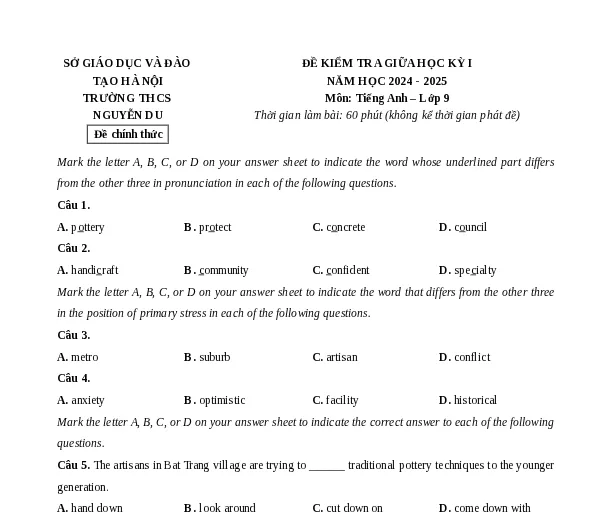
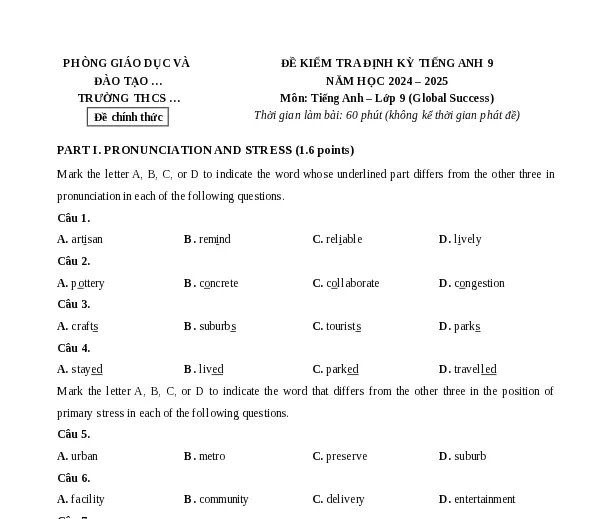
Mark the letter A, B, C, or D on your answer sheet to indicate the word whose underlined part differs from the other three in pronunciation in each of the following questions.
Câu 1.
A. candle
B. artisan
C. craft
D. pass
Câu 2.
A. garbage
B. village
C. fragrance
D. cottage
Mark the letter A, B, C, or D on your answer sheet to indicate the word that differs from the other three in the position of primary stress in each of the following questions.
Câu 3.
A. suburb
B. local
C. preserve
D. craftsperson
Câu 4.
A. electrician
B. community
C. facility
D. responsibility
Mark the letter A, B, C, or D on your answer sheet to indicate the correct answer to each of the following questions.
Câu 5. The town council decided to upgrade local public ______ such as parks, libraries, and sports centres to serve residents better.
A. facilities
B. occasions
C. fragrances
D. attractions
Câu 6. A skilled ______ can weave beautiful bamboo baskets without using any modern machinery.
A. electrician
B. firefighter
C. artisan
D. delivery person
Câu 7. Traditional pottery-making techniques have been ______ from generation to generation in Bat Trang village.
A. cut down on
B. handed down
C. looked around
D. come back
Câu 8. The doctor advised my uncle to ______ fast food and sugary drinks to improve his health.
A. get on with
B. cut down on
C. hand down
D. remind of
Câu 9. Residents in this neighbourhood always show great ______ by helping each other during hard times.
A. neighborly
B. neighbor
C. neighborliness
D. neighboring
Câu 10. We take great ______ in preserving our village's 500-year-old silk-weaving craft.
A. proud
B. pride
C. proudly
D. prideful
Câu 11. I really have no idea ______ to ask for directions because there is nobody on the street.
A. what
B. who
C. why
D. which
Câu 12. Nam is wondering ______ to buy the traditional conical hat or the silk scarf as a souvenir for his pen pal.
A. whether
B. if
C. why
D. that
Câu 13. Could you tell me ______ to repair these broken electrical wires safely?
A. how
B. what
C. why
D. which
Câu 14. Every citizen must ______ the law to ensure social order and protect public property.
A. sort
B. instruct
C. obey
D. shorten
Mark the letter A, B, C, or D on your answer sheet to indicate the best option to complete each of the following exchanges.
Câu 15. Lan: "Could you show me where to find the nearest craft workshop?" - Minh: "______"
A. Yes, it's very expensive.
B. Certainly. Just turn right at the next corner and walk 100 metres.
C. I like buying pottery there.
D. You must obey the traffic rules.
Câu 16. Tom: "Thank you very much for delivering this heavy parcel to my door!" - Delivery person: "______"
A. Don't mention it. Have a great day!
B. I'm not sure what to do.
C. It costs ten dollars.
D. Yes, I am a delivery person.
Mark the letter A, B, C, or D on your answer sheet to indicate the correct meaning of each sign or notice.
Câu 17. What does this notice tell residents to do?
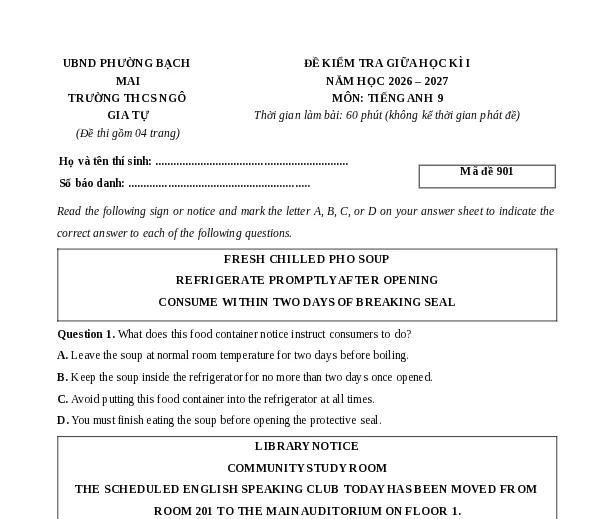
PLEASE SORT YOUR HOUSEHOLD WASTE BEFORE 7 P.M. DAILY
A. Residents must collect all rubbish from the suburb at 7 p.m.
B. People are asked to classify different types of garbage before 7 p.m. every day.
C. The garbage collectors only work before 7 a.m.
D. No one is allowed to throw away trash in this neighbourhood.
Câu 18. What does this sign mean?
WARNING: HIGH VOLTAGE! DO NOT TOUCH ELECTRICAL WIRES!
A. You can ask an electrician to turn on the electricity.
B. Touching the wires here is extremely dangerous and strictly prohibited.
C. You should shorten the electrical wires yourself.
D. Electricity will be cut off completely today.
Mark the letter A, B, C, or D on your answer sheet to indicate the word(s) CLOSEST in meaning to the underlined word(s) in each of the following questions.
Câu 19. Hoi An Ancient Town is a world-famous tourist attraction that welcomes millions of visitors each year.
A. unknown
B. well-known
C. local
D. modern
Câu 20. It is essential to preserve historical buildings so that future generations can understand our heritage.
A. destroy
B. protect
C. shorten
D. produce
Mark the letter A, B, C, or D on your answer sheet to indicate the word(s) OPPOSITE in meaning to the underlined word(s) in each of the following questions.
Câu 21. They decided to move from the noisy city centre to a peaceful suburb.
A. downtown area
B. countryside
C. craft village
D. residential area
Câu 22. Most young people in our village get on well with the elderly craftspeople.
A. have a good relationship with
B. obey the rules of
C. have conflicts with
D. take care of
Read the following passage and mark the letter A, B, C, or D on your answer sheet to indicate the correct word or phrase that best fits each of the numbered blanks from 23 to 27.
Community helpers play a vital role in keeping our neighbourhoods safe, clean, and functional. Every morning, garbage collectors wake up early to clear waste and ensure the streets remain clean. Firefighters are always prepared to put out fires and protect people's (23) ______ in emergencies. In addition, police officers maintain social order and remind citizens to obey the law.
Living in a close-knit community also means caring for one another. Many young people choose to work (24) ______ at community centres, offering tutoring to disadvantaged children or organizing social activities. Local authorities have also built more sports (25) ______ and parks to improve the quality of life. Whenever residents face difficulties, they often meet to discuss how (26) ______ solutions together. Thanks to mutual support and active (27) ______, our neighbourhood has become a pleasant and welcoming place for everyone.
Câu 23.
A. fragrance
B. property
C. pottery
D. craft
Câu 24.
A. voluntary
B. volunteer
C. voluntarily
D. volunteering
Câu 25.
A. facilities
B. occasions
C. artisans
D. specialities
Câu 26.
A. find
B. finding
C. to find
D. to finding
Câu 27.
A. contribution
B. neighborliness
C. development
D. attraction
Read the following passage and mark the letter A, B, C, or D on your answer sheet to indicate the correct answer to each of the questions from 28 to 32.
Bat Trang, situated on the bank of the Red River just outside Hanoi, is one of Vietnam's most celebrated traditional craft villages. With a history stretching back over five centuries, the village is renowned worldwide for its exquisite hand-crafted ceramics and porcelain. In the past, Bat Trang supplied fine pottery to royal palaces and exported products to several Asian countries.
Today, while modern industrial machines have replaced manual labour in many production sectors, artisans in Bat Trang still hand-craft their best-selling products. From preparing the clay and shaping the vessels on potters' wheels to painting intricate motifs and glazing, each step requires extraordinary patience and dexterity. The distinctive designs and high quality have turned the village into a major tourist attraction.
Visitors flocking to Bat Trang not only purchase souvenirs but also participate in pottery-making workshops. Under the guidance of seasoned craftsmen, tourists learn how to mould clay into bowls or cups and paint their own creations. Furthermore, local specialty foods served in village restaurants offer travellers a rich cultural experience.
However, Bat Trang faces challenges regarding environmental protection and retaining skilled young workers. Village elders are making strenuous efforts to pass down their unique craftsmanship to younger generations, ensuring that this priceless cultural heritage will flourish well into the future.
Câu 28. What is the main idea of the passage?
A. The history and daily challenges of modern shopping malls in Hanoi.
B. The preservation, traditional art, and tourism appeal of Bat Trang pottery village.
C. Why traditional handicrafts cannot compete with industrial machines.
D. The process of making Vietnamese specialty food in craft villages.
Câu 29. According to paragraph 1, Bat Trang pottery was once ______.
A. only sold to local farmers
B. made entirely by automated machinery
C. supplied to royal palaces and exported abroad
D. discovered by foreign tourists fifty years ago
Câu 30. The word "exquisite" in paragraph 1 is closest in meaning to ______.
A. extremely delicate and beautiful
B. cheap and simple
C. broken and useless
D. strange and frightening
Câu 31. What can tourists do when visiting Bat Trang according to paragraph 3?
A. Work as full-time firefighters and electricians.
B. Practice moulding clay and painting their own pottery items.
C. Rebuild the Red River dyke system.
D. Teach local artisans how to use modern computers.
Câu 32. The word "their" in paragraph 4 refers to ______.
A. challenges
B. village elders
C. tourists
D. souvenirs
Mark the letter A, B, C, or D on your answer sheet to indicate the correct arrangement of sentences to make a meaningful exchange or announcement.
Câu 33.
a. Sure. First, go straight along this street until you see the central library.
b. Excuse me, could you show me how to get to the traditional silk workshop?
c. That's very clear. Thank you so much for your help!
d. Then turn left into Nguyen Hue Street; the workshop is right next to the bakery.
A. b - a - d - c
B. b - d - a - c
C. a - d - b - c
D. c - b - a - d
Câu 34.
a. Our youth club is organising a clean-up campaign this Sunday morning.
b. If you want to join, please register at the community centre before Friday.
c. Together, we can make our neighbourhood greener and cleaner!
d. All volunteers will help sort garbage and plant new trees along the main road.
A. a - b - d - c
B. a - d - b - c
C. d - a - c - b
D. b - a - d - c
Mark the letter A, B, C, or D on your answer sheet to indicate the sentence that is closest in meaning to each of the following questions.
Câu 35. "Where should I buy genuine hand-crafted souvenirs?" asked Linda.
A. Linda wondered where to buy genuine hand-crafted souvenirs.
B. Linda asked where buying genuine hand-crafted souvenirs.
C. Linda wondered why to buy genuine hand-crafted souvenirs.
D. Linda didn't know whether to buy genuine hand-crafted souvenirs or not.
Câu 36. My grandfather is not sure whether he should sell the old workshop or not.
A. My grandfather is not sure if to sell the old workshop or not.
B. My grandfather is not sure whether to sell the old workshop.
C. My grandfather doesn't know why to sell the old workshop.
D. My grandfather wonders how to sell the old workshop immediately.
Câu 37. Lan doesn't know who she should contact when there is an electrical emergency.
A. Lan doesn't know who to contact when there is an electrical emergency.
B. Lan doesn't know what to contact when there is an electrical emergency.
C. Lan has no idea who contacting when there is an electrical emergency.
D. Lan is wondering who should contact in an electrical emergency.
Mark the letter A, B, C, or D on your answer sheet to indicate the sentence that best combines each pair of sentences.
Câu 38. The artisan was extremely skillful. He could carve intricate patterns on hard eggshells.
A. The artisan was so skillful that he could carve intricate patterns on hard eggshells.
B. The artisan was too skillful to carve intricate patterns on hard eggshells.
C. Skillful as the artisan was, he couldn't carve patterns on eggshells.
D. Although the artisan was skillful, he carved patterns on eggshells.
Câu 39. We arrived at the local craft village. We wanted to find out how people made conical hats.
A. We arrived at the local craft village in order to finding out how to make conical hats.
B. We arrived at the local craft village so that we could find out how conical hats were made.
C. We arrived at the local craft village because we didn't know whether people made conical hats.
D. We arrived at the local craft village so as to look for people making conical hats.
Câu 40. He doesn't know how he can shorten this speech. He is asking his teacher for advice.
A. Not knowing how to shorten this speech, he is asking his teacher for advice.
B. Because he knows how to shorten the speech, he gives his teacher advice.
C. He asks his teacher whether to shorten the speech or not.
D. He doesn't know what to shorten this speech, so he asks his teacher.
--------- HẾT ---------
Họ và tên thí sinh: ................................................................ Số báo danh: ........................
HƯỚNG DẪN CHẤM VÀ ĐÁP ÁN CHI TIẾT
ĐỀ ÔN TẬP UNIT 1 - TIẾNG ANH 9
A. BẢNG ĐÁP ÁN (40 CÂU × 0,25 ĐIỂM = 10,0 ĐIỂM)
Câu | Đ/án | Câu | Đ/án | Câu | Đ/án | Câu | Đ/án |
|---|---|---|---|---|---|---|---|
1 | A | 11 | B | 21 | A | 31 | B |
2 | C | 12 | A | 22 | C | 32 | B |
3 | C | 13 | A | 23 | B | 33 | A |
4 | D | 14 | C | 24 | C | 34 | B |
5 | A | 15 | B | 25 | A | 35 | A |
6 | C | 16 | A | 26 | C | 36 | B |
7 | B | 17 | B | 27 | B | 37 | A |
8 | B | 18 | B | 28 | B | 38 | A |
9 | C | 19 | B | 29 | C | 39 | B |
10 | B | 20 | B | 30 | A | 40 | A |
B. GIẢI THÍCH CHI TIẾT TỪNG CÂU
Câu 1. Đáp án A
- A. candle /ˈkændl/ (nguyên âm /æ/)
- B. artisan /ˈɑːtɪzæn/ (nguyên âm /ɑː/)
- C. craft /krɑːft/ (nguyên âm /ɑː/)
- D. pass /pɑːs/ (nguyên âm /ɑː/)
Câu 2. Đáp án C
- A. garbage /ˈɡɑːbɪdʒ/
- B. village /ˈvɪlɪdʒ/
- C. fragrance /ˈfreɪɡrəns/ (chữ g phát âm là /ɡ/)
- D. cottage /ˈkɒtɪdʒ/
Câu 3. Đáp án C
- A. suburb /ˈsʌbɜːb/ (trọng âm 1)
- B. local /ˈləʊkəl/ (trọng âm 1)
- C. preserve /prɪˈzɜːv/ (trọng âm 2)
- D. craftsperson /ˈkrɑːftsˌpɜːsən/ (trọng âm 1)
Câu 4. Đáp án D
- A. electrician /ɪˌlekˈtrɪʃn/ (trọng âm 3)
- B. community /kəˈmjuːnəti/ (trọng âm 2)
- C. facility /fəˈsɪləti/ (trọng âm 2)
- D. responsibility /rɪˌspɒnsəˈbɪləti/ (trọng âm 4)
Câu 5. Đáp án A
- public facilities (danh từ): cơ sở vật chất / tiện ích công cộng (công viên, thư viện...).
- occasions: các dịp; fragrances: hương thơm; attractions: điểm thu hút.
Câu 6. Đáp án C
- artisan (n): thợ thủ công lành nghề.
- Lời dẫn nói về việc đan giỏ tre không dùng máy móc hiện đại nên chọn artisan.
Câu 7. Đáp án B
- hand down (cụm động từ): truyền lại (từ thế hệ này sang thế hệ khác).
- cut down on: cắt giảm; look around: ngắm nghía xung quanh; come back: quay trở lại.
Câu 8. Đáp án B
- cut down on (phrasal verb): cắt giảm (đồ ăn nhanh, đồ uống có đường).
Câu 9. Đáp án C
- Cần danh từ sau tính từ great.
- neighborliness (n): tình làng nghĩa xóm, sự thân thiện hàng xóm.
- neighbor (n): người hàng xóm; neighborly (adj): thân tình; neighboring (adj): lân cận.
Câu 10. Đáp án B
- Cấu trúc: take pride in something/doing something = tự hào về cái gì (= be proud of). Sau tính từ great cần danh từ pride.
Câu 11. Đáp án B
- Cấu trúc: Question word + to V.
- Ngữ cảnh: hỏi đường người nào (who to ask for directions vì vế sau có nobody). Ta không dùng why + to V.
Câu 12. Đáp án A
- Tường thuật lựa chọn Yes/No hoặc giữa hai khả năng (A or B): dùng whether + to V. Lưu ý: tuyệt đối không dùng if + to V.
Câu 13. Đáp án A
- how to repair: cách thức / làm thế nào để sửa dây điện an toàn.
Câu 14. Đáp án C
- Cụm từ cố định: obey the law (tuân thủ luật pháp).
Câu 15. Đáp án B
- Lan hỏi đường đến xưởng thủ công ("Could you show me where to find...?"). Minh chỉ đường lịch sự: "Certainly. Just turn right at the next corner..." (Chắc chắn rồi. Cứ rẽ phải ở góc tiếp theo...).
Câu 16. Đáp án A
- Đáp lại lời cảm ơn "Thank you very much...": "Don't mention it. Have a great day!" (Không có chi đâu. Chúc một ngày tốt lành!).
Câu 17. Đáp án B
- Biển báo: "PLEASE SORT YOUR HOUSEHOLD WASTE BEFORE 7 P.M. DAILY" (Xin vui lòng phân loại rác thải sinh hoạt trước 7 giờ tối hàng ngày). Đồng nghĩa với classify different types of garbage.
Câu 18. Đáp án B
- Biển báo: "WARNING: HIGH VOLTAGE! DO NOT TOUCH ELECTRICAL WIRES!" (Cảnh báo: Điện cao thế! Không chạm vào dây điện!). Cảnh báo việc chạm vào dây điện rất nguy hiểm và bị cấm.
Câu 19. Đáp án B
- world-famous (adj) = well-known (nổi tiếng thế giới).
- unknown: vô danh; local: địa phương; modern: hiện đại.
Câu 20. Đáp án B
- preserve (v) = protect (bảo tồn, gìn giữ, bảo vệ).
- destroy: phá hủy; shorten: rút ngắn; produce: sản xuất.
Câu 21. Đáp án A
- suburb (n): vùng ngoại ô >< downtown area (khu trung tâm thành phố).
Câu 22. Đáp án C
- get on well with (hòa thuận, có mối quan hệ tốt với ai) >< have conflicts with (xung đột, bất hòa với ai).
Câu 23. Đáp án B
- protect people's property: bảo vệ tài sản của người dân trong trường hợp khẩn cấp.
Câu 24. Đáp án C
- Sau động từ work cần một trạng từ: voluntarily (làm việc một cách tự nguyện / làm tình nguyện).
Câu 25. Đáp án A
- Cụm danh từ: sports facilities (cơ sở vật chất / khu tập luyện thể thao).
Câu 26. Đáp án C
- Cấu trúc: how + to V (tìm giải pháp cùng nhau).
Câu 27. Đáp án B
- mutual support and active neighborliness: sự hỗ trợ lẫn nhau và tình làng nghĩa xóm tích cực.
Câu 28. Đáp án B
- Bài đọc giới thiệu về lịch sử, quy trình làm gốm thủ công, hoạt động du lịch trải nghiệm và nỗ lực bảo tồn của làng gốm Bát Tràng.
Câu 29. Đáp án C
- Đoạn 1 nêu rõ: "In the past, Bat Trang supplied fine pottery to royal palaces and exported products to several Asian countries."
Câu 30. Đáp án A
- exquisite (adj): tinh xảo, tuyệt đẹp (= extremely delicate and beautiful).
Câu 31. Đáp án B
- Đoạn 3: "Under the guidance of seasoned craftsmen, tourists learn how to mould clay into bowls or cups and paint their own creations."
Câu 32. Đáp án B
- Từ "their" ở đoạn 4 thay thế cho danh từ số nhiều đứng trước: "Village elders are making strenuous efforts to pass down their unique craftsmanship..." (Các bậc cao niên trong làng nỗ lực truyền lại tay nghề độc đáo của họ...).
Câu 33. Đáp án A
- Trật tự hội thoại hợp lý: b (Hỏi đường) a (Chỉ dẫn bước 1) d (Chỉ dẫn bước 2) c (Cảm ơn).
Câu 34. Đáp án B
- Trật tự thông báo hợp lý: a (Giới thiệu chiến dịch dọn vệ sinh) d (Nhiệm vụ của tình nguyện viên) b (Hạn đăng ký) c (Khẩu hiệu kêu gọi).
Câu 35. Đáp án A
- Câu hỏi trực tiếp dạng Wh-question chuyển sang cấu trúc gián tiếp: wondered where to buy genuine hand-crafted souvenirs.
Câu 36. Đáp án B
- Cấu trúc: whether to V (không dùng if to V, không dùng why/how vì câu gốc diễn đạt sự đắn đo có nên bán hay không).
Câu 37. Đáp án A
- doesn't know who she should contact doesn't know who to contact (rút gọn mệnh đề danh ngữ bằng Wh-word + to V).
Câu 38. Đáp án A
- Cấu trúc kết hợp câu kết quả: so + adj + that + clause (Người thợ khéo tay đến mức ông ấy có thể chạm khắc những hoa văn tinh xảo trên vỏ trứng cứng).
Câu 39. Đáp án B
- Kết hợp câu chỉ mục đích: arrived at... so that we could find out... (Chúng tôi đến làng nghề thủ công để có thể tìm hiểu cách người ta làm nón lá).
Câu 40. Đáp án A
- Dùng phân từ hiện tại (Present participle clause) mang nghĩa nguyên nhân: Not knowing how to shorten this speech, he is asking his teacher for advice. (Vì không biết làm thế nào để rút ngắn bài phát biểu, cậu ấy đang hỏi xin lời khuyên từ cô giáo).