SỞ GIÁO DỤC VÀ ĐÀO TẠO TP. HỒ CHÍ MINH
TRƯỜNG THCS NGUYỄN DU
Đề chính thức
ĐỀ KIỂM TRA CHUYÊN ĐỀ NÂNG CAO LỚP 9
NĂM HỌC 2024 - 2025
Môn: Tiếng Anh – Unit 4: Remembering the past
Thời gian làm bài: 60 phút (không kể thời gian phát đề)
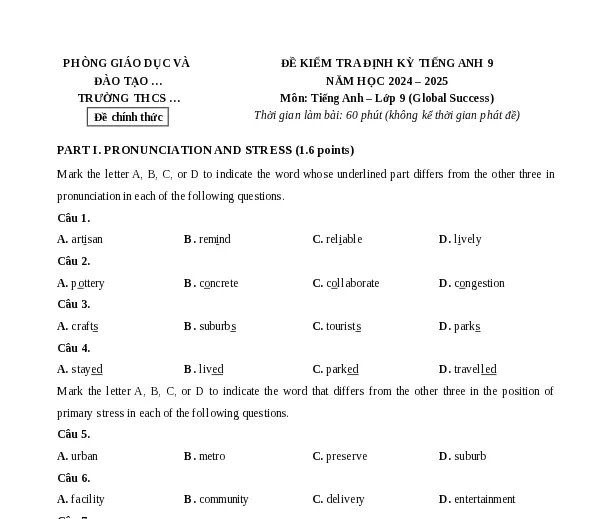
I. PRONUNCIATION & STRESS (1.0 point)
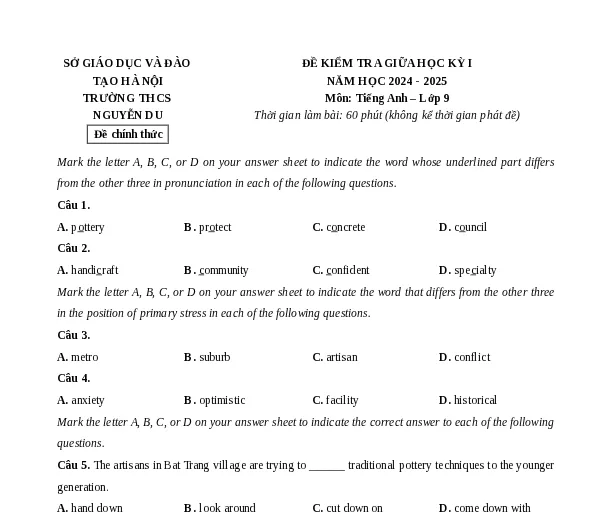
Choose the word whose underlined part is pronounced differently from that of the others.
Câu 1 (0,25 điểm).
A. preserve
B. observe
C. monuscript
D. artisan
Câu 2 (0,25 điểm).
A. ancestor
B. century
C. ceremony
D. monastic
Choose the word that differs from the other three in the position of primary stress.
Câu 3 (0,25 điểm).
A. heritage
B. monument
C. pottery
D. memorial
Câu 4 (0,25 điểm).
A. commemorate
B. historical
C. traditional
D. architectural
II. MULTIPLE CHOICE (2.0 points)
Choose the correct answer (A, B, C or D) to each of the following questions.
Câu 5 (0,25 điểm). While the elder artisans ______ the intricate bronze patterns, the apprentices were taking careful notes.
A. cast
B. were casting
C. had cast
D. are casting
Câu 6 (0,25 điểm). Many folk performances are on the brink of extinction; I wish the younger generation ______ more interest in preserving them.
A. took
B. will take
C. takes
D. has taken
Câu 7 (0,25 điểm). Our village is renowned for its centuries-old ______ of silk weaving, handed down through five generations.
A. craft
B. folklore
C. souvenir
D. generation
Câu 8 (0,25 điểm). The ancient Citadel of Hue was officially recognized as a UNESCO World Cultural ______ site in 1993.
A. Artifact
B. Heritage
C. Custom
D. Relic
Câu 9 (0,25 điểm). When my grandmother was young, people ______ send handwritten letters rather than instant digital messages.
A. got used to
B. were used to
C. used to
D. use to
Câu 10 (0,25 điểm). The communal house serves as a spiritual place to ______ local national heroes who sacrificed their lives for the homeland.
A. memorize
B. remind
C. commemorate
D. reconstruct
Câu 11 (0,25 điểm). - Liam: "Do you mind if I record the folk singer's performance during the ritual?" - Guide: "______"
A. Not at all, but please turn off your camera flash.
B. Yes, of course. Feel free to use your camera.
C. I'd love to, thanks for inviting me.
D. You can say that again; it was fantastic.
Câu 12 (0,25 điểm). - Mai: "It's such a pity that ancient calligraphy is fading away nowadays." - Phuc: "______. Cultural clubs are making great efforts to revive it."
A. That's completely true
B. I couldn't agree more
C. Not necessarily
D. You are welcome
III. SIGNS AND NOTICES (0.5 point)
Look at the sign or notice. Choose the best answer (A, B, C or D).
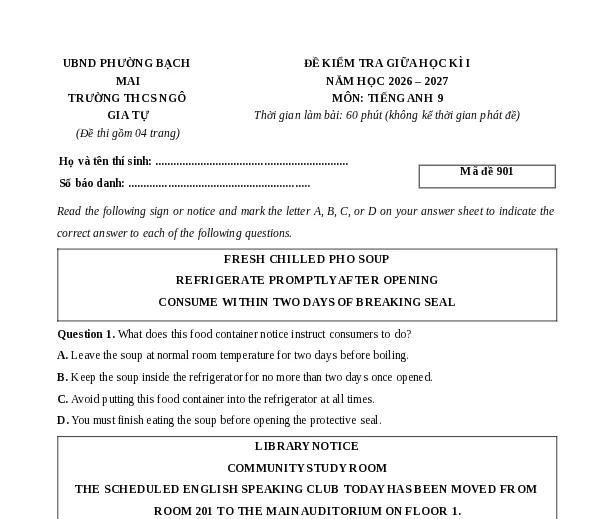
Câu 13 (0,25 điểm). What does this sign imply?
HISTORICAL MONUMENT RESTORATION IN PROGRESS
Please keep off the scaffoldings and mind falling debris.
A. Visitors can climb the scaffoldings to inspect the restoration.
B. Entry near the construction structures is unsafe and strictly discouraged.
C. The monument is fully open and free of all potential hazards.
D. Workers must remove all debris before visitors enter the courtyard.
Câu 14 (0,25 điểm). What should museum visitors do upon seeing this notice?
NO FLASH PHOTOGRAPHY ALLOWED
Sensitive ancient pigments may degrade under intense artificial light.
A. Take photos only when using flashlights.
B. Avoid taking photos with flash to prevent damaging antique artwork.
C. Pay an extra fee if they want to photograph the oil paintings.
D. Keep their mobile devices and digital cameras outside the gallery.
IV. CLOZE TEST (1.5 points)
Read the passage and choose the best option (A, B, C or D) for each space.
Preserving ancestral customs in modern times poses a significant challenge for rapid urban development. In many Asian communities, ancient craft villages were once thriving hubs where almost every household engaged in pottery, lacquerware, or silk weaving. However, with the rise of industrial mass production, traditional items have struggled to (15) ______ commercially viable.
Younger villagers, (16) ______ better employment prospects in metropolises, often show reluctance to inherit their parents' manual trades. While elderly masters are still (17) ______ their utmost to pass down ancestral secrets, the lack of enthusiastic learners remains alarming. Fortunately, many cultural advocates wish our modern society (18) ______ greater respect for artisanal values.
Innovative entrepreneurs are currently bridging this gap (19) ______ integrating experiential tourism into craft villages. Visitors can now shape clay pots themselves or dye organic fabrics alongside veteran artisans. This creative approach not only creates substantial income for local residents (20) ______ rekindles immense national pride in their intangible heritage.
Câu 15 (0,25 điểm).
A. stay
B. appear
C. look
D. sound
Câu 16 (0,25 điểm).
A. seeking
B. having sought
C. sought
D. to seek
Câu 17 (0,25 điểm).
A. paying
B. doing
C. taking
D. making
Câu 18 (0,25 điểm).
A. had paid
B. would pay
C. pays
D. is paying
Câu 19 (0,25 điểm).
A. on
B. by
C. at
D. with
Câu 20 (0,25 điểm).
A. and
B. yet
C. but also
D. as well
V. READING COMPREHENSION (1.5 points)
Read the following passage and do the tasks below.
Living museums, unlike conventional galleries where artifacts are enclosed in glass cases, offer visitors an immersive glimpse into past eras. One prime example is the Beamish Open Air Museum in northern England, which recreates daily life during the early 19th and 20th centuries. Spanning over three hundred acres, the site features working tramways, traditional bakeries, blacksmith forges, and fully furnished Victorian cottages.
Costumed interpreters, who play the roles of historical townsfolk, bring the entire setting to life. While tourists are wandering along the cobbled streets, they can smell coal smoke from old locomotives, taste freshly baked coal-oven breads, and witness craftsmen forging wrought iron by hand. Children are often fascinated by classroom lessons conducted in accordance with strict 19th-century disciplinary standards, where slate tablets replace modern touchscreens.
Supporters argue that experiential living museums foster deeper emotional bonds with collective memory than dry textbook descriptions. They allow younger generations to comprehend the arduous hardships and resilience of their forebears. Nevertheless, curators face recurring debates regarding historical authenticity versus commercial entertainment. Striking a delicate balance between educational integrity and engaging spectacle remains essential to sustaining such living memorials for years to come.
Decide whether the following statements are True (T) or False (F).
Câu 21 (0,25 điểm). Artifacts in living museums are typically displayed behind protective glass showcases.
Câu 22 (0,25 điểm). Visitors at Beamish can observe manual metalworking and taste traditional culinary products.
Câu 23 (0,25 điểm). Victorian-style school simulations in the museum allow students to experience modern digital gadgets.
Câu 24 (0,25 điểm). Museum curators must constantly reconcile the desire to educate visitors with the demand for entertainment.
Choose the best answer (A, B, C or D) for each question.
Câu 25 (0,25 điểm). The word "forebears" in paragraph 3 is closest in meaning to:
A. descendants
B. contemporaries
C. ancestors
D. predecessors
Câu 26 (0,25 điểm). What serves as the primary theme of the reading passage?
A. The decline of traditional educational practices during the Victorian era.
B. The innovative role of open-air living museums in preserving past heritage.
C. Technical procedures for maintaining 19th-century steam locomotives.
D. A comparison between English open-air attractions and Asian historical sites.
VI. WORD FORMATION (1.5 points)
Give the correct form of the word in brackets to complete each sentence.
Câu 27 (0,25 điểm). Local authorities are executing a comprehensive plan for the ______ of historical landmarks across the province. (PRESERVE)
Câu 28 (0,25 điểm). The old wooden pagoda was damaged in the blaze, but engineers managed to ______ its facade completely. (CONSTRUCT)
Câu 29 (0,25 điểm). Many exquisite ceramic vases displayed in the museum demonstrate remarkable ______ by ancient craftspeople. (ARTISAN)
Câu 30 (0,25 điểm). It is ______ that folk festivals strengthen communal solidarity among diverse generations. (DENY)
Câu 31 (0,25 điểm). Our grandfather loves telling stories about the country's turbulent past with deep ______ and pride. (EMOTIONAL)
Câu 32 (0,25 điểm). The museum installed multilingual audio guides to enhance the ______ value for foreign tourists. (EDUCATE)
VII. REARRANGEMENT (0.5 point)
Rearrange the groups of words in the correct order to make complete sentences.
Câu 33 (0,25 điểm). while / were cooking / My grandparents / the historic radio broadcast / listening to / dinner. / were
My grandparents _________________________________________________________________
Câu 34 (0,25 điểm). young people / value the / customs / I wish / handed down by / indigenous / their ancestors.
I wish ___________________________________________________________________________
VIII. SENTENCE TRANSFORMATION (1.5 points)
Rewrite each of the following sentences without changing its original meaning.
Câu 35 (0,25 điểm). In the past, people commonly rode trams to work in Hanoi, but now they ride motorbikes.
People used _____________________________________________________________________
Câu 36 (0,25 điểm). It is a pity that my school doesn't organize more excursions to historical heritage sites.
I wish my school __________________________________________________________________
Câu 37 (0,25 điểm). During the artisan's bamboo weaving demonstration, the electricity suddenly went out.
While the artisan __________________________________________________________________
Câu 38 (0,25 điểm). Although life in the subsidy era was impoverished, people maintained profound neighborliness.
In spite of _______________________________________________________________________
Câu 39 (0,25 điểm). The villagers take immense pride in their century-old traditional conical hat craft.
The villagers are __________________________________________________________________
Câu 40 (0,25 điểm). The last time the local committee renovated this commemorative monument was twenty years ago.
The local committee hasn't __________________________________________________________
--------- HẾT ---------
Họ và tên thí sinh: ........................................................... Số báo danh: ........................
HƯỚNG DẪN CHẤM VÀ ĐÁP ÁN CHI TIẾT
ĐỀ THI KIỂM TRA CHUYÊN ĐỀ NÂNG CAO - TIẾNG ANH 9 (UNIT 4)
A. HƯỚNG DẪN CHUNG
1. Giám khảo chấm đúng theo thang điểm 10,0 quy định của bài thi; mỗi câu trắc nghiệm và điền khuyết đạt 0,25 điểm.
2. Đối với phần biến đổi từ (Word Formation) và viết lại câu (Sentence Transformation), thí sinh sai chính tả, sai dạng thức ngữ pháp, thiếu mạo từ/giới từ làm thay đổi ý nghĩa câu sẽ bị trừ điểm theo từng phần hoặc không tính điểm theo quy định.
3. Chấp nhận các phương án viết lại câu tương đương đúng ngữ pháp và bám sát nét nghĩa gốc.
B. ĐÁP ÁN VÀ THANG ĐIỂM CHI TIẾT
Phần | Câu | Nội dung đáp án & Giải thích | Điểm |
|---|---|---|---|
I | 1 | C. manuscript (/s/ trong /ˈmænjuskrɪpt/, các từ còn lại phát âm là /z/: preserve /prɪˈzɜːv/, observe /əbˈzɜːv/, artisan /ˈɑːtɪzæn/). | 0,25 |
2 | D. monastic (/k/ trong /məˈnæstɪk/, các từ còn lại phát âm là /s/: ancestor /ˈænsestə/, century /ˈsentʃəri/, ceremony /ˈserəməni/). | 0,25 | |
3 | D. memorial (Trọng âm rơi vào âm tiết 2: /məˈmɔːriəl/; các từ còn lại rơi vào âm tiết 1: heritage /ˈherɪtɪdʒ/, monument /ˈmɒnjumənt/, pottery /ˈpɒtəri/). | 0,25 | |
4 | D. architectural (Trọng âm rơi vào âm tiết 3: /ˌɑːkɪˈtektʃərəl/; các từ còn lại rơi vào âm tiết 2: commemorate /kəˈmeməreɪt/, historical /hɪˈstɒrɪkl/, traditional /trəˈdɪʃənl/). | 0,25 | |
II | 5 | B. were casting (Hành động xảy ra đồng thời trong quá khứ: While + past continuous, past continuous). | 0,25 |
6 | A. took (Cấu trúc Wish cho hiện tại: S + wish(es) + S + V-ed/past simple). | 0,25 | |
7 | A. craft (Cụm từ craft of silk weaving - nghề thủ công dệt lụa). | 0,25 | |
8 | B. Heritage (Cụm danh từ cố định: UNESCO World Cultural Heritage site - di sản văn hoá thế giới). | 0,25 | |
9 | C. used to (Thói quen trong quá khứ đã chấm dứt: used to + V-infinitive). | 0,25 | |
10 | C. commemorate (commemorate national heroes - tưởng nhớ, tri ân các anh hùng dân tộc). | 0,25 | |
11 | A. Not at all, but please turn off your camera flash. (Đáp lại câu hỏi xin phép lịch sự "Do you mind...?"). | 0,25 | |
12 | C. Not necessarily (Bày tỏ quan điểm không hẳn đồng tình vì vế sau nêu nỗ lực phục hồi thư pháp). | 0,25 | |
III | 13 | B. Entry near the construction structures is unsafe and strictly discouraged. (Biển cảnh báo giàn giáo và gạch đá rơi). | 0,25 |
14 | B. Avoid taking photos with flash to prevent damaging antique artwork. (Không dùng đèn flash vì làm hại màu vẽ cổ). | 0,25 | |
IV | 15 | A. stay (stay commercially viable - duy trì khả năng sinh lời/tồn tại về mặt thương mại). | 0,25 |
16 | A. seeking (Mệnh đề phân từ rút gọn chủ động: Younger villagers, seeking better employment...). | 0,25 | |
17 | B. doing (Collocation: do one's utmost - dốc hết sức làm gì). | 0,25 | |
18 | B. would pay (Cấu trúc wish + would + V thể hiện mong muốn ai đó thay đổi hành vi/thái độ). | 0,25 | |
19 | B. by (Giới từ chỉ phương thức: by + V-ing - bằng cách...). | 0,25 | |
20 | C. but also (Cặp liên từ tương quan: not only ... but also ...). | 0,25 | |
V | 21 | False (Dòng 1: Living museums, unlike conventional galleries where artifacts are enclosed in glass cases...). | 0,25 |
22 | True (Đoạn 2: witness craftsmen forging wrought iron by hand... taste freshly baked coal-oven breads). | 0,25 | |
23 | False (Đoạn 2: where slate tablets replace modern touchscreens - bảng đá thay thế màn hình cảm ứng). | 0,25 | |
24 | True (Đoạn 3: curators face recurring debates regarding historical authenticity versus commercial entertainment). | 0,25 | |
25 | C. ancestors (forebears = tổ tiên, thế hệ đi trước = ancestors). | 0,25 | |
26 | B. The innovative role of open-air living museums in preserving past heritage. (Bài đọc nói về vai trò bảo tồn của bảo tàng sống). | 0,25 | |
VI | 27 | preservation (Sau mạo từ the và giới từ for cần danh từ). | 0,25 |
28 | reconstruct (Sau managed to + V-inf: tái tạo/xây dựng lại mặt tiền chùa). | 0,25 | |
29 | artistry / artisanship (Danh từ chỉ tính nghệ thuật, tay nghề thủ công điêu luyện). | 0,25 | |
30 | undeniable (Tính từ sau It is... that: không thể phủ nhận được). | 0,25 | |
31 | emotion (Danh từ sau tính từ deep và trước and pride). | 0,25 | |
32 | educational (Tính từ bổ nghĩa cho danh từ value). | 0,25 | |
VII | 33 | My grandparents were cooking dinner while they were listening to the historic radio broadcast. | 0,25 |
34 | I wish young people valued the indigenous customs handed down by their ancestors. | 0,25 | |
VIII | 35 | People used to ride trams to work in Hanoi (in the past). | 0,25 |
36 | I wish my school organized (more) excursions to historical heritage sites. | 0,25 | |
37 | While the artisan was demonstrating bamboo weaving, the electricity suddenly went out. | 0,25 | |
38 | In spite of poverty / being impoverished / their impoverished life in the subsidy era, people maintained profound neighborliness. | 0,25 | |
39 | The villagers are proud of their century-old traditional conical hat craft. | 0,25 | |
40 | The local committee hasn't renovated this commemorative monument for twenty years. | 0,25 | |
TỔNG | 10,0 | ||