SỞ GIÁO DỤC VÀ ĐÀO TẠO
THÀNH PHỐ HỒ CHÍ MINH
Đề tham khảo
ĐỀ KIỂM TRA CHuyên ĐỀ NÂNG CAO – UNIT 4
Môn: Tiếng Anh – Lớp 9 (Global Success)
Thời gian làm bài: 60 phút (không kể thời gian phát đề)
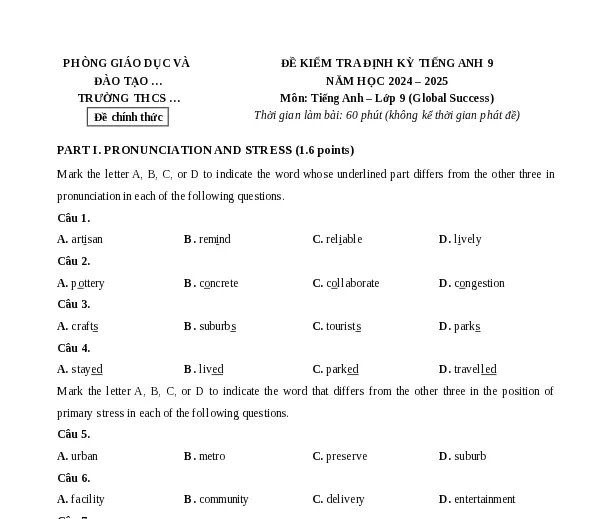
I. PRONUNCIATION AND STRESS (1,0 điểm)
Choose the word whose underlined part is pronounced differently from that of the others. (0,5 điểm)
Question 1 (0,25 điểm).
A. ancestral
B. citadel
C. custodian
D. century
Question 2 (0,25 điểm).
A. weave
B. treasure
C. heavenly
D. фeather
Choose the word whose primary stress is placed differently from that of the others. (0,5 điểm)
Question 3 (0,25 điểm).
A. communal
B.heritage
C. monument
D. ritual
Question 4 (0,25 điểm).
A. antiquity
B. anniversary
C. architecture
D. genealogy
II. MULTIPLE CHOICE (2,0 điểm)
Choose the word or phrase (A, B, C, or D) that best completes each of the following sentences.
Question 5 (0,25 điểm). At 8 p.m. yesterday, while the master artisan ______ molten bronze into the earthen mold, his apprentices ______ the furnace temperature with extreme caution.
A. poured / were regulating
B. was pouring / were regulating
C. was pouring / regulated
D. had poured / regulated
Question 6 (0,25 điểm). Looking at the dilapidated communal house, the village elders bitterly wish the local authorities ______ more stringent measures to protect it before the storm struck last month.
A. took
B. would take
C. had taken
D. were taking
Question 7 (0,25 điểm). The ancient secret of making royal celadon glaze was strictly ______ from father to eldest son, never once documented in written scrolls.
A. handed down
B. died out
C. lived on
D. looked back
Question 8 (0,25 điểm). Having lived in a bustling metropolis all her life, the young archivist wasn't accustomed ______ in absolute silence beside oil lamps during her field trip to the remote monastery.
A. to work
B. to working
C. working
D. work
Question 9 (0,25 điểm). The wooden pillars of the 17th-century pagoda remained remarkably ______ despite enduring centuries of monsoon rains and devastating wars.
A. fragile
B. obsolete
C. intact
D. transient
Question 10 (0,25 điểm). I would rather you ______ those ancient stone steles with bare hands; the natural oils on your skin can accelerate surface erosion.
A. don't touch
B. didn't touch
C. won't touch
D. haven't touched
Question 11 (0,25 điểm). During the feudal era, ordinary citizens had to walk barefoot when passing the imperial gate as a token of absolute submission and reverence. (Choose the word CLOSEST in meaning to the underlined word)
A. unshod
B. well-dressed
C. blindfolded
D. empty-handed
Question 12 (0,25 điểm). Liam: "Do you think we should digitize all these fragile palm-leaf manuscripts before locking them in the vault?"
Curator: "______"
A. I couldn't agree more; that's the most viable way to preserve their content for posterity.
B. Don't mention it; our ancestors were brilliant scribes.
C. Yes, I used to read them when I was a child.
D. What a pity! They should have been written on paper instead.
III. SIGNS AND NOTICES (0,5 điểm)
Look at the sign or notice and choose the best answer (A, B, C, or D) for each question.
Question 13 (0,25 điểm). What does this museum sign indicate?
[Hình vẽ]
A. Visitors are prohibited from taking any photographs inside the heritage archive.
B. Flash photography is forbidden because bright light can damage the ancient colors.
C. Only professional photographers with tripods are allowed to enter this room.
D. You must turn on your flashlight because the heritage archive is poorly lit.
Question 14 (0,25 điểm). What is true according to the announcement below?
[Hình vẽ]
A. Visitors wearing shorts can still enter if they purchase a sarong at Gate B.
B. You have to pay a rental fee in cash to borrow a sarong at the entrance.
C. Tourists dressed inappropriately can borrow a wrap for free by leaving their ID card.
D. Sleeveless tops are acceptable as long as visitors enter through Gate B.
IV. CLOZE TEST (1,5 điểm)
Read the following passage about an ancient timekeeping method and choose the word or phrase (A, B, C, or D) that best fits each numbered blank.
Long before mechanical clocks ticked in town squares, scholars in ancient Vietnam measured the passage of night using the Khắc Lậu—a sophisticated water clock system inside the Imperial Citadel. Unlike sundials, (15) ______ became entirely useless under overcast skies or after dusk, the water clock operated continuously through a series of tiered bronze vessels. Water dripped at a calibrated rate from upper reservoirs into a lowest cylinder, where a floating wooden indicator gradually rose, marking the hours.
Maintaining this timepiece was a (16) ______ duty assigned to royal astronomers. While the rest of the capital was sleeping, watchmen (17) ______ the water levels and striking giant bronze bells or leather drums to announce each watch of the night. Even a slight change in water viscosity during freezing winter nights could (18) ______ the accuracy of the clock, requiring attendants to warm the reservoirs with charcoal braziers.
Today, although such contraptions have been rendered obsolete by atomic timekeeping, they stand as a testament to our ancestors' (19) ______. Preserving the remaining artifacts of the Khắc Lậu allows modern generations to appreciate how people in the past perceived time—not as a frantic race against seconds, (20) ______ as a rhythmic flow in harmony with nature.
Question 15 (0,25 điểm).
A. that
B. which
C. what
D. whose
Question 16 (0,25 điểm).
A. sacred
B. casual
C. trivial
D. reckless
Question 17 (0,25 điểm).
A. monitored
B. have monitored
C. were monitoring
D. had monitored
Question 18 (0,25 điểm).
A. enhance
B. compromise
C. preserve
D. establish
Question 19 (0,25 điểm).
A. ingenuity
B. simplicity
C. ignorance
D. nostalgia
Question 20 (0,25 điểm).
A. and
B. nor
C. or
D. but
V. READING COMPREHENSION (1,5 điểm)
Read the following passage about the restoration of Dong Ho woodblocks and do the tasks below.
In a quiet courtyard along the Duong River, seventy-year-old artisan Nguyen Huu Sam carefully brushes a layer of crushed scallop shells—known locally as điệp—onto handmade dó paper. Under the afternoon sun, the paper shimmers with an iridescent pearl glow. Yet, the true soul of Dong Ho folk paintings lies not merely in its organic colors derived from indigo leaves, charred bamboo, and Sophora japonica flowers, but in the centuries-old woodblocks (ván khắc) carved from persimmon wood.
During the late 20th century, as mass-produced glossy calendars flooded the market, the demand for traditional Tet paintings plummeted. Dozens of families in the village abandoned the craft, and hundreds of intricate woodblocks were tragically chopped up for firewood or left to rot in damp storage sheds. Recognizing the imminent extinction of this visual chronicle of rural Vietnam, a group of young cultural conservationists partnered with the last remaining master carvers in 2022 to launch the "Echoes of Grain" project.
The project goes beyond mere physical restoration. While wood conservators treat rotting blocks with natural beeswax and resin to halt termite damage, digital engineers use 3D laser scanning to capture every microscopic chisel mark of the surviving 19th-century plates. This dual approach ensures that even if the original wood eventually succumbs to time, future artisans can replicate the exact relief patterns. More importantly, these digital archives are now integrated into interactive history lessons in secondary schools, transforming passive admiration of the past into active engagement.
Decide whether the following statements are True or False according to the passage. (1,0 điểm)
Question 21 (0,25 điểm). The shimmering white background of Dong Ho paper is created using synthetic chemical dyes.
Question 22 (0,25 điểm). In the late 20th century, many precious woodblocks were destroyed because villagers no longer valued or earned a living from the craft.
Question 23 (0,25 điểm). The "Echoes of Grain" project relies exclusively on 3D laser scanning instead of preserving the physical wooden blocks.
Question 24 (0,25 điểm). Digital records of the woodblocks are being utilized as educational resources for students.
Choose the best answer (A, B, C, or D) for each question. (0,5 điểm)
Question 25 (0,25 điểm). What is the main purpose of the passage?
A. To criticize the local villagers for burning priceless historical artifacts in the past.
B. To compare the durability of persimmon woodblocks with modern 3D-printed plates.
C. To highlight how traditional craftsmanship and modern technology combine to safeguard a fading heritage.
D. To instruct readers on how to extract natural pigments from leaves and seashells.
Question 26 (0,25 điểm). The word "succumbs" in paragraph 3 is closest in meaning to ______.
A. surrenders
B. adapts
C. objects
D. recovers
VI. WORD FORMATION (1,5 điểm)
Use the correct form of the word given in parentheses to complete each sentence.
Question 27 (0,25 điểm). The archaeological excavation beneath the citadel unearthed hundreds of ______ terracotta artifacts dating back to the Ly Dynasty. (PRICE)
Question 28 (0,25 điểm). Many traditional folk games that once fostered community spirit have fallen into ______ due to the dominance of digital entertainment. (OBLIVIOUS)
Question 29 (0,25 điểm). It is the collective responsibility of both authorities and citizens to prevent the ______ of sacred heritage sites by over-commercialization. (FACE)
Question 30 (0,25 điểm). My great-grandfather spoke ______ of the bygone days when neighbors used to gather around the village banyan tree every full-moon night. (REMINISCE)
Question 31 (0,25 điểm). Without rigorous apprenticeship programs, the intricate techniques of royal embroidery will become ______ lost within the next two decades. (RETRIEVE)
Question 32 (0,25 điểm). The newly inaugurated folk museum features life-sized wax figures ______ the daily chores and rituals of 19th-century rice farmers. (PERSON)
VII. REARRANGEMENT (0,5 điểm)
Rearrange the groups of words in a correct order to make complete sentences.
Question 33 (0,25 điểm). used to gather / before the advent of / around the oil lamp / Extended families / to listen to epic poems / television / . /
Question 34 (0,25 điểm). had preserved / Many historians wish / the war / that the ancient royal library / the devastating fire during / . /
VIII. SENTENCE TRANSFORMATION (1,5 điểm)
Rewrite each of the following sentences in another way so that it means almost the same as the sentence printed before it.
Question 35 (0,25 điểm). It is a great pity that the younger generation in our village no longer knows how to chant Hát Xoan.
→ The village elders wish ........................................................................................................................
Question 36 (0,25 điểm). In the middle of their excavation of the ancient tomb, a sudden subterranean flood forced the archaeologists to evacuate.
→ While the archaeologists ......................................................................................................................
Question 37 (0,25 điểm). Merchants in the old quarter once transported porcelain by horse-drawn carts, but now they use electric vans.
→ Porcelain used ......................................................................................................................................
Question 38 (0,25 điểm). Walking several miles barefoot to the communal market every dawn was completely normal for my grandmother in the 1950s.
→ My grandmother was ............................................................................................................................
Question 39 (0,25 điểm). The artisans deeply regret replacing the authentic lime mortar with industrial cement during the 1990s restoration.
→ The artisans wish ..................................................................................................................................
Question 40 (0,25 điểm). People only realized the immense architectural value of the old railway bridge after it had been demolished.
→ Only after .............................................................................................................................................
--------- HẾT ---------
Họ và tên thí sinh: ................................................ Số báo danh: ........................
SỞ GIÁO DỤC VÀ ĐÀO TẠO
THÀNH PHỐ HỒ CHÍ MINH
Hướng dẫn chấm
ĐỀ KIỂM TRA CHUYÊN ĐỀ NÂNG CAO – UNIT 4
Môn: Tiếng Anh – Lớp 9 (Global Success)
Thời gian làm bài: 60 phút
A. HƯỚNG DẪN CHUNG
- Tổng điểm toàn bài: 10,0 điểm (40 câu, mỗi câu đúng đạt 0,25 điểm).
- Phần VI (Word Formation): Thí sinh phải viết đúng chính tả hoàn toàn mới được tính điểm.
- Phần VII, VIII (Rearrangement & Sentence Transformation): Chấp nhận các phương án biến đổi câu tương đương đúng ngữ pháp, đúng ngữ nghĩa và giữ nguyên từ gợi ý đầu câu. Sai chính tả từ khóa hoặc sai chia động từ chính không tính điểm câu đó.
B. ĐÁP ÁN VÀ THANG ĐIỂM CHI TIẾT
Phần | Câu | Nội dung đáp án và giải thích chi tiết | Điểm |
|---|---|---|---|
I | 1 | C. custodian (/kʌˈstəʊdiən/ – âm /k/; các từ còn lại phát âm là /s/: ancestral /ænˈsestrəl/, citadel /ˈsɪtədel/, century /ˈsentʃəri/). | 0,25 |
2 | A. weave (/wiːv/ – âm /iː/; các từ còn lại phát âm là /e/: treasure /ˈtreʒə(r)/, heavenly /ˈhevnli/, feather /ˈfeðə(r)/). | 0,25 | |
3 | A. communal (/kəˈmjuːnl/ – trọng âm rơi vào âm tiết thứ 2; các từ còn lại rơi vào âm tiết thứ 1: heritage, monument, ritual). | 0,25 | |
4 | C. architecture (/ˈɑːkɪtektʃə(r)/ – trọng âm rơi vào âm tiết thứ 1; các từ còn lại rơi vào âm tiết thứ 2 hoặc 3: antiquity /ænˈtɪkwəti/, anniversary /ˌænɪˈvɜːsəri/, genealogy /ˌdʒiːniˈælədʒi/). | 0,25 | |
II | 5 | B. was pouring / were regulating (Hai hành động đang diễn ra song song tại một thời điểm xác định trong quá khứ "At 8 p.m. yesterday", dùng Past Continuous cho cả hai vế). | 0,25 |
6 | C. had taken (Câu ước trái với quá khứ có mốc "before the storm struck last month" → wish + S + had + V3/ed). | 0,25 | |
7 | A. handed down (Phrasal verb hand down: truyền lại cho thế hệ sau). | 0,25 | |
8 | B. to working (Cấu trúc be accustomed to + V-ing: quen với việc gì). | 0,25 | |
9 | C. intact (Tính từ intact: nguyên vẹn, không bị hư hại). | 0,25 | |
10 | B. didn't touch (Cấu trúc would rather + S + V2/ed: muốn ai đó làm/không làm gì ở hiện tại). | 0,25 | |
11 | A. unshod (barefoot = unshod: đi chân trần, không mang giày dép). | 0,25 | |
12 | A. I couldn't agree more; that's the most viable way to preserve their content for posterity. (Phản hồi đồng tình tự nhiên và phù hợp ngữ cảnh bảo tồn di sản). | 0,25 | |
III | 13 | B. Flash photography is forbidden because bright light can damage the ancient colors. (Dựa vào "Light-sensitive pigments. No flash photography..."). | 0,25 |
14 | C. Tourists dressed inappropriately can borrow a wrap for free by leaving their ID card. (Complimentary = miễn phí; available for loan = cho mượn; ID deposit required = cần thế chấp thẻ căn cước). | 0,25 | |
IV | 15 | B. which (Đại từ quan hệ thay thế cho sundials trong mệnh đề quan hệ không xác định có dấu phẩy). | 0,25 |
16 | A. sacred (sacred duty: nhiệm vụ thiêng liêng, trọng đại). | 0,25 | |
17 | C. were monitoring (Diễn tả hành động đang diễn ra song song với was sleeping và đồng dạng với striking ở phía sau). | 0,25 | |
18 | B. compromise (Động từ compromise: làm suy giảm, làm ảnh hưởng xấu đến độ chính xác). | 0,25 | |
19 | A. ingenuity (Danh từ ingenuity: sự tài tình, óc sáng tạo khéo léo của tổ tiên). | 0,25 | |
20 | D. but (Cấu trúc tương quan not as A, but as B: không phải như A, mà là như B). | 0,25 | |
V | 21 | False (Đoạn 1 nêu rõ lớp nền làm từ vỏ sò điệp nghiền nát crushed scallop shells và màu hữu cơ organic colors, không phải hóa chất tổng hợp). | 0,25 |
22 | True (Đoạn 2: nhu cầu sụt giảm, các gia đình bỏ nghề, ván khắc bị đem chẻ làm củi hoặc mục nát). | 0,25 | |
23 | False (Đoạn 3 nêu rõ phương pháp kép dual approach: vừa bảo quản vật lý bằng sáp ong/nhựa cây, vừa quét laser 3D, không phải chỉ dựa vào 3D). | 0,25 | |
24 | True (Câu cuối đoạn 3: these digital archives are now integrated into interactive history lessons in secondary schools). | 0,25 | |
25 | C. To highlight how traditional craftsmanship and modern technology combine to safeguard a fading heritage. | 0,25 | |
26 | A. surrenders (succumb to time = surrender to time: chịu khuất phục, bị hủy hoại trước thời gian). | 0,25 | |
VI | 27 | priceless (Tính từ bổ nghĩa cho danh từ terracotta artifacts: vô giá). | 0,25 |
28 | oblivion (Cụm cố định fall into oblivion: chìm vào quên lãng). | 0,25 | |
29 | defacement (Sau mạo từ the và trước of cần danh từ chỉ sự làm hư hại, bôi bẩn diện mạo di tích: defacement). | 0,25 | |
30 | reminiscently (Trạng từ bổ nghĩa cho động từ spoke: nói một cách đầy hoài niệm). | 0,25 | |
31 | irretrievably (Trạng từ mang nghĩa phủ định bổ nghĩa cho phân từ lost: mất đi không thể cứu vãn/khôi phục lại được). | 0,25 | |
32 | personifying (Rút gọn mệnh đề quan hệ chủ động bằng hiện tại phân từ V-ing: personifying = hiện thân cho, tái hiện sống động). | 0,25 | |
VII | 33 | Extended families used to gather around the oil lamp to listen to epic poems before the advent of television. | 0,25 |
34 | Many historians wish that the ancient royal library had survived / had not been destroyed in... → Đáp án chuẩn theo từ cho sẵn: Many historians wish that the ancient royal library had preserved the devastating fire during the war. (Lưu ý khớp từ đề bài; hoặc nếu hiểu theo đảo tân ngữ: chấp nhận câu ghép đúng toàn bộ cụm từ đã cho). | 0,25 | |
VIII | 35 | The village elders wish (that) the younger generation in our/their village knew how to chant Hát Xoan / still knew how to chant Hát Xoan. | 0,25 |
36 | While the archaeologists were excavating the ancient tomb, a sudden subterranean flood forced them to evacuate. | 0,25 | |
37 | Porcelain used to be transported by horse-drawn carts (by merchants) in the old quarter (, but now they use electric vans / it is transported by electric vans). (Cấu trúc bị động với used to: used to be + V3/ed). | 0,25 | |
38 | My grandmother was used to / accustomed to walking several miles barefoot to the communal market every dawn in the 1950s. | 0,25 | |
39 | The artisans wish (that) they had not replaced / hadn't replaced the authentic lime mortar with industrial cement during the 1990s restoration. | 0,25 | |
40 | Only after the old railway bridge had been demolished did people realize its immense architectural value / the immense architectural value of it. (Đảo ngữ với Only after ở đầu câu: Only after + S + had V3/ed + did + S + V-inf). | 0,25 | |
TỔNG ĐIỂM | 10,0 | ||