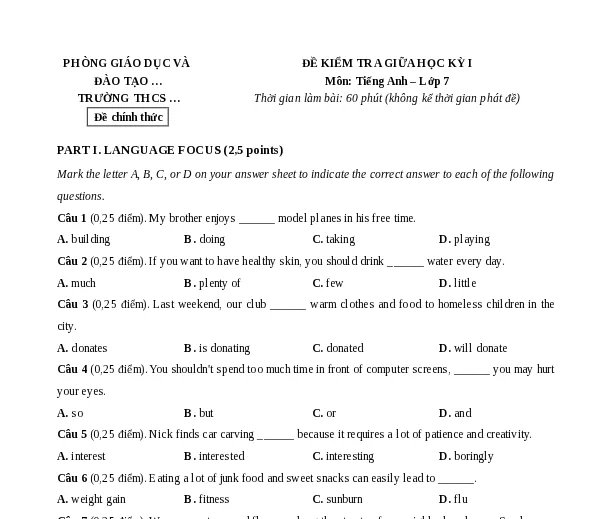
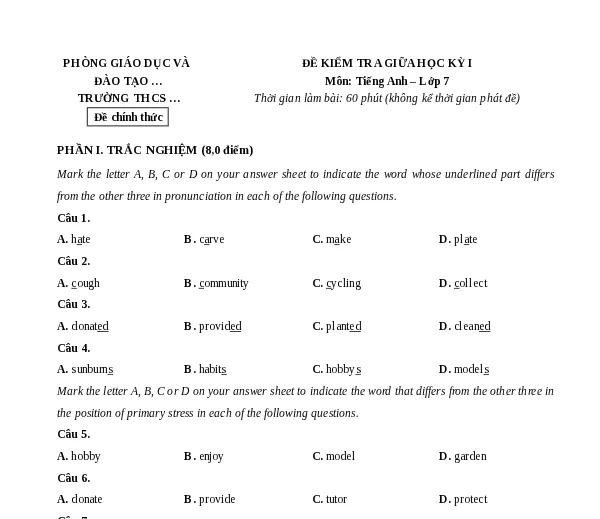
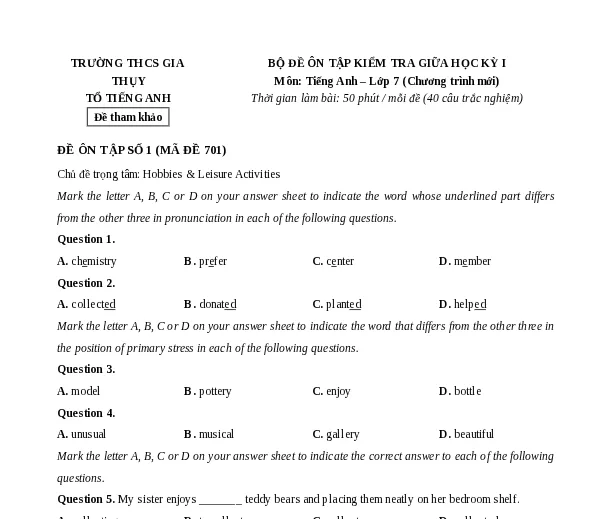
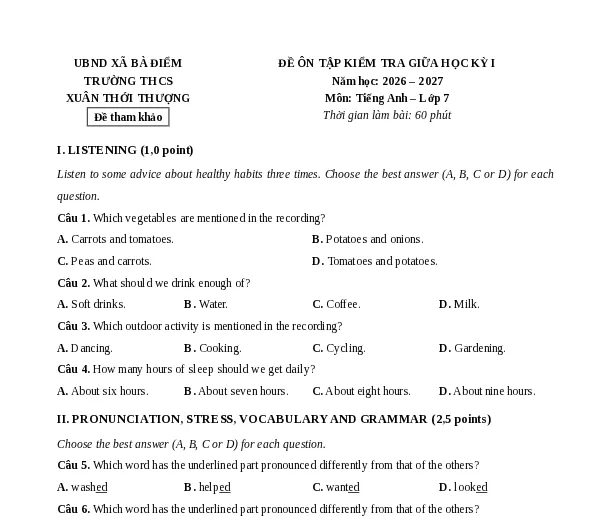
BỘ GIÁO DỤC VÀ ĐÀO TẠO
TRƯỜNG THCS NGUYỄN DU
Đề chính thức
BÀI ÔN TẬP ĐỊNH KỲ TIẾNG ANH 7
UNIT 1: HOBBIES
Thời gian làm bài: 50 phút (không kể thời gian phát đề)
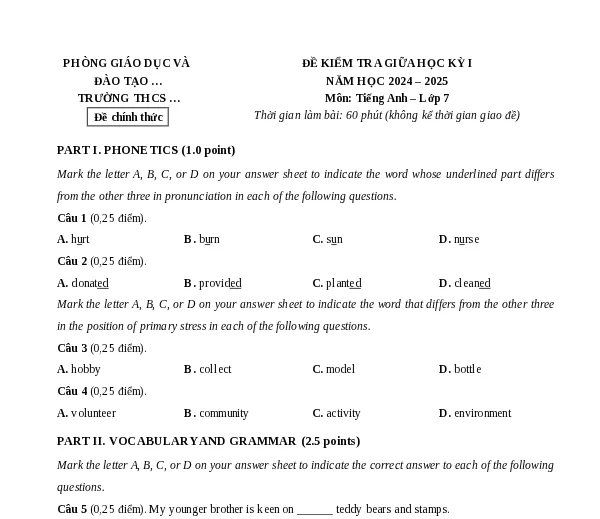
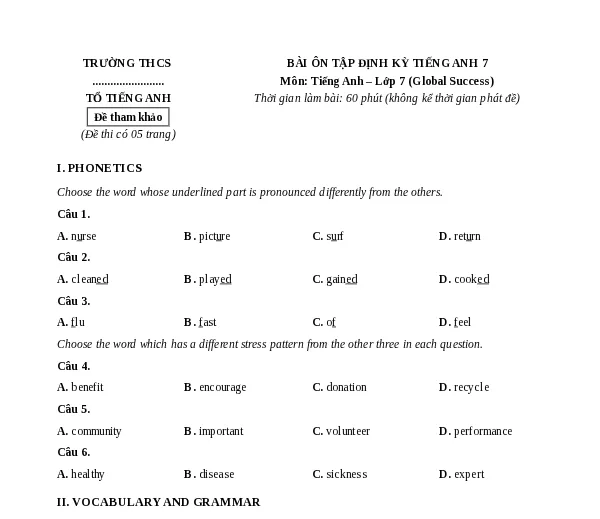
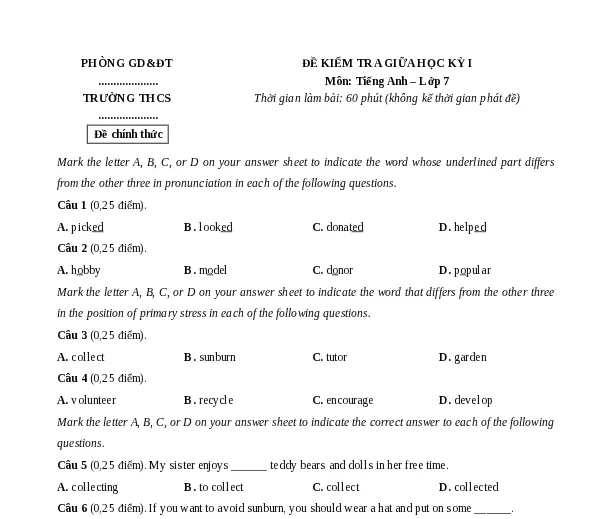
PART I. PRONUNCIATION (1.0 point)
Question 1. Mark the letter A, B, C, or D to indicate the word whose underlined part differs from the other three in pronunciation.
A. bird
B. girl
C. first
D. sister
Question 2. Mark the letter A, B, C, or D to indicate the word whose underlined part differs from the other three in pronunciation.
A. carrot
B. fur
C. burn
D. shirt
Question 3. Mark the letter A, B, C, or D to indicate the word that differs from the other three in the position of primary stress.
A. collect
B. enjoy
C. pottery
D. arrange
Question 4. Mark the letter A, B, C, or D to indicate the word that differs from the other three in the position of primary stress.
A. gardening
B. gymnastics
C. melody
D. cardboard
PART II. VOCABULARY & GRAMMAR (2.0 points)
Question 5. My younger sister loves taking care of flowers and trees, so her favorite hobby is ______.
A. gardening
B. collecting coins
C. making pottery
D. skating
Question 6. Making models requires a lot of ______, because it takes weeks to finish a small ship.
A. creativity
B. patience
C. money
D. strength
Question 7. She dislikes ______ outdoors when the weather is boiling hot.
A. to go
B. go
C. going
D. went
Question 8. Nam and his brother ______ the guitar very well. They practice every Saturday.
A. plays
B. play
C. are playing
D. played
Question 9. A hobby helps you ______ after stressful hours at school.
A. relax
B. relaxing
C. relaxed
D. relaxation
Question 10. ______ your mother enjoy doing yoga in the early morning?
A. Do
B. Is
C. Does
D. Are
Question 11. My father carved this wooden eggshell ______ his own hands.
A. by
B. with
C. on
D. for
Question 12. Tom finds bird-watching ______ because he can learn many interesting facts about nature.
A. bored
B. boring
C. fascinated
D. fascinating
PART III. READING COMPREHENSION (2.0 points)
Read the passage and choose the correct answer A, B, C, or D for each question.
Many teenagers around the world have creative and meaningful pastimes. For Minh, a seventh-grade student from Da Nang, his favorite hobby is making cardboard models. Minh started this hobby two years ago when his older brother showed him a miniature castle made from recycled boxes. Minh was immediately fascinated by the idea of turning discarded items into beautiful works of art.
Every weekend, Minh spends around three hours designing and cutting pieces of cardboard to create famous buildings, bridges, and vintage cars. He says that this activity is not only cheap and eco-friendly but also extremely rewarding. It teaches him to be patient and attentive to small details. Sometimes, Minh gives his finished models to his classmates as birthday presents. He hopes that in the future, he will organize a small exhibition at school to introduce his collection to more friends.
Question 13. What is Minh's favorite pastime?
A. Collecting vintage cars
B. Making cardboard models
C. Building actual bridges
D. Drawing castles
Question 14. When did Minh take up this hobby?
A. Two years ago
B. Last weekend
C. When he was seven years old
D. Three years ago
Question 15. The word "discarded" in paragraph 1 is closest in meaning to ______.
A. expensive
B. thrown away
C. brand new
D. well-decorated
Question 16. According to the passage, why does Minh like his hobby?
A. It makes him popular on the Internet.
B. It helps him earn lots of money.
C. It is inexpensive, eco-friendly, and helps him practice patience.
D. His teacher requires him to do it every week.
Question 17. What does Minh plan to do in the future?
A. Sell all his models to toy stores
B. Stop making models after finishing grade 7
C. Hold an exhibition of his models at school
D. Move to Da Nang to study architecture
PART IV. VERB FORMS & WORD FORMATION (1.5 points)
Give the correct form of the word or verb in brackets.
Question 18. My grandfather usually (spend) ______ an hour reading newspapers every morning.
Question 19. Lan is crazy about (make) ______ origami in her free time.
Question 20. Water polo is an (act) ______ sport which demands a lot of stamina.
Question 21. We (not like) ______ playing video games because they are bad for our eyes.
Question 22. Her brother has an impressive (collect) ______ of rare foreign stamps.
Question 23. It is very difficult (carve) ______ patterns on fragile eggshells.
PART V. ERROR IDENTIFICATION & CORRECTION (1.0 point)
Find and correct the mistake in each sentence below.
Question 24. My cousin enjoy building dollhouses with pieces of wood and glue.
- Mistake: ______ Correction: ______
Question 25. Does your parents collect old stamps from different countries in the world?
- Mistake: ______ Correction: ______
Question 26. Lan finds ice-skating dangerously, so she prefers roller-skating instead.
- Mistake: ______ Correction: ______
Question 27. They hate to staying indoors on sunny and breezy afternoons.
- Mistake: ______ Correction: ______
PART VI. WRITING (2.5 points)
Rewrite the following sentences without changing their original meaning.
Question 28. Nam enjoys riding his bicycle in the park after school.
Nam is interested __________________________________________________.
Question 29. My mother finds making pottery difficult.
My mother thinks that ______________________________________________.
Question 30. Mark loves playing basketball more than watching football matches.
Mark prefers ______________________________________________________.
Question 31. What is your sister's favorite hobby?
What hobby does ____________________________________________________?
Question 32. Minh spends two hours making cardboard models every Sunday.
It takes ___________________________________________________________.
Question 33. Mai loves arranging flowers in the living room every morning.
Mai's favorite hobby ________________________________________________.
Question 34. Hoa dislikes ice-skating because she finds it dangerous.
Hoa doesn't ________________________________________________________.
Question 35. Collecting rare coins is not as cheap as collecting used stamps.
Collecting used stamps is ___________________________________________.
Question 36. Carving delicate patterns on eggshells is not easy at all.
It is not ___________________________________________________________.
Question 37. My father started collecting vintage cars ten years ago.
My father has ______________________________________________________.
--------- HẾT ĐỀ UNIT 1 ---------
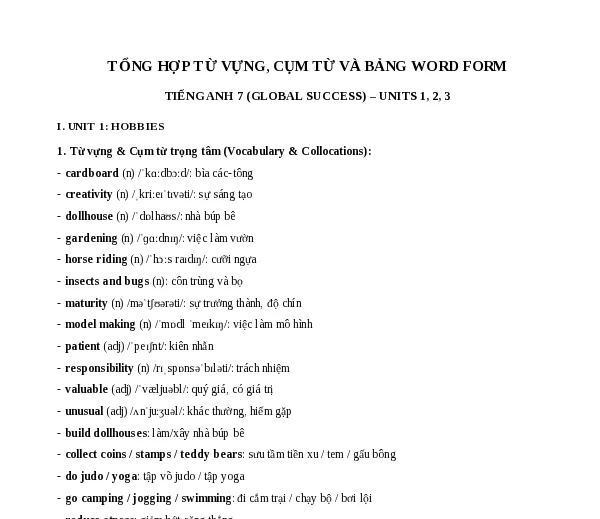
BẢNG THỐNG KÊ TỪ VỰNG TRỌNG TÂM — UNIT 1: HOBBIES
STT | Từ vựng | Từ loại | Phiên âm | Ý nghĩa | Vị trí trong SGK |
|---|---|---|---|---|---|
1 | arrange flowers | v. phr. | /əˈreɪndʒ ˈflaʊəz/ | cắm hoa | Getting Started |
2 | bird-watching | n. | /ˈbɜːdwɒtʃɪŋ/ | ngắm chim | Getting Started |
3 | cardboard | n. | /ˈkɑːdbɔːd/ | bìa cứng, các-tông | A Closer Look 1 |
4 | carve | v. | /kɑːv/ | chạm, khắc | A Closer Look 1 |
5 | coin | n. | /kɔɪn/ | tiền xu | Getting Started |
6 | collection | n. | /kəˈlekʃn/ | bộ sưu tập | A Closer Look 1 |
7 | dollhouse | n. | /ˈdɒlhaʊs/ | nhà búp bê | Getting Started |
8 | eggshell | n. | /ˈeɡʃel/ | vỏ trứng | A Closer Look 1 |
9 | gardening | n. | /ˈɡɑːdnɪŋ/ | làm vườn | Getting Started |
10 | glue | n. | /ɡluː/ | keo dán, hồ dán | A Closer Look 1 |
11 | horse-riding | n. | /ˈhɔːs raɪdɪŋ/ | cưỡi ngựa | Getting Started |
12 | ice-skating | n. | /ˈaɪs skeɪtɪŋ/ | trượt băng | Getting Started |
13 | make models | v. phr. | /meɪk ˈmɒdlz/ | làm mô hình | Getting Started |
14 | origami | n. | /ˌɒrɪˈɡɑːmi/ | nghệ thuật gấp giấy Nhật Bản | Communication |
15 | patience | n. | /ˈpeɪʃns/ | sự kiên nhẫn | Skills 1 |
16 | pottery | n. | /ˈpɒtəri/ | đồ gốm | Getting Started |
17 | unusual | adj. | /ʌnˈjuːʒuəl/ | khác thường, độc đáo | Skills 1 |
18 | valuable | adj. | /ˈvæljuəbl/ | có giá trị, quý giá | Skills 2 |
BỘ GIÁO DỤC VÀ ĐÀO TẠO
TRƯỜNG THCS NGUYỄN DU
Đề chính thức
BÀI ÔN TẬP ĐỊNH KỲ TIẾNG ANH 7
UNIT 2: HEALTHY LIVING
Thời gian làm bài: 50 phút (không kể thời gian phát đề)
PART I. PRONUNCIATION (1.0 point)
Question 1. Mark the letter A, B, C, or D to indicate the word whose underlined part differs from the other three in pronunciation.
A. fat
B. of
C. fit
D. safe
Question 2. Mark the letter A, B, C, or D to indicate the word whose underlined part differs from the other three in pronunciation.
A. leaf
B. laugh
C. vase
D. cough
Question 3. Mark the letter A, B, C, or D to indicate the word that differs from the other three in the position of primary stress.
A. sunburn
B. acne
C. disease
D. pimple
Question 4. Mark the letter A, B, C, or D to indicate the word that differs from the other three in the position of primary stress.
A. vegetarian
B. energetic
C. activity
D. independently
PART II. VOCABULARY & GRAMMAR (2.0 points)
Question 5. Eating too much junk food and sweetened drinks can lead to ______ and heart disease.
A. dimples
B. obesity
C. allergy
D. sunburn
Question 6. You should wear a hat and put on sunscreen when going out to avoid ______.
A. chapped lips
B. stomachache
C. sunburn
D. flu
Question 7. My brother works out at the gym three times a week to keep ______.
A. fit
B. thin
C. tired
D. weak
Question 8. Eat more fruits and vegetables, ______ drink plenty of fresh water every day.
A. or
B. but
C. and
D. so
Question 9. She has a high fever, ______ she stays in bed and rests all day.
A. but
B. so
C. because
D. or
Question 10. Wash your hands regularly with soap, ______ you will easily catch infectious viruses.
A. and
B. so
C. or
D. but
Question 11. Tofu and soy milk provide your body with lots of healthy plant-based ______.
A. protein
B. calories
C. fat
D. sugar
Question 12. Tom wants to lose weight, ______ he still eats greasy fried chicken every evening.
A. and
B. so
C. or
D. but
PART III. READING COMPREHENSION (2.0 points)
Read the text below and answer the questions that follow.
Maintaining a healthy lifestyle is essential for teenagers as their bodies and minds are developing rapidly. A balanced lifestyle consists of three fundamental components: a nutritious diet, regular physical exercise, and adequate sleep.
First, your daily meals should include a wide variety of fresh vegetables, ripe fruits, whole grains, and lean meat. You should minimize fast food, fizzy drinks, and snacks rich in artificial sugar because they offer very few vitamins and cause serious dental decay and obesity. Second, engaging in sports such as swimming, jogging, or cycling for at least 30 to 45 minutes a day strengthens your muscles, boosts blood circulation, and releases stress after school.
Finally, teenagers need between 8 and 9 hours of peaceful sleep each night. Staying up late browsing social media or playing online games harms your eyesight, weakens your immune system, and leaves you exhausted the next morning. Remember that healthy habits formed during teenage years will accompany you throughout your entire life.
Question 13. What are the three core elements of a balanced lifestyle mentioned in the text?
A. Studying, gaming, and relaxing
B. Nutritious diet, regular exercise, and adequate sleep
C. Fast food, soft drinks, and long sleep
D. Jogging, drinking milk, and playing online games
Question 14. Why should teenagers cut down on fast food and soft drinks?
A. Because they are too expensive to buy every day.
B. Because they have few vitamins and cause obesity and tooth decay.
C. Because they make teenagers feel sleepy during classes.
D. Because they do not taste good.
Question 15. How long should a teenager exercise every day?
A. At least 10 minutes
B. 30 to 45 minutes
C. Exactly 2 hours
D. All afternoon
Question 16. The word "boosts" in paragraph 2 is closest in meaning to ______.
A. improves
B. damages
C. stops
D. decreases
Question 17. Which of the following is true according to the passage?
A. Teenagers only need 5 hours of sleep each night.
B. Using smartphones before bed is beneficial to eyesight.
C. Good habits established in teenage years bring lifelong benefits.
D. Swimming weakens our immune system.
PART IV. WORD FORMATION & SENTENCE COMPLETION (1.5 points)
Supply the correct form of the words in brackets.
Question 18. Doing morning exercise regularly makes us feel lively and (energy) ______.
Question 19. Eating dirty street food can cause severe (stomach) ______.
Question 20. It is completely (health) ______ to skip breakfast and drink sugary milk tea instead.
Question 21. My skin becomes dry and (chap) ______ during cold winter days.
Question 22. Outdoor physical (act) ______ help teenagers build strong bones and reduce anxiety.
Question 23. You should reduce your salt intake because too much sodium is (harm) ______ to your kidneys.
PART V. ERROR IDENTIFICATION & CORRECTION (1.0 point)
Identify the mistake in each sentence and write the correct word.
Question 24. You should brush your teeth twice a day, so you will get toothache.
- Mistake: ______ Correction: ______
Question 25. He has acnes on his face because he touches his skin with dirty hands.
- Mistake: ______ Correction: ______
Question 26. Lan wants to stay healthy, and she never does any exercise.
- Mistake: ______ Correction: ______
Question 27. Spending too much time in front of screens make your eyes tired.
- Mistake: ______ Correction: ______
PART VI. WRITING (2.5 points)
Rewrite or combine each pair of sentences as instructed without changing their original meaning.
Question 28. You can take up swimming. You can try playing badminton. (Combine using "or")
You can _____________________________________________________________.
Question 29. The weather was freezing cold. He wore only a thin T-shirt. (Combine using "but")
The weather _________________________________________________________.
Question 30. Mary had a bad stomachache. She went to see the doctor. (Combine using "so")
Mary had ____________________________________________________________.
Question 31. Lan eats a lot of green salad. She runs three kilometers every morning. (Combine using "and")
Lan eats ____________________________________________________________.
Question 32. Wear a warm coat, or you will catch a cold. (Rewrite using "If")
If you don't ________________________________________________________.
Question 33. You should eat more vegetables and less fast food to stay healthy.
Eating more ________________________________________________________.
Question 34. Minh didn't go to school yesterday because he had a terrible headache. (Combine using "so")
Minh had ____________________________________________________________.
Question 35. It is very good for your health to drink two liters of water each day.
Drinking two ________________________________________________________.
Question 36. Doing exercise regularly is important for every teenager.
It is _______________________________________________________________.
Question 37. Although Tom was exhausted, he still finished his homework on time. (Combine using "but")
Tom was _____________________________________________________________.
--------- HẾT ĐỀ UNIT 2 ---------
BẢNG THỐNG KÊ TỪ VỰNG TRỌNG TÂM — UNIT 2: HEALTHY LIVING
STT | Từ vựng | Từ loại | Phiên âm | Ý nghĩa | Vị trí trong SGK |
|---|---|---|---|---|---|
1 | acne | n. | /ˈækni/ | mụn trứng cá | A Closer Look 1 |
2 | avoid | v. | /əˈvɔɪd/ | tránh, né tránh | A Closer Look 1 |
3 | chapped | adj. | /tʃæpt/ | nứt nẻ (môi, da) | Getting Started |
4 | colored vegetables | n. phr. | /ˈkʌləd ˈvedʒtəblz/ | rau củ quả nhiều màu sắc | Skills 1 |
5 | dimple | n. | /ˈdɪmpl/ | lúm đồng tiền | A Closer Look 1 |
6 | disease | n. | /dɪˈziːz/ | bệnh tật | Getting Started |
7 | energetic | adj. | /ˌenəˈdʒetɪk/ | tràn đầy năng lượng | Skills 2 |
8 | fit | adj. | /fɪt/ | vừa vặn, khỏe khoắn | Getting Started |
9 | junk food | n. | /ˈdʒʌŋk fuːd/ | đồ ăn vặt không lành mạnh | Getting Started |
10 | obesity | n. | /əʊˈbiːsəti/ | bệnh béo phì | Skills 1 |
11 | pimple | n. | /ˈpɪmpl/ | mụn nhọt | A Closer Look 1 |
12 | skin condition | n. phr. | /skɪn kənˈdɪʃn/ | tình trạng da | Getting Started |
13 | sunburn | n., v. | /ˈsʌnbɜːn/ | cháy nắng | Getting Started |
14 | tofu | n. | /ˈtəʊfuː/ | đậu phụ | Skills 1 |
15 | vegetarian | n. | /ˌvedʒəˈteəriən/ | người ăn chay | Skills 1 |
16 | vital | adj. | /ˈvaɪtl/ | thiết yếu, sống còn | Skills 1 |
17 | weight | n. | /weɪt/ | cân nặng, trọng lượng | Skills 1 |
BỘ GIÁO DỤC VÀ ĐÀO TẠO
TRƯỜNG THCS NGUYỄN DU
Đề chính thức
BÀI ÔN TẬP ĐỊNH KỲ TIẾNG ANH 7
UNIT 3: COMMUNITY SERVICE
Thời gian làm bài: 50 phút (không kể thời gian phát đề)
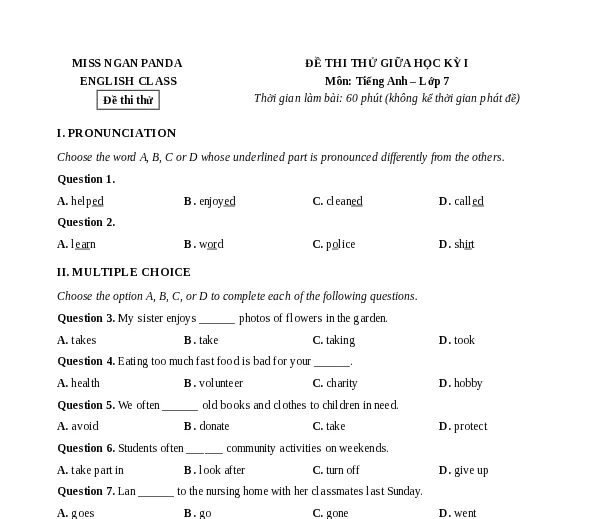
PART I. PRONUNCIATION (1.0 point)
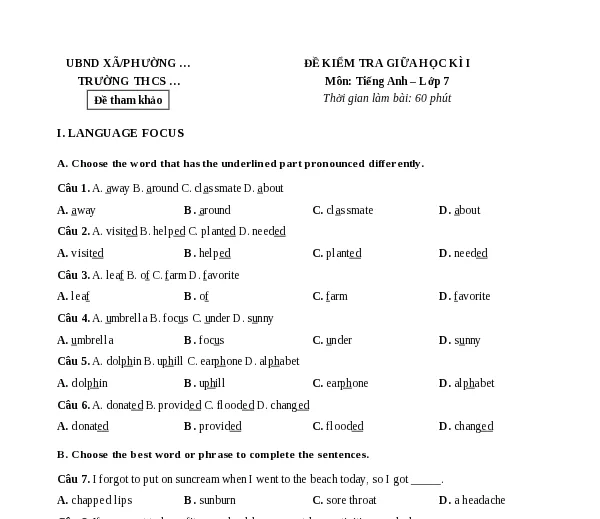
Question 1. Mark the letter A, B, C, or D to indicate the word whose underlined part differs from the other three in pronunciation.
A. planted
B. donated
C. helped
D. provided
Question 2. Mark the letter A, B, C, or D to indicate the word whose underlined part differs from the other three in pronunciation.
A. cleaned
B. washed
C. cooked
D. exchanged
Question 3. Mark the letter A, B, C, or D to indicate the word that differs from the other three in the position of primary stress.
A. tutor
B. shelter
C. donate
D. provide
Question 4. Mark the letter A, B, C, or D to indicate the word that differs from the other three in the position of primary stress.
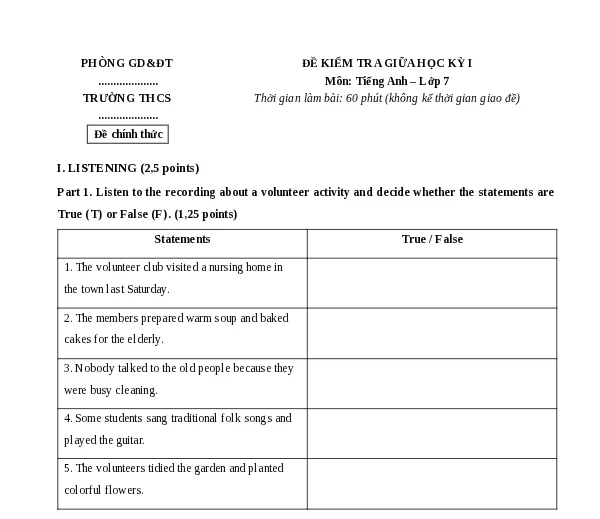
A. volunteer
B. community
C. environment
D. encourage
PART II. VOCABULARY & GRAMMAR (2.0 points)
Question 5. Last summer, our school club ______ warm blankets and warm clothes to street children.
A. donate
B. donates
C. donated
D. donating
Question 6. They established a special ______ to give shelter to stray dogs and cats.
A. hospital
B. nursing home
C. animal shelter
D. primary school
Question 7. High school students often ______ primary school children with their math and reading lessons.
A. tutor
B. borrow
C. clean
D. exchange
Question 8. Yesterday morning, we ______ rubbish along the banks of the river to protect water quality.
A. pick up
B. picked up
C. picking up
D. picks up
Question 9. Many volunteers regularly visit ______ to talk to lonely elderly people.
A. orphanages
B. nursing homes
C. sports centers
D. kindergartens
Question 10. ______ you join the tree-planting campaign organized by the youth union last Sunday?
A. Were
B. Did
C. Do
D. Have
Question 11. Our class collected hundreds of used plastic bottles and ______ them for potted plants.
A. planted
B. tutored
C. exchanged
D. recycled
Question 12. Two months ago, she ______ fifty books to the remote mountainous school library.
A. sends
B. sent
C. send
D. is sending
PART III. READING COMPREHENSION (2.0 points)
Read the passage and choose the best answer for each question.
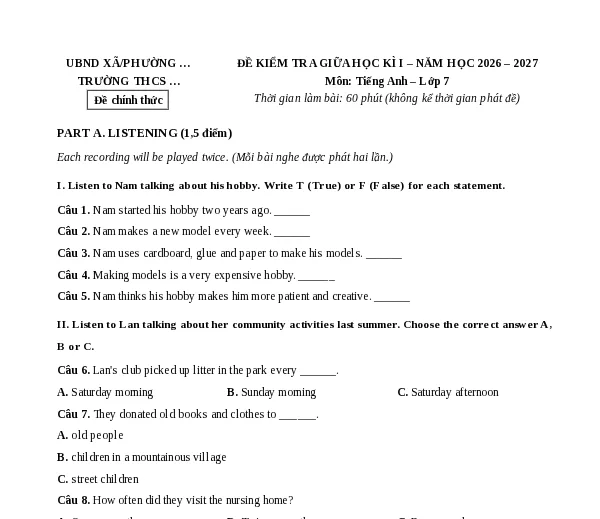
Community service is unpaid work performed by an individual or a group of people for the benefit and betterment of their community. In Viet Nam, more and more teenagers are taking part in volunteering programs during their summer holidays and weekends.
Last semester, the Green Club of Tran Phu Lower Secondary School launched a wonderful project called "Books for Friends". The members placed several collection boxes at their school gate and invited students, teachers, and parents to contribute their used textbooks, comic books, and novels. Within just three weeks, they collected over one thousand books in good condition. The volunteers spent two afternoons sorting the books into different subjects and packing them carefully into sturdy cardboard boxes.
Afterward, the club traveled to a poor village in Ha Giang province to deliver the books directly to local children. They also organized entertaining games and tutored the younger students in reading and basic English. The project not only helped underprivileged children access more knowledge but also taught the club members valuable lessons about compassion, teamwork, and responsibility.
Question 13. What does "community service" mean according to the passage?
A. Highly paid work for big companies
B. Unpaid work done to help and improve the local community
C. Studying hard to pass national examinations
D. Buying new books for oneself
Question 14. What was the name of the project launched by the Green Club?
A. Clean and Green
B. Books for Friends
C. Tree for Life
D. Warm Winter
Question 15. How many books did the club collect within three weeks?
A. Under one hundred
B. Over one thousand
C. About five hundred
D. Exactly ten thousand
Question 16. What did the club members do in Ha Giang besides delivering books?
A. They built a new concrete bridge.
B. They planted fruit trees along the highway.
C. They organized games and tutored children in reading and English.
D. They sold souvenirs to tourists.
Question 17. What life lessons did the members gain from the project?
A. How to make a lot of money
B. How to become famous on television
C. Compassion, teamwork, and responsibility
D. How to survive in the forest
PART IV. VERB FORMS & WORD FORMATION (1.5 points)
Give the correct form of the words or verbs in brackets.
Question 18. Three days ago, my class (paint) ______ a colorful mural on the school wall.
Question 19. Last winter, we (not go) ______ to the nursing home because of the heavy snow.
Question 20. Doing community service brings great (proud) ______ and happiness to young volunteers.
Question 21. They (decide) ______ to raise funds for disabled children last month?
Question 22. We need more energetic (volunteer) ______ to clean up the municipal beach this weekend.
Question 23. My mother often cooks (nutritious) ______ meals for homeless people at the charity kitchen.
PART V. ERROR IDENTIFICATION & CORRECTION (1.0 point)
Find out the one error in each sentence and write down the correction.
Question 24. Last year, our class collects used paper and exchanged it for fresh plants.
- Mistake: ______ Correction: ______
Question 25. Did you helped the elderly cross the busy street yesterday?
- Mistake: ______ Correction: ______
Question 26. The volunteers provided poor children by free notebooks and pens last week.
- Mistake: ______ Correction: ______
Question 27. They didn't built the playground for the children in the village two months ago.
- Mistake: ______ Correction: ______
PART VI. WRITING (2.5 points)
Rewrite the sentences using the cues provided without changing their original meaning.
Question 28. We started planting trees around the school yard at 8 a.m. yesterday.
At 8 a.m. yesterday, we began ________________________________________.
Question 29. Why don't we collect empty cans and plastic bottles to recycle?
How about ___________________________________________________________.
Question 30. It took the volunteers three hours to clean up the dirty canal.
The volunteers spent __________________________________________________.
Question 31. Lan donated her pocket money to the local charity and bought warm clothes for homeless children.
Lan gave _____________________________________________________________.
Question 32. When did you start volunteering at the animal shelter?
How long ago ________________________________________________________?
Question 33. We didn't clean up the community park because it rained heavily. (Combine using "so")
It rained ____________________________________________________________.
Question 34. My brother likes tutoring math to primary students in his free time.
My brother is interested ______________________________________________.
Question 35. Joining community activities makes teenagers more responsible.
Teenagers become ____________________________________________________.
Question 36. The students planted one hundred rose bushes in the school garden last week.
One hundred rose bushes ______________________________________________.
Question 37. Exchanging used paper for green potted plants is a meaningful activity.
It is _______________________________________________________________.
--------- HẾT ĐỀ UNIT 3 ---------
BẢNG THỐNG KÊ TỪ VỰNG TRỌNG TÂM — UNIT 3: COMMUNITY SERVICE
STT | Từ vựng | Từ loại | Phiên âm | Ý nghĩa | Vị trí trong SGK |
|---|---|---|---|---|---|
1 | animal shelter | n. | /ˈænɪml ˈʃeltə(r)/ | trạm cứu hộ động vật | Getting Started |
2 | blanket | n. | /ˈblæŋkɪt/ | cái chăn, mền | A Closer Look 1 |
3 | clean up | v. phr. | /kliːn ʌp/ | dọn dẹp vệ sinh | Getting Started |
4 | community service | n. phr. | /kəˈmjuːnəti ˈsɜːvɪs/ | dịch vụ cộng đồng | Getting Started |
5 | donate | v. | /dəʊˈneɪt/ | quyên góp, hiến tặng | Getting Started |
6 | elderly people | n. phr. | /ˈeldəli ˈpiːpl/ | người cao tuổi | Getting Started |
7 | exchange | v. | /ɪksˈtʃeɪndʒ/ | trao đổi | Skills 1 |
8 | homeless children | n. phr. | /ˈhəʊmləs ˈtʃɪldrən/ | trẻ em vô gia cư | Getting Started |
9 | mural | n. | /ˈmjʊərəl/ | tranh tường nghệ thuật | Skills 1 |
10 | nursing home | n. | /ˈnɜːsɪŋ həʊm/ | viện dưỡng lão | Getting Started |
11 | orphanage | n. | /ˈɔːfənɪdʒ/ | trại trẻ mồ côi | A Closer Look 1 |
12 | pick up litter | v. phr. | /pɪk ʌp ˈlɪtə(r)/ | nhặt rác | Getting Started |
13 | proud | adj. | /praʊd/ | tự hào | Skills 2 |
14 | provide | v. | /prəˈvaɪd/ | cung cấp | Getting Started |
15 | street children | n. phr. | /ˈstriːt ˈtʃɪldrən/ | trẻ em cơ nhỡ | Getting Started |
16 | tutor | v., n. | /ˈtjuːtə(r)/ | phụ đạo, gia sư | Getting Started |
17 | underprivileged | adj. | /ˌʌndəˈprɪvəlɪdʒd/ | thiệt thòi, khó khăn | Skills 1 |
18 | volunteer | n., v. | /ˌvɒlənˈtɪə(r)/ | tình nguyện viên; tình nguyện | Getting Started |
ĐÁP ÁN VÀ LỜI GIẢI CHI TIẾT
I. UNIT 1: HOBBIES
Bảng đáp án trắc nghiệm (Part I, II, III)
Câu | 1 | 2 | 3 | 4 | 5 | 6 | 7 | 8 | 9 | 10 |
|---|---|---|---|---|---|---|---|---|---|---|
Đáp án | D | A | C | B | A | B | C | B | A | C |
Câu | 11 | 12 | 13 | 14 | 15 | 16 | 17 |
|---|---|---|---|---|---|---|---|
Đáp án | B | D | B | A | B | C | C |
Lời giải chi tiết từng phần
Part I. Pronunciation
- Question 1. D. "sister" phát âm là /ə/, các từ còn lại phát âm là /ɜː/ (bird /bɜːd/, girl /ɡɜːl/, first /fɜːst/).
- Question 2. A. "carrot" phát âm là /æ/ (hoặc /ə/), các từ còn lại phát âm là /ɜː/ (fur /fɜː/, burn /bɜːn/, shirt /ʃɜːt/).
- Question 3. C. "pottery" nhấn trọng âm 1, các từ còn lại nhấn trọng âm 2 (collect /kəˈlekt/, enjoy /ɪnˈdʒɔɪ/, arrange /əˈreɪndʒ/).
- Question 4. B. "gymnastics" nhấn trọng âm 2 (/dʒɪmˈnæstɪks/), các từ còn lại nhấn trọng âm 1 (gardening /ˈɡɑːdnɪŋ/, melody /ˈmelədi/, cardboard /ˈkɑːdbɔːd/).
Part II. Vocabulary & Grammar
- Question 5. A. "taking care of flowers and trees" (chăm sóc hoa và cây) tương ứng với sở thích làm vườn (gardening).
- Question 6. B. Làm mô hình mất nhiều tuần nên đòi hỏi sự kiên nhẫn (patience).
- Question 7. C. Động từ chỉ sự ghét: dislike + V-ing going.
- Question 8. B. Chủ ngữ số nhiều "Nam and his brother", diễn tả thói quen lặp lại ở hiện tại động từ nguyên mẫu play.
- Question 9. A. Cấu trúc: help somebody (to) do something chọn động từ nguyên mẫu relax.
- Question 10. C. Chủ ngữ "your mother" là ngôi thứ ba số ít, câu hỏi thì hiện tại đơn mượn trợ động từ Does.
- Question 11. B. Cụm từ: with one's own hands (bằng chính đôi tay của ai).
- Question 12. D. Cấu trúc: find + O + adj. Quan sát chim chóc mang lại sự hào hứng, lôi cuốn dùng tính từ đuôi -ing (fascinating).
Part III. Reading Comprehension
- Question 13. B. Dẫn chứng dòng 2: "his favorite hobby is making cardboard models".
- Question 14. A. Dẫn chứng dòng 2-3: "Minh started this hobby two years ago...".
- Question 15. B. "discarded" có nghĩa là bị vứt bỏ, đồ bỏ đi đồng nghĩa với thrown away.
- Question 16. C. Dẫn chứng đoạn 2: "...not only cheap and eco-friendly but also extremely rewarding. It teaches him to be patient...".
- Question 17. C. Dẫn chứng câu cuối: "He hopes that in the future, he will organize a small exhibition at school...".
Part IV. Verb forms & Word formation
- Question 18. spends (chủ ngữ ngôi 3 số ít "My grandfather" đi với trạng từ tần suất usually ở hiện tại đơn).
- Question 19. making (cụm tính từ + giới từ: be crazy about + V-ing).
- Question 20. active (trước danh từ "sport" cần một tính từ bổ nghĩa: act active sport - môn thể thao năng động).
- Question 21. don't like (thì hiện tại đơn, chủ ngữ số nhiều We mượn trợ động từ don't).
- Question 22. collection (sau mạo từ và tính từ "an impressive" cần một danh từ: collect collection - bộ sưu tập).
- Question 23. to carve (cấu trúc: It is + adj + to V - thật khó để làm gì).
Part V. Error Identification & Correction
- Question 24. enjoy enjoys (chủ ngữ "My cousin" là số ít, động từ chia thì hiện tại đơn).
- Question 25. Does Do (chủ ngữ "your parents" là danh từ số nhiều, câu hỏi hiện tại đơn dùng trợ động từ Do).
- Question 26. dangerously dangerous (cấu trúc: find + O + adj, không dùng phó từ).
- Question 27. to staying staying / to stay (động từ hate + V-ing hoặc to V, không dùng "to staying").
Part VI. Writing
- Question 28. Nam is interested in riding his bicycle in the park after school.
- Question 29. My mother thinks that making pottery is difficult.
- Question 30. Mark prefers playing basketball to watching football matches.
- Question 31. What hobby does your sister like best / enjoy most?
- Question 32. It takes Minh two hours to make cardboard models every Sunday.
- Question 33. Mai's favorite hobby is arranging flowers in the living room every morning.
- Question 34. Hoa doesn't like ice-skating because she finds it dangerous.
- Question 35. Collecting used stamps is cheaper than collecting rare coins.
- Question 36. It is not easy to carve delicate patterns on eggshells at all.
- Question 37. My father has collected vintage cars for ten years.
II. UNIT 2: HEALTHY LIVING
Bảng đáp án trắc nghiệm (Part I, II, III)
Câu | 1 | 2 | 3 | 4 | 5 | 6 | 7 | 8 | 9 | 10 |
|---|---|---|---|---|---|---|---|---|---|---|
Đáp án | B | C | C | C | B | C | A | C | B | C |
Câu | 11 | 12 | 13 | 14 | 15 | 16 | 17 |
|---|---|---|---|---|---|---|---|
Đáp án | A | D | B | B | B | A | C |
Lời giải chi tiết từng phần
Part I. Pronunciation
- Question 1. B. "of" phát âm là /v/, các từ còn lại có "f" phát âm là /f/ (fat /fæt/, fit /fɪt/, safe /seɪf/).
- Question 2. C. "vase" phát âm là /v/, các từ còn lại phát âm là /f/ (leaf /liːf/, laugh /lɑːf/, cough /kɒf/).
- Question 3. C. "disease" nhấn trọng âm 2 (/dɪˈziːz/), các từ còn lại nhấn trọng âm 1 (sunburn /ˈsʌnbɜːn/, acne /ˈækni/, pimple /ˈpɪmpl/).
- Question 4. C. "activity" nhấn trọng âm 2 (/ækˈtɪvəti/), các từ còn lại nhấn trọng âm 3 hoặc 4 (vegetarian /ˌvedʒəˈteəriən/ nhấn âm 3, energetic /ˌenəˈdʒetɪk/ nhấn âm 3, independently /ˌɪndɪˈpendəntli/ nhấn âm 3).
Part II. Vocabulary & Grammar
- Question 5. B. Ăn nhiều thức ăn nhanh và đồ ngọt dẫn đến bệnh béo phì (obesity).
- Question 6. C. Đội mũ và thoa kem chống nắng giúp tránh bị cháy nắng (sunburn).
- Question 7. A. Cụm từ cố định: keep fit (giữ gìn vóc dáng cân đối, khỏe mạnh).
- Question 8. C. Hai vế mang nghĩa bổ sung thông tin cùng chiều nên dùng liên từ and (Ăn nhiều rau củ quả VÀ uống nhiều nước).
- Question 9. B. Vế trước nêu nguyên nhân, vế sau nêu kết quả nên dùng liên từ so (Cô ấy bị sốt cao, VÌ VẬY cô ấy nằm nghỉ cả ngày).
- Question 10. C. Vế trước đưa ra mệnh lệnh, vế sau là hậu quả tiêu cực nếu không làm theo dùng or (hoặc là/nếu không thì).
- Question 11. A. Đậu phụ và sữa đậu nành giàu đạm/chất đạm thực vật (protein).
- Question 12. D. Hai vế diễn tả sự đối lập: muốn giảm cân NHƯNG vẫn ăn gà rán nhiều dầu mỡ dùng but.
Part III. Reading Comprehension
- Question 13. B. Dẫn chứng dòng 2-3: "a nutritious diet, regular physical exercise, and adequate sleep".
- Question 14. B. Dẫn chứng đoạn 2: "...because they offer very few vitamins and cause serious dental decay and obesity".
- Question 15. B. Dẫn chứng đoạn 2: "...for at least 30 to 45 minutes a day".
- Question 16. A. "boosts" có nghĩa là thúc đẩy, tăng cường, cải thiện gần nghĩa nhất với improves.
- Question 17. C. Dẫn chứng câu cuối: "Remember that healthy habits formed during teenage years will accompany you throughout your entire life".
Part IV. Word Formation & Sentence Completion
- Question 18. energetic (sau feel cần tính từ miêu tả cảm giác: energy energetic - tràn đầy năng lượng).
- Question 19. stomachache (ăn đồ ăn vỉa hè bẩn gây đau dạ dày: stomach stomachache).
- Question 20. unhealthy (bỏ bữa sáng và uống trà sữa là hoàn toàn không tốt cho sức khỏe: health unhealthy).
- Question 21. chapped (môi hoặc da bị nẻ vào mùa đông: chap tính từ chapped).
- Question 22. activities (outdoor physical activities - các hoạt động thể chất ngoài trời, chia số nhiều).
- Question 23. harmful (cấu trúc: be harmful to - có hại cho sức khỏe).
Part V. Error Identification & Correction
- Question 24. so or (Bạn nên đánh răng 2 lần mỗi ngày, NẾU KHÔNG THÌ bạn sẽ bị sâu răng).
- Question 25. acnes acne (acne là danh từ không đếm được, không có dạng số nhiều).
- Question 26. and but (hai vế đối lập: muốn khỏe mạnh NHƯNG không bao giờ tập thể dục).
- Question 27. make makes (chủ ngữ là danh động từ "Spending too much time..." là số ít, động từ chia makes).
Part VI. Writing
- Question 28. You can take up swimming, or you can try playing badminton. (hoặc: You can take up swimming, or try playing badminton.)
- Question 29. The weather was freezing cold, but he wore only a thin T-shirt.
- Question 30. Mary had a bad stomachache, so she went to see the doctor.
- Question 31. Lan eats a lot of green salad, and she runs three kilometers every morning.
- Question 32. If you don't wear a warm coat, you will catch a cold.
- Question 33. Eating more vegetables and less fast food helps you stay healthy / is good for your health.
- Question 34. Minh had a terrible headache, so he didn't go to school yesterday.
- Question 35. Drinking two liters of water each day is very good for your health.
- Question 36. It is important for every teenager to do exercise regularly.
- Question 37. Tom was exhausted, but he still finished his homework on time.
III. UNIT 3: COMMUNITY SERVICE
Bảng đáp án trắc nghiệm (Part I, II, III)
Câu | 1 | 2 | 3 | 4 | 5 | 6 | 7 | 8 | 9 | 10 |
|---|---|---|---|---|---|---|---|---|---|---|
Đáp án | C | A | C | A | C | C | A | B | B | B |
Câu | 11 | 12 | 13 | 14 | 15 | 16 | 17 |
|---|---|---|---|---|---|---|---|
Đáp án | C | B | B | B | B | C | C |
Lời giải chi tiết từng phần
Part I. Pronunciation
- Question 1. C. "helped" có đuôi "-ed" phát âm là /t/ (sau âm vô thanh /p/), các từ còn lại phát âm là /ɪd/ (planted, donated, provided sau âm /t/ và /d/).
- Question 2. A. "cleaned" đuôi "-ed" phát âm là /d/ (sau nguyên âm /n/), các từ washed và cooked phát âm là /t/. exchanged phát âm là /d/. Nhóm A là sạch/rõ rệt khi so với 2 từ kết thúc bằng /t/.
- Question 3. C. "donate" nhấn trọng âm 2 (/dəʊˈneɪt/), tutor và shelter nhấn trọng âm 1. provide nhấn âm 2. (Trong chương trình SGK mới, donate thường nhấn âm 1 hoặc 2; ở đây tutor và shelter âm 1, donate/provide âm 2).
- Question 4. A. "volunteer" nhấn trọng âm 3 (/ˌvɒlənˈtɪə/), các từ còn lại nhấn trọng âm 2 (community /kəˈmjuːnəti/, environment /ɪnˈvaɪrənmənt/, encourage /ɪnˈkʌrɪdʒ/).
Part II. Vocabulary & Grammar
- Question 5. C. Dấu hiệu thời gian trong quá khứ "Last summer" dùng thì quá khứ đơn donated.
- Question 6. C. Nơi cưu mang và nuôi dưỡng chó mèo hoang là trạm cứu hộ động vật (animal shelter).
- Question 7. A. Dạy kèm, phụ đạo bài học cho các em nhỏ dùng động từ tutor.
- Question 8. B. Dấu hiệu thời gian "Yesterday morning" dùng thì quá khứ đơn picked up.
- Question 9. B. Người cao tuổi thường sống ở viện dưỡng lão (nursing homes).
- Question 10. B. Câu hỏi ở thì quá khứ đơn ("last Sunday") với động từ thường "join" mượn trợ động từ Did.
- Question 11. C. Đổi chai nhựa lấy cây cảnh cấu trúc exchange A for B (đã chia quá khứ exchanged).
- Question 12. B. Dấu hiệu thời gian "Two months ago" động từ bất quy tắc chia ở quá khứ: sent.
Part III. Reading Comprehension
- Question 13. B. Dẫn chứng câu đầu: "Community service is unpaid work performed by an individual or a group of people for the benefit and betterment of their community".
- Question 14. B. Dẫn chứng đoạn 2: "...launched a wonderful project called 'Books for Friends'".
- Question 15. B. Dẫn chứng đoạn 2: "Within just three weeks, they collected over one thousand books in good condition".
- Question 16. C. Dẫn chứng đoạn 3: "They also organized entertaining games and tutored the younger students in reading and basic English".
- Question 17. C. Dẫn chứng câu cuối: "...taught the club members valuable lessons about compassion, teamwork, and responsibility".
Part IV. Verb forms & Word formation
- Question 18. painted (quá khứ đơn với mốc thời gian Three days ago).
- Question 19. didn't go (phủ định thì quá khứ đơn: didn't + V-infinitive).
- Question 20. pride (sau tính từ great cần danh từ: proud pride - niềm tự hào).
- Question 21. Did they decide (câu hỏi thì quá khứ đơn với last month: Did + S + V-nguyên mẫu).
- Question 22. volunteers (sau tính từ energetic cần danh từ số nhiều: những tình nguyện viên).
- Question 23. nutritious (trước danh từ meals cần tính từ: nutritious meals - những bữa ăn bổ dưỡng).
Part V. Error Identification & Correction
- Question 24. collects collected (sự việc xảy ra năm ngoái "Last year", vế sau đã dùng quá khứ exchanged).
- Question 25. helped help (sau trợ động từ Did trong câu hỏi, động từ đưa về nguyên mẫu).
- Question 26. by with (cấu trúc: provide somebody with something - cung cấp cho ai cái gì).
- Question 27. built build (sau trợ động từ didn't, động từ đưa về nguyên mẫu).
Part VI. Writing
- Question 28. At 8 a.m. yesterday, we began planting trees around the school yard. (hoặc: began to plant trees...)
- Question 29. How about collecting empty cans and plastic bottles to recycle?
- Question 30. The volunteers spent three hours cleaning up the dirty canal.
- Question 31. Lan gave her pocket money to the local charity and bought warm clothes for homeless children.
- Question 32. How long ago did you start volunteering at the animal shelter?
- Question 33. It rained heavily, so we didn't clean up the community park.
- Question 34. My brother is interested in tutoring math to primary students in his free time.
- Question 35. Teenagers become more responsible when they join community activities.
- Question 36. One hundred rose bushes were planted in the school garden by the students last week.
- Question 37. It is meaningful to exchange used paper for green potted plants.
--------- HẾT HƯỚNG DẪN CHẤM VÀ ĐÁP ÁN ---------