TRƯỜNG THCS ....................
TỔ TIẾNG ANH
Tài liệu ôn tập
BÀI TẬP BỔ TRỢ NÂNG CAO NĂNG LỰC
Môn: Tiếng Anh – Lớp 6
UNIT 4: MY NEIGHBOURHOOD
Thời gian làm bài: 90 phút (100 câu hỏi)
PHẦN I. PHONETICS
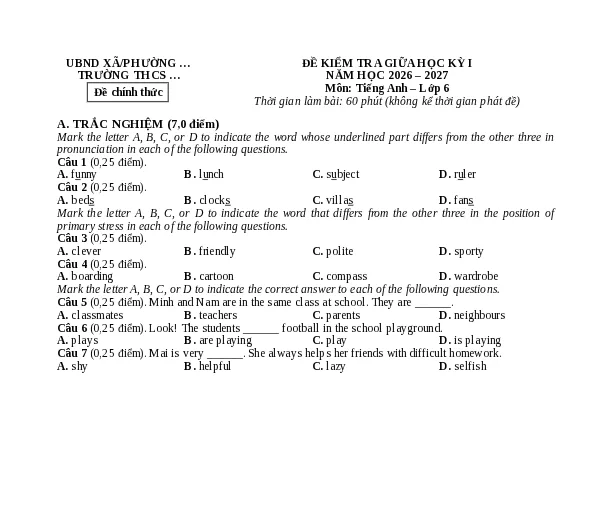
Mark the letter A, B, C or D to indicate the word whose underlined part differs from the other three in pronunciation in each of the following questions.
Câu 1.
A. cheap
B. peaceful
C. sleepy
D. heavy
Câu 2.
A. big
B. visit
C. city
D. live
Câu 3.
A. street
B. beef
C. busy
D. sea
Câu 4.
A. beach
B. great
C. clean
D. team
Câu 5.
A. convenient
B. building
C. police
D. historic
Câu 6.
A. thing
B. wide
C. ship
D. milk
Câu 7.
A. meet
B. see
C. need
D. coffee
Câu 8.
A. village
B. cottage
C. luggage
D. palace
Câu 9.
A. square
B. share
C. park
D. prepare
Câu 10.
A. cinema
B. cathedral
C. city
D. central
Mark the letter A, B, C or D to indicate the word that differs from the other three in the position of primary stress in each of the following questions.
Câu 11.
A. modern
B. noisy
C. polite
D. quiet
Câu 12.
A. suburb
B. market
C. corner
D. pagoda
Câu 13.
A. narrow
B. crowded
C. boring
D. expensive
Câu 14.
A. peaceful
B. polite
C. busy
D. friendly
Câu 15.
A. temple
B. palace
C. cathedral
D. centre
PHẦN II. VOCABULARY AND COMMUNICATION
Mark the letter A, B, C or D to indicate the correct answer to each of the following questions.
Câu 16. There is a big ______ in my town where children often go to see paintings and statues.
A. art gallery
B. supermarket
C. pharmacy
D. cinema
Câu 17. You can buy stamps, envelopes and send letters at the local ______.
A. railway station
B. post office
C. bus stop
D. bookstore
Câu 18. The streets in the old quarter are very ______, so cars cannot easily drive through them.
A. wide
B. modern
C. narrow
D. spacious
Câu 19. My neighbourhood is very ______. Everyone is willing to help each other when someone is in trouble.
A. friendly
B. noisy
C. boring
D. polluted
Câu 20. Let's go to the ______ to buy some fresh bread, cakes and rolls for breakfast.
A. grocery
B. bakery
C. pharmacy
D. library
Câu 21. We live in the ______ of Da Nang city, so life here is much quieter and greener than in the city centre.
A. suburbs
B. centres
C. squares
D. stations
Câu 22. Hoi An is famous for its ______ houses with yellow walls and wooden doors.
A. historic
B. modern
C. noisy
D. polluted
Câu 23. You must go to the ______ to buy medicine when you have a headache or a cold.
A. chemist's
B. restaurant
C. stadium
D. café
Câu 24. There are too many motorbikes and factories here, which makes the air extremely ______.
A. fresh
B. clean
C. polluted
D. quiet
Câu 25. Turn left at the traffic lights, then go ______ on until you see the cathedral on your right.
A. straight
B. through
C. back
D. along
Câu 26. The square is situated in the ______ of the town, surrounded by many old buildings.
A. heart
B. side
C. edge
D. corner
Câu 27. Can you ______ me the way to the nearest railway station, please?
A. talk
B. tell
C. speak
D. say
Câu 28. Take the second turning ______ your left and the cinema will be opposite the museum.
A. in
B. on
C. at
D. to
Câu 29. The market is very ______ in the early morning because many people come to buy fresh fish and vegetables.
A. empty
B. crowded
C. peaceful
D. sleepy
Câu 30. My brother doesn't like living in the city because the cost of living there is too ______.
A. expensive
B. cheap
C. high
D. low
Câu 31. A ______ is an open area in a town where people can gather, walk, or attend public events.
A. square
B. lane
C. pavement
D. highway
Câu 32. It is very ______ to live near a supermarket because you can buy things easily at any time.
A. inconvenient
B. convenient
C. difficult
D. terrible
Câu 33. The people in my village are very ______ and hospitable; they always welcome visitors warmly.
A. unkind
B. helpful
C. boring
D. noisy
Câu 34. Minh: "Excuse me, is there a bank near here?" – Stranger: "______"
A. Yes, it's straight ahead, next to the post office.
B. No, I don't like going to the bank.
C. You can buy some money there.
D. It is open every morning at 8 a.m.
Câu 35. Nam: "Shall we go to the amusement park this Sunday?" – Phong: "______"
A. That's a great idea!
B. You're welcome.
C. No, I'm not.
D. It's very far from here.
Câu 36. Lan: "Where is the post office?" – Hoa: "It's ______ the bank and the bookstore."
A. between
B. among
C. next
D. opposite to
Câu 37. Go ______ this street and you will see the park at the end of the road.
A. along
B. between
C. behind
D. across
Câu 38. A ______ is a holy building where Christians go to worship and pray.
A. cathedral
B. pagoda
C. temple
D. stadium
Câu 39. Living in a big city is very exciting, but it is often ______ than living in the countryside.
A. noisier
B. quiet
C. peaceful
D. calm
Câu 40. You should look at the ______ to find your way when you are in an unfamiliar city.
A. dictionary
B. textbook
C. map
D. newspaper
PHẦN III. GRAMMAR - COMPARISONS
Mark the letter A, B, C or D to indicate the correct comparative form of the adjective to complete each sentence.
Câu 41. Houses in the city centre are much ______ than houses in the countryside.
A. expensive
B. more expensive
C. most expensive
D. expensiver
Câu 42. The streets in the new residential area are ______ than those in the old quarter.
A. wider
B. more wide
C. widest
D. more wider
Câu 43. Life in Da Lat is ______ than life in Ho Chi Minh City.
A. peacefuler
B. more peaceful
C. peacefuller
D. most peaceful
Câu 44. This department store is ______ than the local market.
A. modern
B. more modern
C. moderner
D. modernest
Câu 45. Air pollution in big cities is getting ______ than it was ten years ago.
A. badder
B. worse
C. worst
D. more bad
Câu 46. The public transport system in Singapore is ______ than that in many other Asian countries.
A. better
B. gooder
C. well
D. best
Câu 47. Today the weather in Hanoi is much ______ than yesterday.
A. hot
B. hotter
C. more hot
D. hottest
Câu 48. My new school is ______ from my house than my old one.
A. farther
B. father
C. more far
D. farest
Câu 49. The food at this Italian restaurant is ______ than the food at the cafeteria.
A. delicious
B. more delicious
C. deliciouser
D. most delicious
Câu 50. Living in an apartment is often ______ than living in a detached house.
A. cheap
B. more cheap
C. cheaper
D. cheapest
Câu 51. Is the river in your village ______ than the river near my town?
A. clean
B. cleaner
C. more clean
D. cleanest
Câu 52. Ho Chi Minh City is ______ than Da Nang.
A. busy
B. busier
C. more busy
D. busiest
Câu 53. This sofa is much ______ than the wooden chair in the corner.
A. comfortable
B. comfortabler
C. more comfortable
D. most comfortable
Câu 54. The museum is ______ than the library; hundreds of tourists visit it every day.
A. crowded
B. more crowded
C. crowder
D. most crowded
Câu 55. Travelling by train is often ______ than travelling by aeroplane.
A. safe
B. safer
C. more safe
D. safest
Câu 56. My grandfather thinks that countryside life is ______ than city life.
A. simple
B. simpler
C. more simple
D. simplest
Câu 57. Is reading books ______ than playing computer games?
A. useful
B. more useful
C. usefuler
D. most useful
Câu 58. A sports car is usually ______ than a family van.
A. fast
B. faster
C. more fast
D. fastest
Câu 59. This test is ______ than the one we took last Monday.
A. easy
B. more easy
C. easier
D. easiest
Câu 60. The road to the mountain village is ______ and steeper than the main road.
A. narrow
B. narrower
C. more narrow
D. narrowest
Câu 61. The buildings in this historic town are ______ than those in the modern metropolis.
A. older
B. more old
C. elder
D. eldest
Câu 62. Walking around the lake is ______ than staying indoors all day.
A. healthy
B. healthier
C. more healthy
D. healthiest
Câu 63. Fresh fruit at the farmers' market is usually ______ than that in the convenience store.
A. fresh
B. fresher
C. more fresh
D. freshest
Câu 64. Learning English is ______ than many students think if they practise every day.
A. easy
B. easier
C. more easier
D. more easy
Câu 65. The air in high mountain areas is much ______ than the air in low industrial regions.
A. pure
B. purer
C. more pure
D. purest
PHẦN IV. ERROR IDENTIFICATION
Mark the letter A, B, C or D to show the underlined part that needs correction in each of the following questions.
Câu 66. The streets in my neighbourhood are more narrow than those in the city centre.
A. more narrow
B. those
C. the
D. centre
Câu 67. My house is more near to the park than Lan's house.
A. more near
B. the
C. than
D. Lan's
Câu 68. Living in the countryside is much more peaceful and healthiest than living in the city.
A. in
B. is
C. more peaceful
D. healthiest
Câu 69. This art gallery is more large and more modern than the one in our town.
A. art gallery
B. more large
C. more modern
D. the one
Câu 70. The seafood here is more good than the food at home.
A. seafood
B. is
C. more good
D. at
Câu 71. Could you tell me how getting to the nearest chemist's from here?
A. tell
B. how getting
C. chemist's
D. from
Câu 72. Turn right at the first corner and walk cross the pedestrian bridge.
A. Turn
B. at
C. walk
D. cross
Câu 73. This square is more crowded as the one near my uncle's apartment.
A. square
B. more crowded
C. as
D. near
Câu 74. Life in small villages is usually more slow than life in busy cities.
A. in
B. is
C. more slow
D. busy
Câu 75. The cinema is on the right of the post office, between the bakery with the supermarket.
A. on
B. of
C. between
D. with
PHẦN V. READING
Reading Passage 1
Read the following passage and mark the letter A, B, C or D to indicate the correct word that best fits each of the numbered blanks.
I live in a peaceful suburb of London. My neighbourhood has almost everything a family needs. There is a large park where children can play games and adults can jog in the morning. Next to the park, there is a modern (76) ______ with thousands of books and magazines. It is very (77) ______ to live here because we have a supermarket, a bakery, and a pharmacy just five minutes away on foot. The streets are clean and wide, with many green trees along the sidewalks. People in my neighbourhood are extremely (78) ______ and polite; they always smile and say hello when they meet each other. However, public transport here is slightly (79) ______ than in the central area, so sometimes we have to wait twenty minutes for a bus. In spite of that minor problem, I love my neighbourhood (80) ______ than any other place I have ever visited.
Câu 76.
A. library
B. stadium
C. station
D. temple
Câu 77.
A. inconvenient
B. convenient
C. polluted
D. boring
Câu 78.
A. unfriendly
B. noisy
C. friendly
D. shy
Câu 79.
A. slower
B. slow
C. more slow
D. slowest
Câu 80.
A. better
B. best
C. more
D. most
Reading Passage 2
Read the following passage and mark the letter A, B, C or D to indicate the correct answer to each of the questions.
An Khanh lives in a small village in Ninh Binh province. Her village is surrounded by green rice fields and limestone mountains. The air here is very fresh and cool, especially early in the morning. There are not many cars or motorbikes, so the village roads are peaceful and safe for children to walk or ride their bicycles to school.
However, An Khanh's village is quite far from the town centre. There is no shopping mall or amusement park nearby. When her family wants to buy clothes or household appliances, they have to travel about ten kilometres to the nearest town. There is only one small clinic in the village, so people with serious illnesses must go to the provincial hospital. Despite these disadvantages, An Khanh still enjoys her village life because the local villagers are close-knit, helpful, and always ready to share whatever they have with their neighbours.
Câu 81. What is An Khanh's village surrounded by?
A. Tall skyscrapers and modern highways.
B. Green rice fields and limestone mountains.
C. Shopping malls and amusement parks.
D. Crowded factories and busy ports.
Câu 82. How do children in the village often go to school?
A. By bus or underground train.
B. By taxi or private car.
C. On foot or by bicycle.
D. By motorbike or boat.
Câu 83. How far is it from the village to the nearest town?
A. About five kilometres.
B. About ten kilometres.
C. About twenty kilometres.
D. About two kilometres.
Câu 84. The word "close-knit" in the second paragraph is closest in meaning to ______.
A. living far apart
B. having strong friendly relations
C. very busy and noisy
D. indifferent to each other
Câu 85. Which of the following is NOT true according to the passage?
A. The air in An Khanh's village is polluted and noisy.
B. There is only one small clinic in the village.
C. People have to go to town to buy household appliances.
D. An Khanh likes living in her village.
Reading Passage 3
Read the following passage and mark the letter A, B, C or D to indicate the correct answer to each of the questions.
Life in Ho Chi Minh City is very dynamic and exciting. As the largest commercial hub of Viet Nam, the city never seems to sleep. During the day, the avenues are filled with streams of vehicles, and the pavements are packed with street vendors, open-air cafés, and shops of all kinds.
There are plenty of advantages to living here. First, education and healthcare services are top-notch, with numerous reputable schools, international universities, and modern hospitals. Second, entertainment facilities are everywhere: youth can spend their weekends at water parks, movie theatres, ice-skating rinks, or giant shopping complexes.
Nevertheless, city dwellers face several daily challenges. Traffic congestion during rush hours is a nightmare for commuters, turning a short trip into an hour-long wait. Furthermore, the cost of living is noticeably higher than in provincial towns. Renting a flat, buying groceries, and dining out all require a larger budget. Finally, noise and air pollution from vehicles and construction sites can affect people's physical and mental health.
Câu 86. What is the main topic of the passage?
A. The history of Ho Chi Minh City.
B. Advantages and disadvantages of living in Ho Chi Minh City.
C. The best tourist attractions in Ho Chi Minh City.
D. How to avoid traffic jams in big cities.
Câu 87. According to paragraph 2, what can young people do on weekends?
A. Work on farms in the countryside.
B. Visit ancient temples in distant mountains.
C. Go to water parks, cinemas, or shopping complexes.
D. Repair roads and build bridges.
Câu 88. The phrase "rush hours" refers to the time of day when ______.
A. streets are empty and peaceful
B. traffic is heaviest because people go to or leave work
C. shops and markets are closed
D. public transport stops working
Câu 89. Why is the cost of living in Ho Chi Minh City considered high?
A. Everything is free of charge.
B. People do not have enough money to buy food.
C. Housing, food, and dining out are expensive.
D. The city has no markets or grocery stores.
Câu 90. Which problem is caused by vehicles and construction sites?
A. Good health
B. Clean air
C. Noise and air pollution
D. Cheaper prices
PHẦN VI. WRITING
Mark the letter A, B, C or D to indicate the sentence that is closest in meaning to the original sentence in each of the following questions.
Câu 91. The countryside is quieter than the city.
A. The city is more noisy than the countryside.
B. The city is noisier than the countryside.
C. The city is as quiet as the countryside.
D. The city is quieter than the countryside.
Câu 92. My old neighbourhood was larger than my current one.
A. My current neighbourhood is more small than my old one.
B. My current neighbourhood is smaller than my old one.
C. My old neighbourhood is smaller than my current one.
D. My current neighbourhood is larger than my old one.
Câu 93. No street in this town is narrower than Silver Lane.
A. Silver Lane is the narrowest street in this town.
B. Silver Lane is wider than all other streets.
C. Silver Lane is narrower than no street in this town.
D. All streets in this town are as narrow as Silver Lane.
Câu 94. A villa is more expensive than an apartment.
A. An apartment is cheaper than a villa.
B. An apartment is more expensive than a villa.
C. An apartment is expensiver than a villa.
D. A villa is cheaper than an apartment.
Câu 95. Travelling by car is more convenient than travelling by bus.
A. Travelling by bus is convenienter than travelling by car.
B. Travelling by bus is less convenient than travelling by car.
C. Travelling by bus is more convenient than travelling by car.
D. Travelling by car is less convenient than travelling by bus.
Câu 96. Her new house is more comfortable than her old house.
A. Her old house is comfortabler than her new house.
B. Her old house is less comfortable than her new house.
C. Her old house is more comfortable than her new house.
D. Her new house is less comfortable than her old house.
Mark the letter A, B, C or D to indicate the best sentence built from the given cues.
Câu 97. life / city / be / busy / and / exciting / than / life / country /.
A. Life in the city is busier and more exciting than life in the country.
B. Life in city is more busy and more exciting than life in country.
C. Life in the city is busier and excitinger than life in the country.
D. Life in the city are busier and more exciting than life in the country.
Câu 98. you / can / tell / me / way / to / nearest / pharmacy / please / ?
A. Can you tell me the way to the nearest pharmacy, please?
B. Can you tell me way to nearest pharmacy, please?
C. Could you tell me the way to nearest pharmacy, please?
D. You can tell me the way to the nearest pharmacy, please?
Câu 99. air / in / mountain / area / be / fresh / than / that / in / industrial / zone /.
A. The air in mountain area is more fresh than that in industrial zone.
B. The air in the mountain area is fresher than that in the industrial zone.
C. Air in the mountain area are fresher than that in industrial zone.
D. The air in the mountain area is fresh than that in the industrial zone.
Câu 100. turn / right / traffic lights / and / go / straight / ahead / .
A. Turn right on the traffic lights and go straightly ahead.
B. Turn right at the traffic lights and go straight ahead.
C. Turn to right at the traffic lights and going straight ahead.
D. Turning right at traffic lights and go straight ahead.
--------- HẾT ---------
Họ và tên thí sinh: ................................................................ Số báo danh: ........................